

Welcome to Newswire — your weekly guide to Chicago government, civic action and what action we can take to make our city great, featuring public meeting coverage by City Bureau’s Documenters.
Quote/Term of the Week
Restorative justice / noun
An approach to achieving justice that brings together (to the extent possible) people involved in a crime to collectively identify and address harms, needs and obligations in order to heal and put things as right as possible.
Revisiting restorative justice courts
Restorative Justice Community Courts (RJCC) are making a resurgence. Cook County State’s Attorney Eileen O’Neill Burke has instructed her office to resume sending qualifying cases to RJCC.
RJCC are aimed at young adults 18 to 26 years old charged with nonviolent felonies or misdemeanors, and who don’t have a violent criminal history. The courts focus on community-building strategies, such as peace circles, to identify the harm a crime causes and figure out ways to accept accountability, usually through an agreement that could involve community service, restitution, counseling and more.
Cook County’s first RJCC started in North Lawndale in 2017, followed by two more courts which started in Avondale and Englewood in 2020. A fourth location was later started in suburban Sauk Village in 2024.
The victim of the crime must agree to participate in the process. This is key, as their needs are a central focus. In addition, the person charged with the crime must live, work, or worship in one of the neighborhoods which has a community court. Restorative justice also shifts the focus of the process away from punishing the person who committed the crime, and toward taking responsibility and taking steps to not reoffend.
The RJCC’s goal is to “end the harmful cycle of revenge and recidivism.” The process usually takes about 18 months. Once someone completes it, they can have their criminal charges dismissed and records expunged.
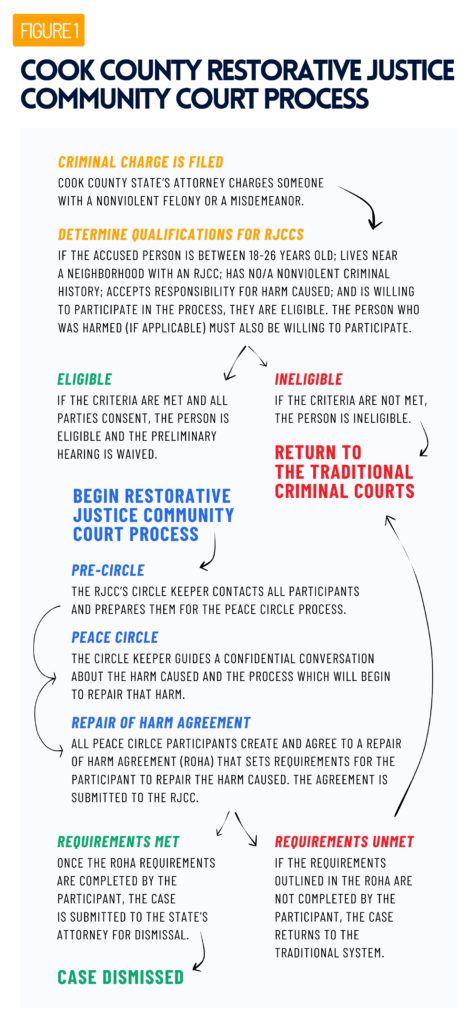
Graphic from Chicago Appleseed
Nearly a year ago, O’Neill Burke instructed her office to stop diverting any of these cases to the alternative courts, choosing to prosecute in typical criminal courts. The move dramatically downsized the RJCC’s caseload and its impact. Gun possession cases made up about 83% of all cases diverted to the RJCC in 2024, according to a report from Chicago Appleseed.
Advocates expressed concern at O’Neill Burke’s move, noting that nonviolent gun charges often drive up the number of people in jail pending trial. In the year after Illinois abolished cash bond, 62% of people charged with nonviolent gun crimes were detained ahead of their trials.
In last week’s Newswire, we discussed pretrial detention and how experts and advocates argue that it contributes to higher rates of destabilization both for the people incarcerated and their communities.
Now that the State’s Attorney is resuming work with RJCC, there will be a key change in the process for gun possession cases. Instead of a peace circle — which includes the person charged, the person harmed and community members all in conversation — it will instead feature a restorative practice conference. The conference will feature education on firearm safety and how to be a lawful gun owner, including information on how to obtain a Firearm Owners Identification (FOID) card. Other cases that include an offender and victim will still include peace circles.
As of Jan. 28, five eligible gun possession cases have been routed to the RJCC since the program restarted on Jan. 5, WTTW reported.
What you can do:
Attend Documenting Cook County's Detention Hearings: Are you a Chicago Documenter looking to get involved with our court watching pilot? Register to attend one of our upcoming training sessions at docs.org.
NOTE: If you are not currently a Documenter, you must first attend our Orientation on Wednesday, Feb. 18 before getting trained for court watching.
Catch up on the headlines & history:
Restorative Justice, Community & The Courts | Chicago Appleseed
Cook County Prepares For First Restorative Justice Court | WBEZ
Cook County State’s Attorney Will No Longer Divert Nonviolent Gun Cases to Restorative Justice Courts | WTTW
Cook County State’s Attorney Reverses Course, Diverts Nonviolent Gun Cases to Restorative Justice Courts | WTTW
A version of this story was first published in the February 18, 2026 issue of the Newswire, an email newsletter that is your weekly guide to Chicago government, civic action and what we can do to make our city great. You can sign up for the weekly newsletter here.
Have thoughts on what you'd like to see in this feature? Email Civic Editor Dawn Rhodes at dawn@citybureau.org.