Black queer communities on the South and West Sides of Chicago are determined to thrive across generations despite the aftermath of widespread loss and disconnection.
By Amari Davis
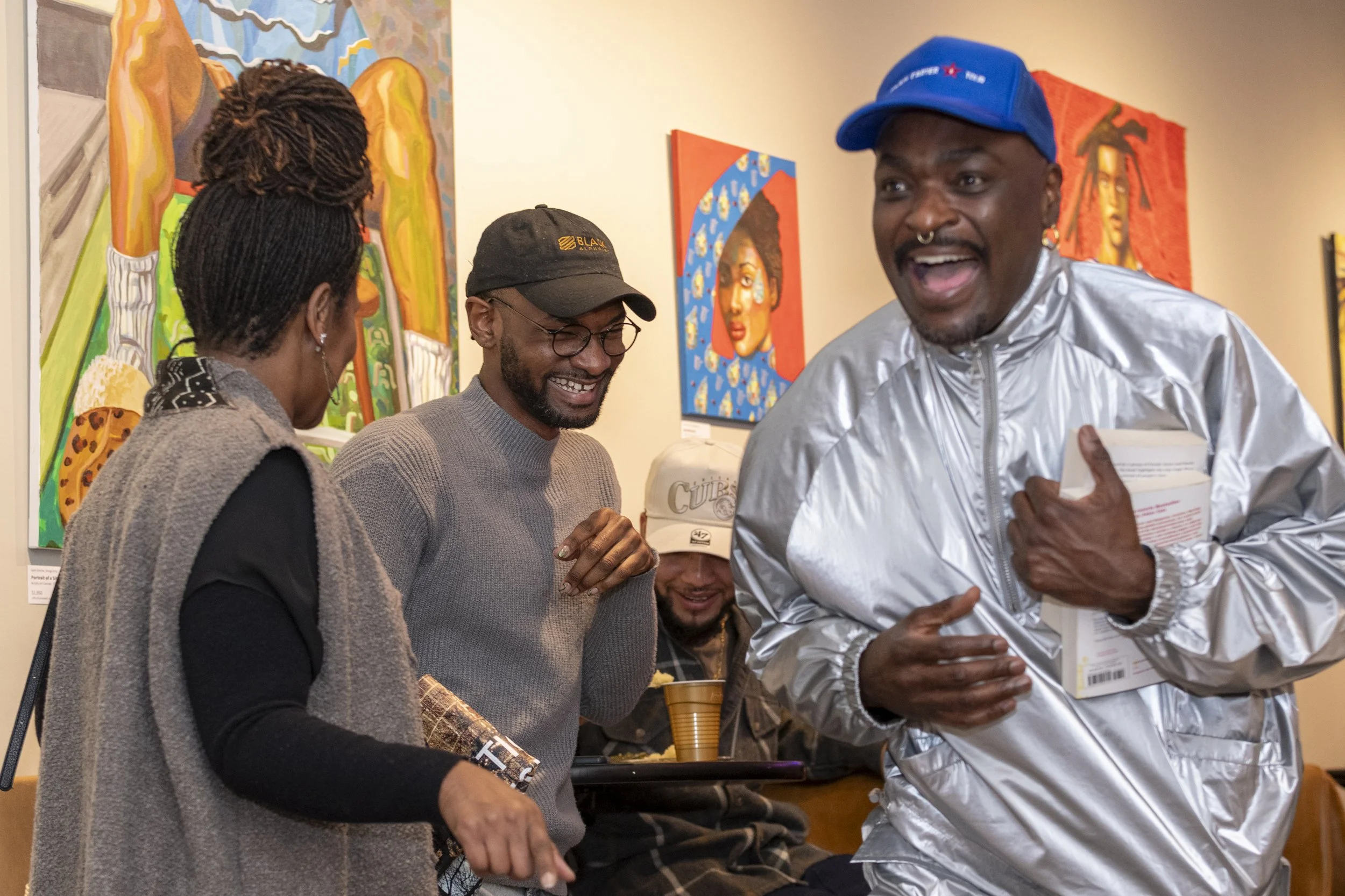
Joshua Miller (center) and Roy Kinsey (right) share a laugh with attendees during the Banned Book Drive at the Jamii Arts Center in Chicago, Nov. 22, 2025. (Dylan Connell/City Bureau).
Queer Black Chicagoans have no trouble naming the mentors who inspired them as they shaped their young lives.
For Leslie Givens, it was Boris Powell, a Chicago-based fashion designer who was “always unapologetic about who he was.”
Ry Douglas, a 28-year-old disabled transgender activist, cites their Threewalls internship with Barak adé Soleil as an instrumental experience in putting accessibility at the forefront of program development.
“He’s definitely an elder who has shown up for so many of us,” Douglas said.
But the dead elders — and the possibilities that died with them — loom just as large. Many of them were casualties of two global public health crises spanning 50 years that disproportionately struck Black communities: the AIDS epidemic and COVID-19.
“I think the biggest thing was our loss of connection,” said Joshua Miller, 30, of the lingering societal impact of the pandemic. “I feel like there were just a lot of folks who I would always see that I don’t talk to as much. There was definitely a loss of trust.”
To be Black and queer in Chicago invites a layered kind of erasure. Whether it be disappearance by lack of inclusion or death by governmental neglect, to exist at the intersection of both could render one invisible to the public eye.
Even as the aftershocks of the COVID-19 pandemic continue to isolate people, Chicago’s Black LGBTQ+ communities are picking up the pieces where public health and government support fell short. From continued HIV prevention initiatives, to storytelling and archiving, to building COVID-concious events, Black queer folks are even more determined to carve out their place in history and foster connections between one another.
In Search of Elders
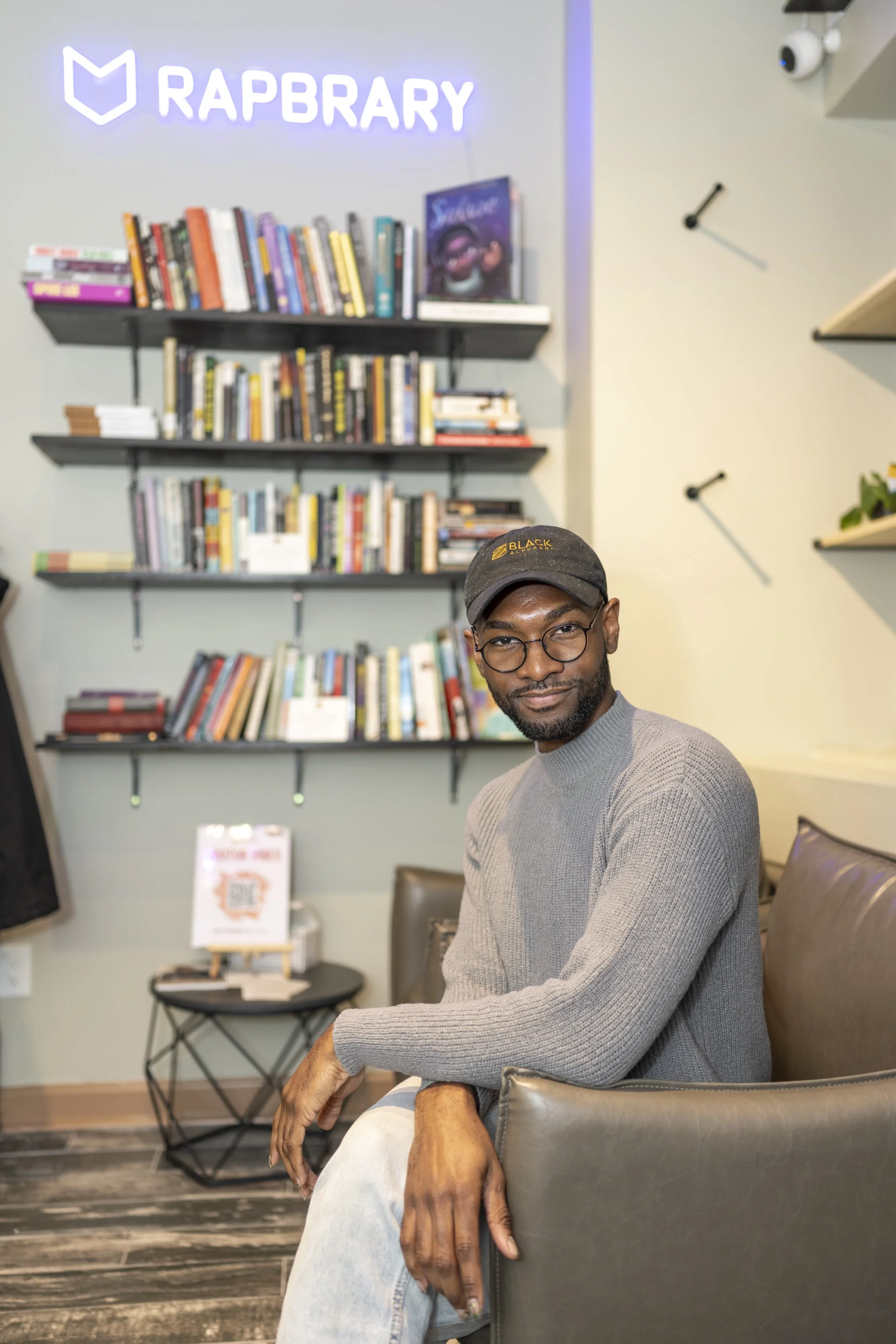
Joshua Miller sits inside the Jamii Arts Center during the Banned Book Drive in Chicago, Nov. 22, 2025. (Dylan Connell/City Bureau).
Miller vividly recalls the first time he walked into the multistory, iron gray community center towering over North Halsted Street as a teenager in what was then the Boystown neighborhood.
“I remember walking in the Center on Halsted,” he said, “and being like, ‘Oh my gosh! This is the gay mecca!’” As he reached adulthood, however, Miller said he began to realize “you don’t really have a space in some of these gay spaces, because they are not specifically for Black gay folks.”
“Now, being 30 and Black as hell, I’m like, ‘Child, y’all don’t want nothing to do with us,’” he said.
As a teen, Miller sought out LGBTQ+ community spaces after sensing a lack of queer elders like him who could be part of his life.
“Most of the queer adults that I knew were white,” he said. “Most of the Black folks I saw were on television, like Billy Porter, Titus Burgess … I do remember specifically craving and seeking out those queer representations.”
That vacuum exists in part because of the AIDS epidemic that devastated LGBTQ+ communities in the 1980s and ’90s. Black people were disproportionately struck by HIV, while being consistently passed over for resources and care.
Even into the 2010s, Black Illinoisans had significantly higher rates of HIV diagnoses, accounting for half of new diagnoses from 2009-2013, despite making up 15% of the state population, according to the state Department of Public Health. As of 2024, Black people make up 46% of people living with HIV/AIDS and 45% of all AIDS diagnoses in Chicago, according to the city’s public health department.
Like Miller, Givens also remembers seeking representation in LGBTQ+ spaces as a teenager at Kenwood Academy High School in the 1980s.
He describes the more progressive school as a “safe haven,” where he felt confident enough to come out as gay. While still in school, Givens became a youth outreach coordinator with Brother 2 Brother, an HIV prevention program. He set up near schools to pass out condoms and raise awareness about HIV and AIDS.
Givens recalled being surrounded by a rich intergenerational community that guided him to a future of organizing.
“I was blessed to be taught by these spearheaders who were in the true trenches of when we were trying to figure out what this [HIV/AIDS] was when it was hitting the LGBTQ+ community,” said Givens, now 53.
Among them was Powell, a fashion designer who has dressed celebrities including Patti LaBelle and Chaka Khan while also devoting himself to AIDS awareness and fundraising.
“He lived in his own truth before the community of the kids started talking about ‘fluid.’ Boris has always been fluid,” said Givens, who eventually moved to New York City to work in fashion and interior design. “He accepted you for who you were; he also uplifted. It was something I admired and adopted.”
Although Miller and Givens come from different generations, they have similar experiences of feeling isolated from Chicago’s larger queer communities.
“At that time, Boystown was mostly white. So oftentimes, I would find myself being the only Black person there,” Givens said.
But the exclusion of queer people of color is not limited to the neighborhood now known as Northalsted, sources say; it exists within a lineage of white supremacy many Black queer people experience their entire lives, especially as it pertains to public health crises.
During the AIDS epidemic, Black queer Chicagoans’ experiences were erased on multiple fronts. Not only were they excluded from mainstream coverage of the disease, but Black newspapers such as the Chicago Defender initially refused to publish news regarding the impact of the crisis on Black communities.
News coverage often centered the white gay community, until Windy City Times created BLACKlines in 1996, in an effort to stray from white male-dominated queer media.
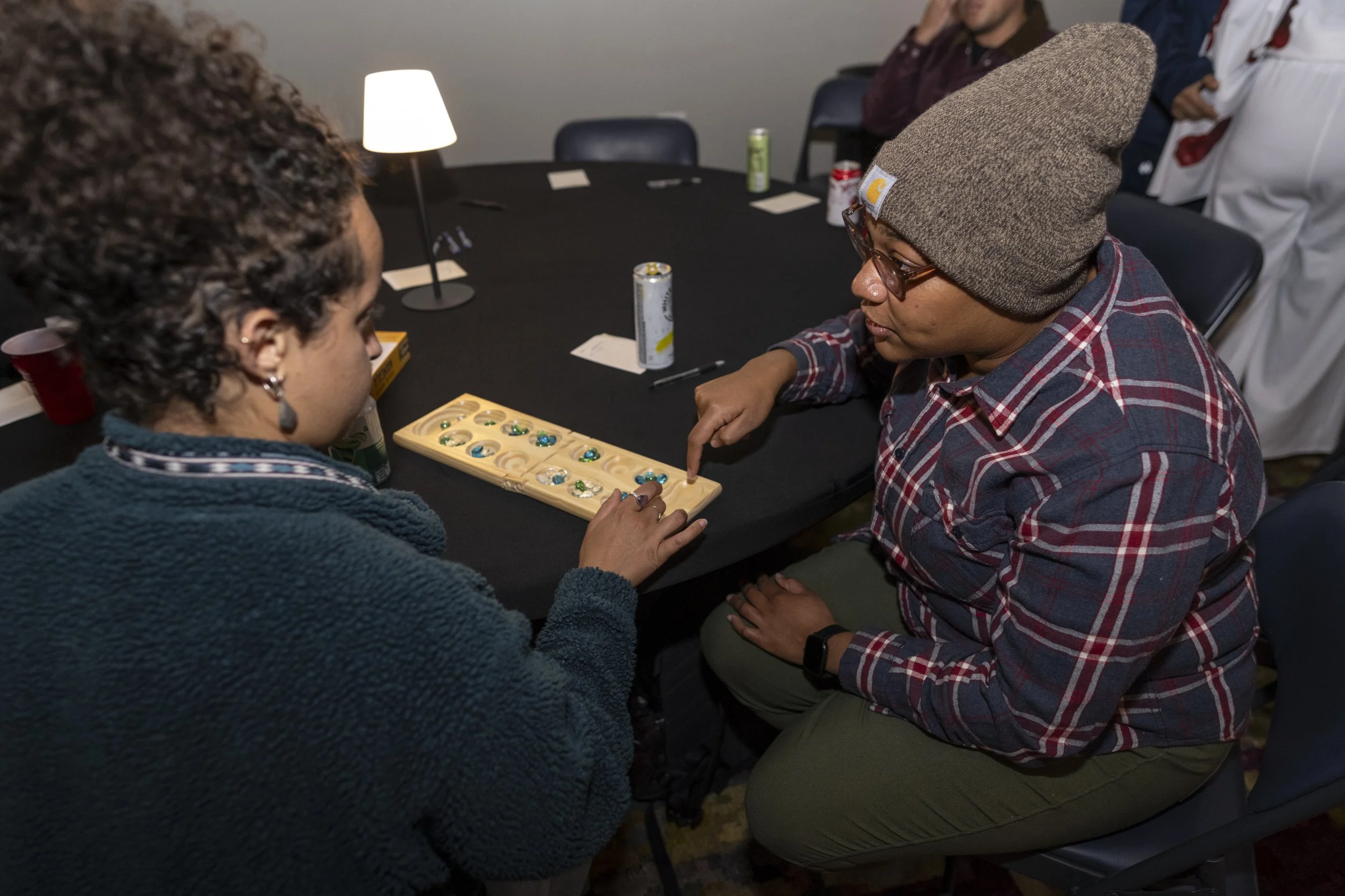
Two attendees play Mancala during the Banned Book Drive at the Jamii Arts Center in Chicago, Nov. 22, 2025. (Dylan Connell/City Bureau).
Erasure Twice Over
Those who survived the AIDS epidemic and became queer elders later faced another mass public health threat to their lives and communities.
Just like the AIDS epidemic, COVID-19 left social isolation and distrust in its wake, plaguing the remnants of intergenerational communities with grief and disconnection. Black queer youth are often left still searching for mirrors of themselves, while elders reckon with further loss of community.
In the early days of COVID-19 lockdown, Dr. Maya Green was Chief Medical Officer at Howard Brown Health who helped develop the organization’s citywide response to the virus’ spread.
Green knew from the start of the pandemic that its effects would be most keenly felt by Black and brown communities like those she’d worked with on the city’s South and West sides.
“I’m from the South Side; when you live in disparity, you don’t really have to wait until it shows up in this specific situation. You just expect it,” said Green, 48. “I remember crying and crying every day, because I knew how the system plays out, and I knew how this would impact our community.”
In the first year of the pandemic, Black people — who make up 29% of the city’s total population, according to Census data — accounted for 41% of coronavirus-related deaths in Chicago, according to a recent study published in the National Library of Medicine. Black residents over 60 years old — 6.5% of the city population — accounted for nearly 80% of those who died.
By 2022, Miller was finishing a master’s degree with a capstone project focused on Black queer experiences during the AIDS epidemic. When one elder was hesitant to meet with Miller in person — the fear of contagion persisted as spikes in cases shot up when the virus mutated — something clicked for the grad student.
“That was something I really remember keying in on and being like, ‘Oh, now we have to learn how to build all of this back up,’” Miller said. “Especially because we’ve been locked down in our homes for two years and had these circles of, like, five folks who are the only people we see within the span of two weeks.”
He missed the friend gatherings that he and his roommate used to host, and artist nights where “folks would spit some poetry, do a dance,” he said. “We’d ask who was working on something and discuss how we could support each other.”
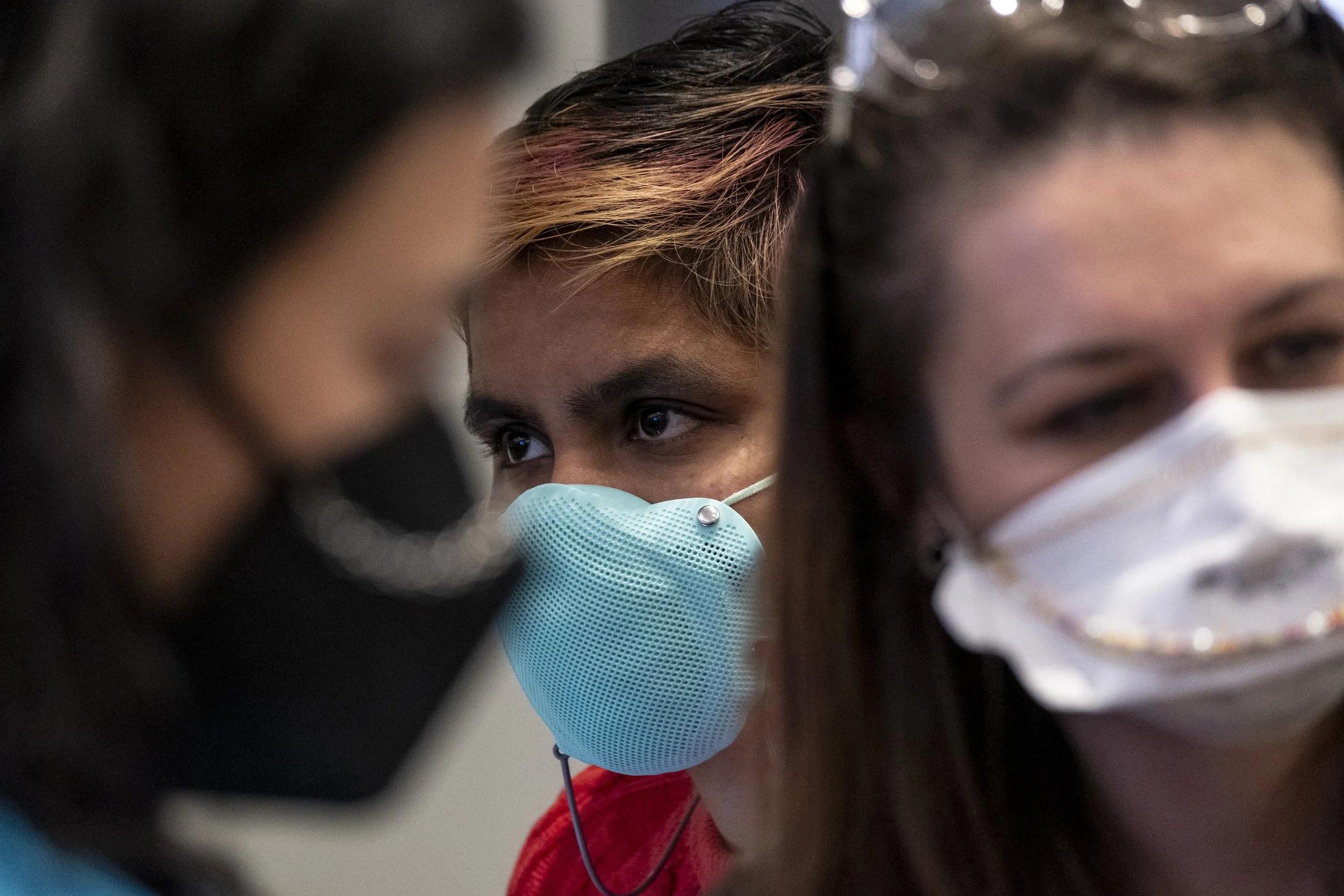
Aditi Aggarwal, center, attends a town hall meeting with Parallel Play at the Chicago Public Library West Loop branch on Nov. 16, 2024. (Joel Angel Juarez/City Bureau)
For some, though, there was a silver lining to the early pandemic social distancing.
Douglas, 28, is a Black transgender and disabled activist who saw the experience as bittersweet. They worried about their health and lost multiple relatives to the disease, but they also saw how their communities mobilized to provide microgrants, food delivery, paid time off, telehealth and virtual accommodations.
“If I’m being real, the second half of March 2020 was a breath of relief, because the help that I had been needing for a while was finally being made available,” Douglas said. “For those of us who often need care on an ongoing basis, when something that impacts everyone happens, that’ll be [one of] the few times that we actually can get the resources we need.”
Six years later, those supports have largely disappeared. Employers in Chicago slowly began coaxing workers back into offices by early 2023, while mask mandates were simultaneously rolled back.
While vaccines became widely available to the general public in 2021, millions continue to experience debilitating symptoms from the virus, a condition known as long COVID.
In a survey of Chicagoans, 25% of self-reported long COVID cases were Black people as of 2023, according to the city’s Department of Public Health. Among all who tested positive for COVID-19 and developed long COVID, 60% were transgender or gender non-conforming — more than twice the citywide average.
COVID-19 continues to impact marginalized communities and isolate people from their support systems. These groups are continuing to host COVID-conscious events and organize around COVID safety to make it easier for people to gather.
House of the Lorde: Hosts a wide range of events from readings, dance classes, and more. reach.houseofthelorde@gmail.com and @houseofthelorde on Instagram
Afroflare Salon: 3Arts project that hosts COVID safer events events for folks struggling with skin conditions
Clean Air Club: Provides free air filters, testing kits, and masks for event organizers all over the city. also posts covid safer event flyers. @clean.air.club on Instagram
Parallel Play Chicago: Collective of community organizers that hosts COVID safer events
Care Not Covid Chi: COVID-cautious advocacy group
With the future of care for Black queer people in mind, in 2023, Douglas and their roommate Kenyatta Johnson co-founded The Axis Circle, which provided COVID-safe community spaces for Black queer people. All events require masks, attendees must produce a negative COVID-19 test, and air purifiers are available and strategically placed for health safety.
“We were having so many conversations about isolation, not just isolation in the sense of COVID, but what it looks like to be disconnected from people and communities,” Douglas said. “So many of us were dealing with disproportionate financial issues because of the push to return to in-person work not being an option for us.”
Douglas recalled pulling from the lineage of Chicago’s Black queer activism. As a Threewalls intern under Soleil, Douglas learned how to put accessibility at the forefront of programming and space making.
“[I] was deeply influenced by his leadership, and I’m so grateful for that, because he is someone I consider an elder in our community,” they said.
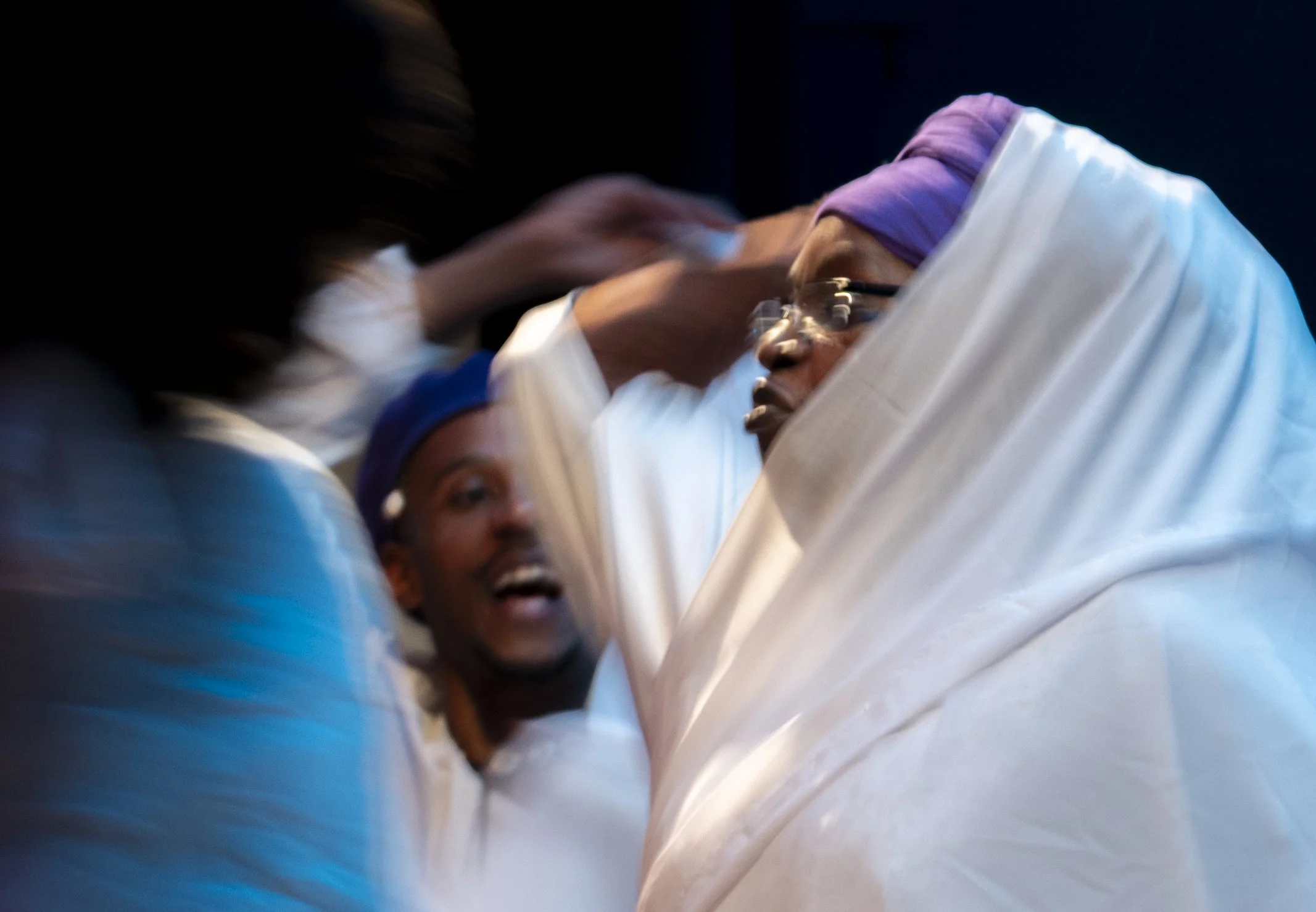
Zahra Glenda Baker dances, spinning in rhythm to the music during the “This Black Is Me” performance at Douglass Park in Chicago, Nov. 7, 2025. (Dylan Connell/City Bureau).
While Douglas works to preserve the lives of Black queer folks of the present, Zahra Baker uses her talents to immortalize the lives of those erased from history.
Baker, 67, has been a Chicago-based Black queer teaching artist for over 30 years. After moving to Chicago in the ’80s to pursue her artistry, she became involved in HIV/AIDS awareness efforts, even as she lost peers to the disease. This led to her practice of naming and remembrance as a tenet of her storytelling, which she passes down to youth.
Baker works with the Queer Youth Ensemble at About Face Theatre, where a group of young folks took inspiration from her lived experiences and turned it into a play — a version of which is featured in the troupe’s current “Living Out Loud” touring production.
“I still feel like there are some missing stories,” Baker said. “I still feel like most of the stories connected to the loss [from AIDS] are not naming my friends; it’s not naming the Black people and how we were affected by it.”
Miller became a filmmaker and team member of Black Alphabet, a Chicago-based arts organization focused on uplifting Black LGBTQ+ communities.
Miller helps coordinate events that build community for Black queer folks, such as art therapy workshops and film screenings. The organization’s largest event is its annual Black Alphabet Film Festival, which showcases a variety of films centered on Black queer experiences and perspectives.
His work continues to be informed by his graduate project excavating memories of Black LGBTQ+ lives from archives focused on the HIV/AIDS epidemic.
“I like to be connected to what my history is because if you don’t learn it, then someone else is going to tell you what it is,” he said. “And that’s when the miscommunication and confusion and fear really starts to seep in.”
Restoration and Rebuilding
As time marches on, a new generation is carrying the mantle of providing care and community for Black queer Chicagoans.
Skai Underwood, 27, is the youth engagement specialist at TaskForce Prevention and Community Services, based in the Austin neighborhood on Chicago’s West Side. She leads Prep4Teens, an award-winning program educating teens on preventive sexual care, sexual health, and bodily autonomy.
Underwood saw a need for increased knowledge of PrEP — a preexposure prophylaxis that greatly reduces the risk of HIV infection — and wanted to provide youth with a community of queer-friendly folks. She has been moved to see participants’ growth during the program — especially one “very shy, very timid” teenager.
“I was a little nervous about [whether] she would interact with other people,” Underwood said. “At the end of our six-week program, she said it was the best summer she ever had.”
Underwood also receives mentorship from the TaskForce leadership team. Among them is Director of Programs Reyna Ortiz, whom Underwood — and others at the organization — see as a maternal figure.
“We call her Mother TaskForce,” Underwood said. “She really is a big inspiration for me. Her just showing up and making sure her voice is being heard. That’s a really strong woman; that shows a woman that knows what they’re doing.”
Like Underwood, Baker, Miller and Ry Douglas, more queer Chicagoans will similarly need to step up to ensure the sustainability of intergenerational relationships, especially as they reach a level of authority and influence in the community, Givens said.
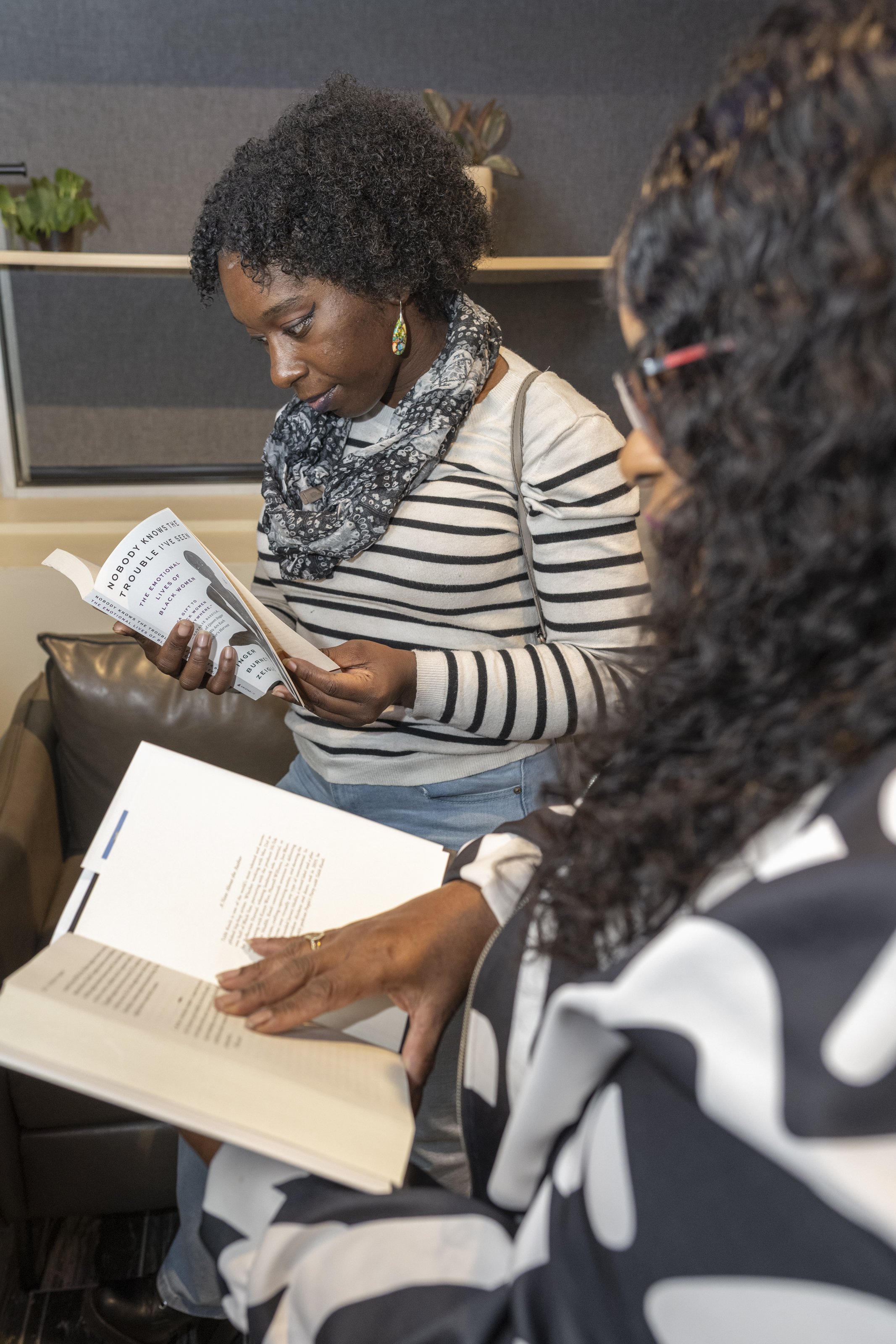
Attendees read books donated to the Banned Book Drive at the Jamii Arts Center in Chicago, Nov. 22, 2025. (Dylan Connell/City Bureau).
After moving back to Chicago from New York City at the pandemic’s onset to care for his mother, Givens has been reconnecting with the path he started on as a teenager, supporting vulnerable communities. Through his role at AllianceCare360 in the Douglas neighborhood, he helps coordinate HIV testing, PreP medication and other preventative health services.
As Givens looks forward, he urges adults and elders alike to find ways to reach out to youth and make those life-altering connections. After all, it made a world of difference for him — and continues to have ripples of impact to this day.
“Why are you not bringing somebody younger into this group with you? Because that’s what happened to me,” he advised. “There’s too much of being raised by social media and given misinformation. Mentorship needs to come out to strengthen the community. We need to be strong in supporting our own.”
Amari Davis was born in Chicago, growing up between Humboldt Park and Logan Square. They are a teaching artist with the Chicago Poetry Center, worked as a classroom teacher for five years, and studied early childhood education at the University of Houston. They got their start in journalism through an Audio Storytelling Intensive with Invisible Institute and the University of Chicago’s Digital Storytelling Initiative, and took part in City Bureau’s Civic Reporting Fellowship in fall 2025.