
The tax on single-use paper and plastic bags has more than doubled since it was first implemented in 2017. Is it an environmental policy, a revenue strategy — or both?
By Alana Warren
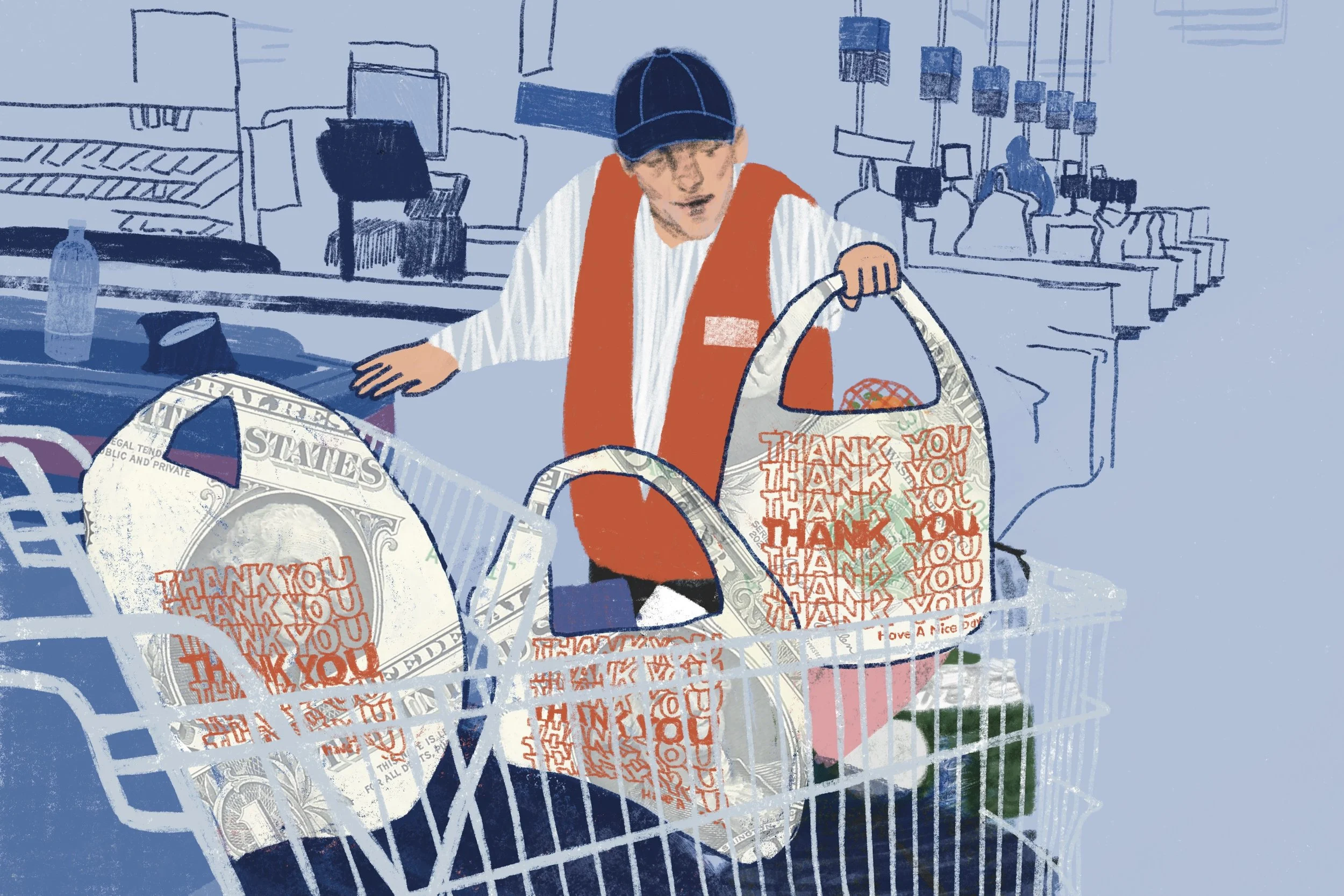
Chicagoans are shelling out another 15 cents for each bag they use in the checkout line. Those fees add up for shoppers, but it also means big money for a cash-strapped city. (Gaby FeBland/for City Bureau)
Chicago Documenters notes from Layla Brown-Clark, Katie Busch, Madeleine Davison, Katrina Herring and Brandi Scarber were used to help report this story. Find more public meeting coverage at Documenters.org.
By now, many Chicagoans might be used to the grocery bag tax. But what is the city’s goal when it comes to it?
The city implemented a 7 cent tax for every plastic and paper bag in 2017. It climbed to 10 cents in 2025 and to 15 cents as of January.
At a West Side budget meeting hosted by Mayor Brandon Johnson in February, some residents were confused and outraged about the tax increasing again this year. “When the tax first started, it was based on grocery bags being [an environmental] nuisance,” said Sidney Brooks, a retired city worker who lives in Austin.
Brooks is right about that. The predecessor to the bag tax was a whole-scale plastic bag ban in 2014. That didn’t work well, so in 2016, then-mayor Rahm Emanuel proposed the tax that shoppers would start paying at checkout lines. Supporters hoped the surcharge would prompt more people to switch to reusable bags and it added a small revenue stream for the city: a projected $9.2 million for the first year.
Fast forward to the city’s 2026 budget hearings, where alders faced a $1.19 billion deficit and escalating pension liabilities. Alders pushed through an alternative budget that increased some taxes and fees, including the 5 cent increase of the grocery bag tax. Ald. Byron Sigcho-Lopez (25th Ward) criticized the move, saying the tax and a plan to sell off city debt would impact low-income Chicagoans the most. Officials project the city will collect $38.1 million in checkout bag fees this year, according to budget documents.
Questions about whether the tax is an environmental or a financial policy have persisted for years. What’s clear is the tax sets up some conflicting outcomes. To continue generating revenue, we’d need to keep increasing the fee or use more bags, which creates more waste. To reduce waste, we need to scale back how much we use those bags — but that means less money for the city.
Here’s what to know about the grocery bag taxes you pay and why.
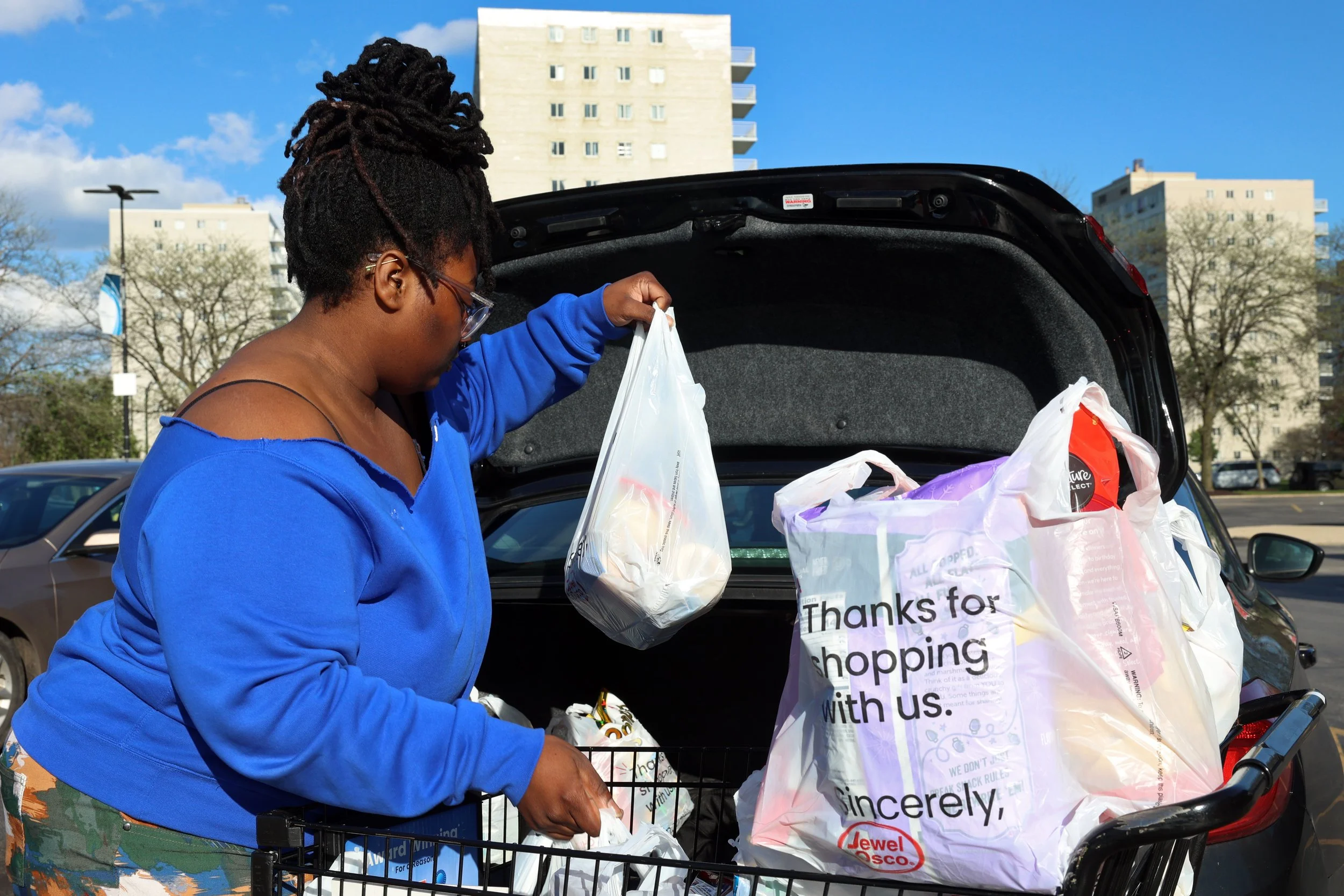
Jelaila Harris, from Beecher, unloads groceries into her car on Saturday, April 18, 2026, at Jewel-Osco in Bronzeville. Harris does Instacart on the South Side and in the southern suburbs. (Anastasia Busby/for City Bureau)
What is the bag tax?
As of 2026, Chicagoans pay 15 cents for every single-use plastic or paper bag you use at the checkout line. Say you leave the store with 10 bags of groceries each week, and they’re all double bagged. That added $3/week could tack another $156 a year to your grocery bills.
Why does Chicago have a bag tax?
Alders approved a 2017 citywide ordinance to charge the tax as a way to curb the use of disposable bags. At the time, Chicago was one of 12 major U.S. cities that enacted bag bans and fees.
The tax replaced an earlier ban on single-use plastic bags, which officials said prompted many retailers to switch to thicker plastic bags that were worse for the environment. The National Tax Association determined that these taxes could reduce the use of disposable bags.
Some environmental groups have supported the idea, but some have also criticized that none of the money from the tax is set aside for environmental programs.
Did the tax help reduce single-use bags?
Debatable, because there isn’t much research examining this.
The city commissioned a study with ideas42 — a behavioral design lab — and researchers from New York University and the University of Chicago Energy & Environment Lab to evaluate shopping bag use in the city between November 2016 and March 2018. The number of people using disposable bags dropped significantly while those using reusable bags doubled in the first year of the tax. City officials cited the results as a win in the few months after the tax was implemented.
There isn’t research analyzing how much we use disposable bags now, but some data suggests we’re using them more often; not less. Compare 2023 and 2024, for example, when the fee was 7 cents/bag. In 2023, the city collected $17.5 million in these fees; in 2024, that went up to $22 million, according to public records obtained from the city’s Department of Finance.
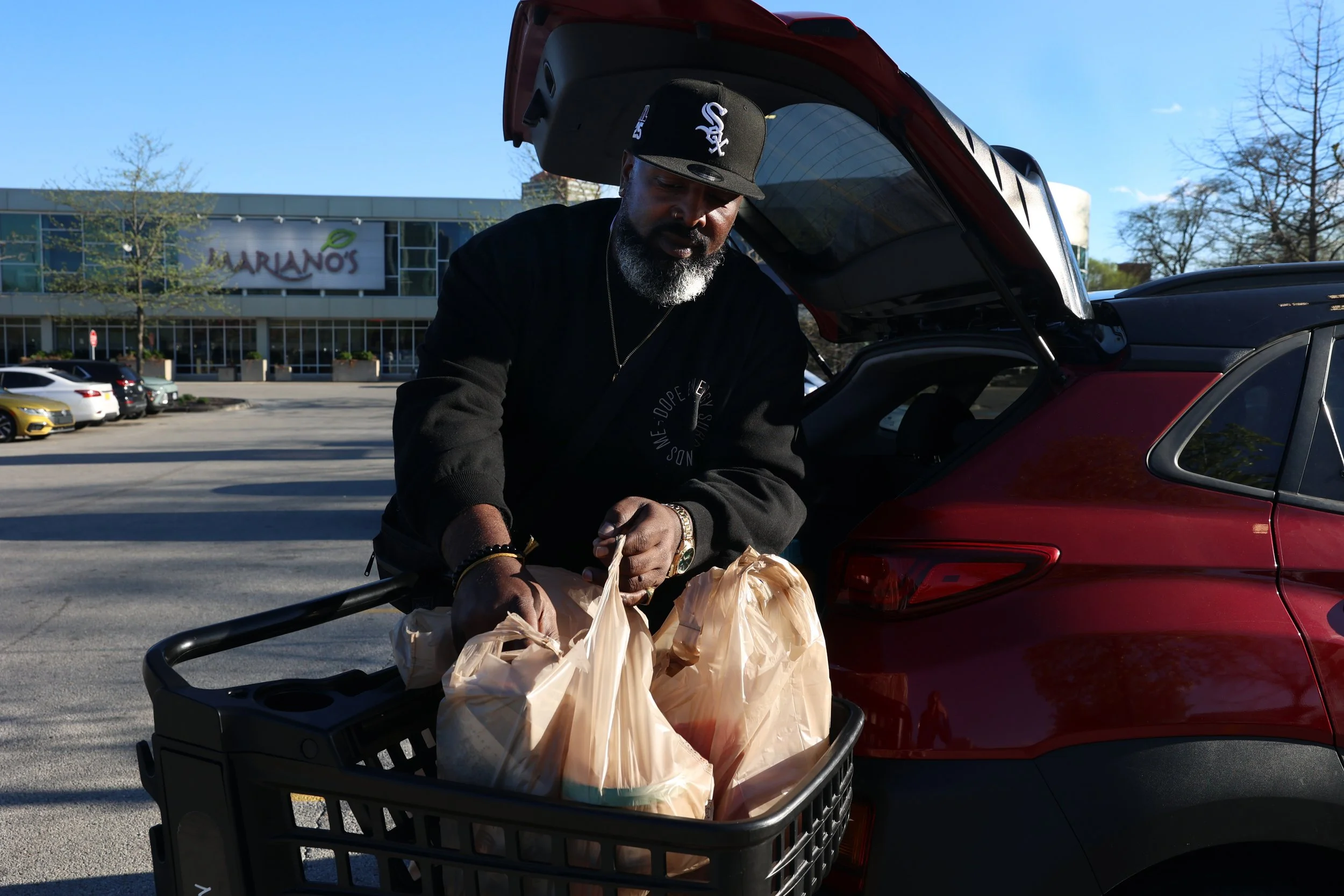
Lawerence “Binkey” Tolefree unloads his groceries into his car on Saturday, April 18, 2026, at Mariano's in Bronzeville. (Anastasia Busby/for City Bureau)
How much money does the tax generate?
For every 15 cent charge, the retailer keeps 1 cent and the city gets the rest, according to city code. When the fee was 7 cents, the retailer kept 2 cents while the city got the rest.
Proceeds from this tax have continued to go up over the years, from $5.7 million in 2017 to $24.3 million in 2025, Department of Finance figures show. The city already has collected $10.3 million in fees through April.
That said, projections for how much the city would collect haven’t always squared up. When it was implemented, initially officials banked on generating around $9 million but only collected around $5.7 million, in part because people stopped using those bags as much. That was fine, officials said.
“It really was trying to encourage people to bring reusable bags when shopping,” Susie Park, then the city’s budget director, told Politico in 2019. “The decline in revenue is potentially a good thing, because it shows a change in behavior. So we’re hoping that continues.”
Late last year, the alderman’s alternative budget proposed the city would bring about $8.7 million more by raising the tax from 10 to 15 cents.
In total, the city has made over $122.2 million from the tax, according to finance officials. The money goes into the city’s Corporate Fund, or general operating fund. It’s not entirely clear how that money is sent to which city services or programs.
Can’t we just recycle our bags?
In theory — but plastic bags are extremely difficult to recycle. What’s more, Chicago’s recycling program has some of the worst success rates in the country, meaning most of what we try to recycle ends up in our landfills and incinerators anyway. Many residents must pay extra for private services that may or may not recycle plastic bags, while the city’s blue cart recycling program does not accept plastic bags. Once we throw away bags (and other plastic), they break down into small fragments that enter our drinking water, clog waterways and endanger wildlife.
Is there a way to reduce the tax’s impact on Chicagoans?
Quite simply: Reusable bags.
“It’s not difficult for consumers to alter their behavior to avoid paying the tax,” said Deborah Carroll, director of the Government Finance Research Center in the College of Urban Planning and Public Affairs at the University of Illinois Chicago.
Carroll added that city leaders could eliminate the bag tax at grocery stores and keep the tax on bags at convenience stores to still make some type of revenue.
“The city can consider educating Chicagoans about the bag tax as well as providing low-cost reusable bags to low-income residents. Changes like these could ultimately reduce the regressivity of the tax,” Carroll said.
Alana Warren, a St. Louis native, started out as a researcher analyzing local and state budgets. Curious about the story behind the numbers, she’s moved into racial equity work and community-centered, collaborative storytelling. She was a Winter 2026 Civic Reporting Fellow focusing on the city budget.
Support our Civic Reporting Fellowship and Documenters programs by becoming a recurring donor.