
With cases on the rise, funding for gender-based violence support is falling increasingly short of meeting heightened need. As a result, survivors are falling through the cracks.
by Sophia Kalakailo
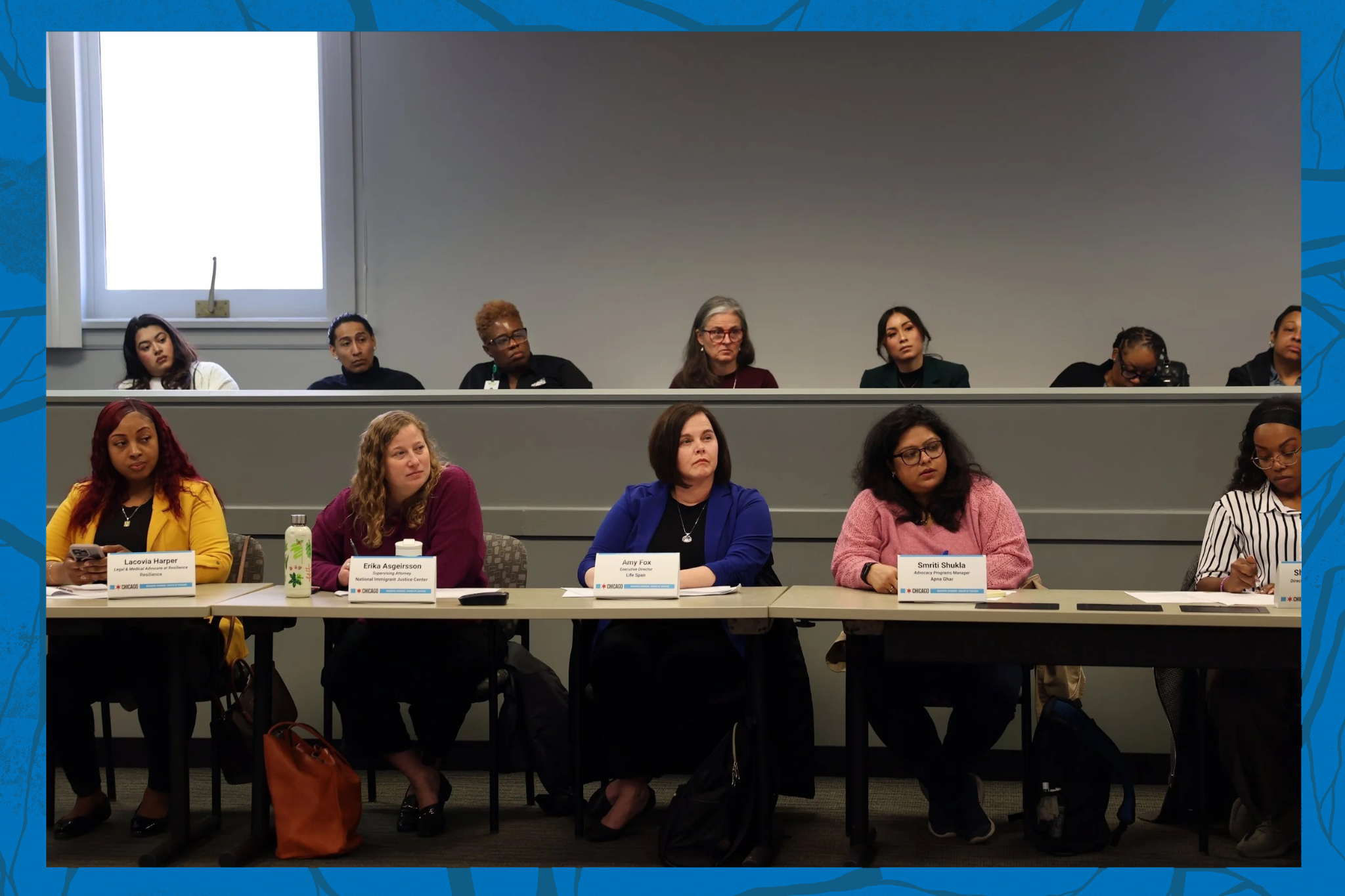
Task force members and members of the public listen during the Gender Based Violence Task Force meeting on Wednesday, May 13, 2026, at City Hall in Chicago. (Photo: Anastasia Busby; Illustrations: David Alvarado)
“Perfect Storm” is a series focused on how federal funding instability is affecting local communities, produced by City Bureau in partnership with local organizations in the Documenters Network. It looks at how communities across the United States — big and small, rural and urban — are reckoning with slashes to federal budgets, the sunsetting of COVID-era grants, and turbulent legal challenges leaving funding in limbo. Find the full series here.
Chicago Documenters assignments from Zackery Bangs, Ava Grubb, Holland Harmon and Ethan Mathews were used to help this reporting. Find more meeting coverage at Documenters.org.
For months, Avery awoke to his roommate screaming and trying to yank his bedroom door open.
If the 26-year-old tried to use the kitchen or bathroom in their apartment, his roommate would yell and throw things at him. If he ever left his bedroom door unlocked, his roommate would go in.
“It literally sounded like he was trying to break my door down,” Avery said, who is using a pseudonym due to concerns of online harassment. “The landlord didn't care, so I learned to start skipping meals. I learned to not go to the bathroom as much.”
Avery sought out shelter space to escape the violence, but most service providers and hotlines told him they couldn’t help him or he wasn’t eligible. As a transmasculine person experiencing abuse from someone he wasn’t in an intimate relationship with, domestic violence shelters didn’t have a place for him.

And even if he were eligible, Chicago has a dire shortage of beds in its network of city and nonprofit-run domestic violence shelters. For nearly half of 2025 — 157 days — there were no available beds or cribs in the city, according to a report from The Network, an advocacy nonprofit.
The need is clear: Chicago calls to the Illinois Domestic Violence Hotline have more than doubled from pre-pandemic levels. Across all of Illinois, there has been a 180% increase in calls since 2019 — with a record-breaking 23,520 calls in 2025. That’s 4,690 more from 2024 to 2025 alone. Shelter was the top need among Chicago callers, the report said.
“We’re turning away more survivors than we have ever had to turn away,” said Kaethe Morris Hoffer, executive director of The Chicago Alliance Against Sexual Exploitation, or CAASE.
And Chicago’s lack of sufficient funding — both in local dollars and federal grants — is largely the reason why.
Demand for services outpaces funding
The demand in Chicago for services like emergency shelter or financial assistance is on the rise. Domestic homicides also surged in 2025, even as overall violent crime dropped, Block Club Chicago reported.
In 2025, the Illinois Domestic Violence Hotline received another record-breaking year of calls, texts and chats, according to The Network, which runs the hotline.
Outreach from Chicagoans more than doubled since 2019, from 10,581 to 23,520. There was a 25% increase in the city’s outreach from 2024 to 2025 alone.
Domestic violence shelter was the top need among Chicago contacts, with 7,784 requests in 2025 — a 20% increase from 2024. There were 1,532 requests for affordable or transitional housing in Chicago, a 56% increase from 2024.
It’s hard to determine one concrete answer for the rise. Some advocates and experts believe worsening economic conditions are responsible for the increased demand for services. Others say increased awareness and outreach are responsible for the statistical rise — not a rise in actual crimes committed, necessarily, but in people’s willingness to report them and seek help.
Regardless of the cause, meeting the need requires more money than the city has allotted. Spent-out reserves, the end of COVID-19 dollars and federal funding cuts made for the “perfect storm” for the city’s 2026 budget, said Madeleine Behr, deputy director of policy and systems advocacy for The Network, which brings together service providers across the Chicagoland region to serve people affected by gender-based violence and domestic violence.
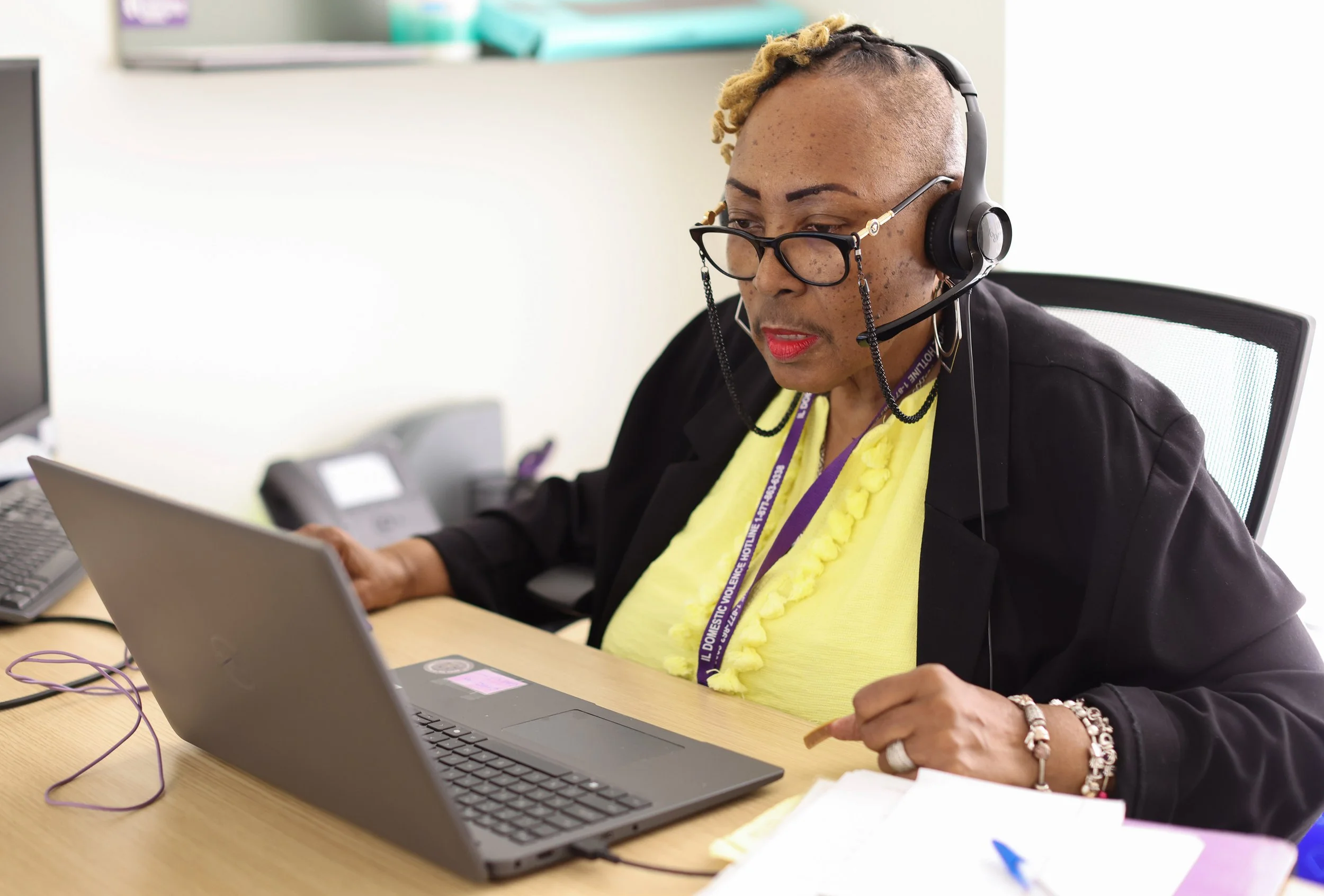
Mayor Brandon Johnson originally proposed a budget late last year that included a 43% cut to gender-based violence funding.
After pushback from advocates and some alderpeople, Chicago ultimately approved a 9% increase in gender-based violence funding for 2026 — from $21.3 million in 2025 to $23.2 million this year. That’s less than a half-percent of Chicago’s $16.7 billion budget going toward a range of services from emergency shelter and financial assistance to counseling and legal services.
Despite increased spending, funding has not kept up with the demand for these services. Across Illinois, while a 29% funding increase meant 1,818 more people received emergency shelter from 2022 to 2024, there was a far more dramatic spike in how many were turned away — 4,557 more people, a 66% rise from 6,934 to 10,744 over the same two-year period.
Across the state, Cook County turned away the most survivors, at 4,112, in 2024. In Chicago, there were 130 days with no beds or cribs available, The Network found.
Meanwhile, the federal government has made significant cuts to services and social safety nets that people affected by domestic, sexual and other kinds of gender-based violence depend upon, deepening the impact.
Less money means more survivors turned away
Chicago-based organization KAN-WIN provides services such as a 24-hour multilingual hotline, transitional housing, legal advocacy and case management to survivors of gender-based violence primarily in Asian American communities.
In mid-July of last year, KAN-WIN lost roughly a half-million dollars, or about 15% of its revenue in 2025, in federal grants. It was just two years into what was supposed to be a four-year grant, aimed at culturally specific domestic and sexual violence services, from the U.S. Department of Health and Human Services, said Executive Director Ji-Hye Kim.
“We had two more years, but they cut it off,” Kim said. “There was not even an appeal process.”
Now, the organization is in a hiring freeze and is staring down an uncertain funding landscape. The cuts come as KAN-WIN has seen an “explosion” of calls to its hotline since the pandemic, Kim said.
The need for free legal services for survivors of sexual assault, sexual stalking, and sex trafficking has also exceeded CAASE’s bandwidth as federal grants continue to chip away at funding, said Morris Hoffer, who has been the nonprofit’s executive director for over a decade.
The funding cuts come as CAASE is seeing an increase in cybersexual abuse, sometimes known as “revenge porn,” and is one of the few legal organizations to specialize in this area.
“I am short [on] attorneys,” she said. “We’ve had attorneys leave us, and I haven’t been able to replace them because I don't have the funding to do it.”
After CAASE hired two legal fellows to help with the case load, the federal government canceled funding for the positions before they could start, Morris Hoffer said.
At significant financial cost, CAASE was able to retain one of the attorneys, Morris Hoffer said. One attorney can handle approximately 35 clients per year, most of whom are victims of rape.
CAASE had to turn away 84 victims in 2025, Morris Hoffer said in an email. From the beginning of this year to mid-June alone, the organization has already turned away 74 people.
“Because of the specialized nature of our services, we’re pretty sure they didn’t have any other organization that could take on their cases,” she said.
CAASE doesn’t solely provide legal representation. The organization helps clients continue employment or stay in school by ensuring the workplace or institution is providing the accommodations they have a right to under Title IX, like changing class or work schedules. Sexual violence and the legal processes that come with it can be “profoundly” disruptive to the lives of the survivors CAASE represents, who are often workers or students, Morris Hoffer said.
CAASE also helps survivors of sex trafficking clear unjust criminal records they have from their time being trafficked. People — most of the time men — who engage in sexual harm “put a huge amount of effort into fighting allegations against them,” which can include “frivolous and abusive” defamation lawsuits against the survivors themselves, Morris Hoffer said.
A Victims of Crime Act grant aimed at supporting underserved victims of violent crime, which the organization first received during the Biden administration, ended March 31.
“It was totally reasonable to expect that it would simply be renewed,” Morris Hoffer said. Without any announcement, the stream of funding quietly came to an end.
Connecting the dots
There is a link between economic stress or a lack of economic independence and gender-based violence, said Sharmili Majmudar, executive vice president of policy, programs and research at Women Employed, a Chicago-based nonprofit that advocates for equity for women in the workforce. Nearly all domestic violence cases include some form of financial abuse, she said.
Since President Donald Trump returned to office, there has also been a breakdown of laws that historically protected women’s employment and financial security, she said.
“We’re very concerned about the ways in which the [Trump] administration’s economic policies — like federal workforce cuts that particularly impacted Black women, for example — are really pushing women out of the workforce, but also pushing women even further out of economically secure pathways,” Majmudar said. “It makes women more vulnerable to everything from food insecurity to homelessness to domestic violence.”
Unemployment among Black women is rising faster than any other group at 7.3%, compared to 4.4% overall, according to a report by Women Employed.
The Equal Employment Opportunity Commission has also dropped a number of gender-discrimination cases since Trump took office. The federal agency that investigates workplace discrimination complaints has shifted its priorities to “anti-Christian bias” and “DEI-related” race and sex discrimination cases usually brought by white people.
“Our concern is very much the increase in financial vulnerability,” Majmudar said. “And that just means that survivors have fewer options, and that means that families that are less secure and less safe.”
Executive orders targeting “diversity, equity and inclusion,” practices by federal contractors and subcontractors, and the chipping away at protections for transgender people have limited how gender-based violence service providers can talk about their work while pursuing federal funding opportunities.
A January 2025 executive order states that federal money can’t be used to “promote gender ideology” and that the government recognizes two sexes, male and female; and guts federal guidance that sought to protect transgender people in schools and workplaces.
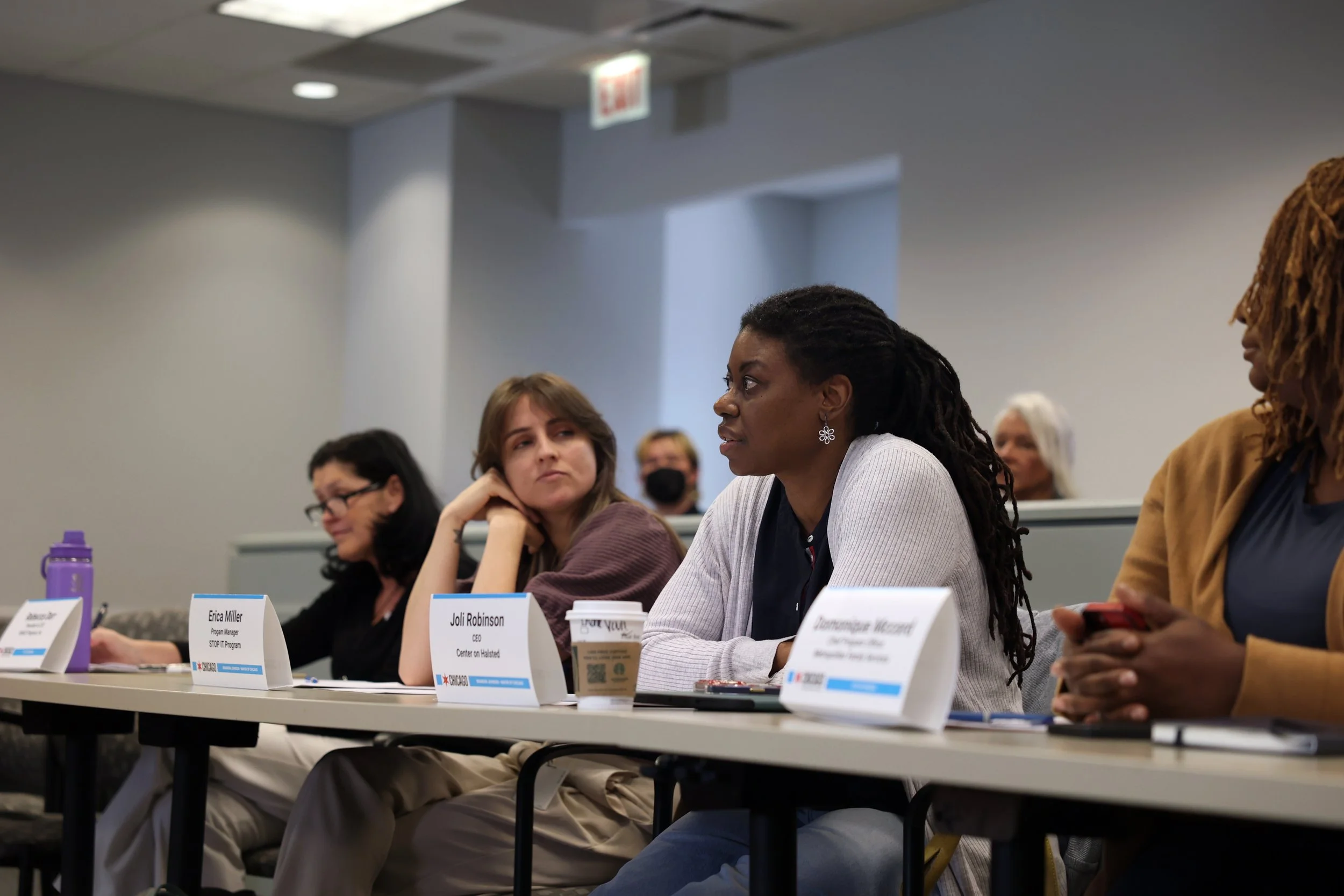
Center on Halsted CEO Joli Robinson speaks at the Gender Based Violence Task Force meeting on Wednesday, May 13, 2026, at City Hall in Chicago. (Anastasia Busby/City Bureau)
Orders like these pose significant challenges to potential funding for an LGBTQ+ community center like Center on Halsted. Unlike KAN-WIN or CAASE, Center on Halsted has not experienced overwhelming financial cuts, but trying to secure new federal funding is challenging, said CEO Joli Robinson.
“What we’re seeing is just the rules being changed, and how do you navigate that?” Robinson said. “What can we put in this application?”
For example, if a federal funding opportunity came along that could help their community, the organization must question whether to apply at all if it can’t mention serving trans people, Robinson said.
Gaps in support didn’t start with Trump
For Avery, there were glaring gaps in support for trans people like him long before the Trump administration cut protective funding and policies.
Avery’s abusive living situation was not the first time he experienced violence for being trans, he said. From workplace discrimination and harassment in restrooms and dressing rooms, to physical and emotional abuse from his own family, and harassment on the CTA or in other public spaces, Avery often had nowhere to turn when he needed help.
Avery especially faced harassment and violence while experiencing homelessness. There were few places he could seek shelter. He couldn’t go to a women’s shelter like many survivors of gender-based violence, but other general-population homeless shelters were also often unsure where to place him.
In a Chicago-area mental hospital, he was not only made to stay on the women’s side of the facility, but was also isolated from other patients entirely and put under constant supervision. He felt his transness was treated as a disorder.
Even in the city’s famously queer neighborhoods on the North Side, he said he experienced racial discrimination, compounded by transphobia from white, cisgender community members.
“I realized I just had enough,” Avery said. He moved out of Chicago last year.
Johari Shuck left her abusive partner last year. Like many survivors of domestic violence, it wasn’t the first time she left. Each time she went back, the abuse worsened.
After she left for the final time last summer, he broke into her condo and sexually assaulted her. Shuck installed a security camera. He stalked her and tried to break into her home at least twice more.
Getting an order of protection was fairly simple to navigate, said Shuck, who is now a member of the city’s Survivor Working Group. But when she went to Chicago police to pursue criminal charges, she got “the runaround.”
First, she had to go to a different police district because one officer knew the man who abused her. Then when she went to court, she was told she was at the wrong court. Shuck waited in lines. She repeated her story over and over. She combed through emails, text messages and security footage documenting a pattern of abusive behavior to send to the police.
“The whole time I keep getting asked, ‘Why did you go back? Why did you do this? Why did you do that?’ and it was just very demeaning and infuriating,” she said, recounting her experience talking to police.
In the end, police told Shuck there wasn’t enough evidence to press charges.
Like Center on Halsted, other organizations face funding challenges from executive orders targeting diversity, equity and inclusion. Morris Hoffer and other service providers also said that acknowledging racial inequality, systemic issues or generally using a social justice lens can prevent them from keeping or receiving federal money.
Morris Hoffer worries that even having Chicago in CAASE’s name, being based in Illinois, and recognizing racial inequality and sexual harm as an organization could all interfere with the Trump administration’s willingness to provide funding.
“Now it’s like when you talk about domestic violence or sexual assault, you can’t do it in the frame of social justice lens or systematic issue,” Kim said.
The federal government is treating gender-based violence and domestic violence as a crime between two people, instead of as a systemic public health crisis, Kim said, limiting how KAN-WIN can talk about their work.
“The danger of treating [domestic violence] just individually is that our culture is very permissive of abuse,” said Jennifer Rosenkranz, a researcher with the Michael Reese Foundation, who focuses on preventing domestic violence.
Prevention programs receive less than 1% of the city’s gender-based violence funding. More voluntary opportunities are needed for people who cause harm, Rosenkranz said. Nine in 10 people in Illinois’ Partner Abuse Intervention Program must be referred through the criminal justice system, meaning some kind of harm has usually already occurred. Out of 27 programs, just four are non-court-mandated.
That’s why Michael Reese and The Network have plans for a new hotline for people who are concerned they will harm their partner. Not many of these hotlines exist, so Rosenkranz hopes to draw from the Maryland-based Gateway 2 Change — the first 24/7 hotline in the U.S. for people at risk of harming an intimate partner.
“We can’t just treat it after it happens,” Rosenkranz said. “There aren’t enough services, there aren’t enough shelter beds, there aren't enough counselors, and so if we’re truly going to end it, we must address the people who are doing it and stop them.”
These programs are funded at the state level, Rosenkranz said, so efforts to better fund prevention are focused there.
Uncertainty makes it hard to plan
Besides outright cuts, many funding sources are increasingly tenuous. A grant program funding legal assistance from the U.S. Department of Justice’s Office on Violence Against Women is typically announced early in the year, and applicants find out if they are receiving funding by August. However, as of July, there had been no word on the program, which funds almost three staff positions at CAASE, Morris Hoffer said.
Quiet ends to grant programs like these, legal battles over the massive DOGE cuts, as well as City Council’s persistent back-and-forths around gender-based violence funding during budget talks has made it hard to plan for the future, some Chicago organizations said.
Through the almost four-month police investigation, Shuck was alone in trying to bring the man who abused her to justice. Despite her extensive contact with law enforcement and court systems, she was not referred to additional resources to help her through the process.
Shuck wished there was some kind of liaison at the court who could have guided her through it. Advocates like this do exist, but there’s limited ability due to funding constraints.
Center on Halsted has a behavioral health clinical advocate at Cook County’s Domestic Violence Courthouse some days of the week who can help survivors navigate the legal system, Robinson said.
“It's hard to plan for the future as an organization that is reliant on government funding at the local city level, at the state level and at the federal level,” Robinson said.
Without more certain and secure funding, Center on Halsted can’t get behaviorial health clinical advocates at the courthouse more consistently, KAN-WIN can’t end its hiring freeze, and CAASE can’t hire more attorneys to represent mostly rape survivors.
Until then, survivors like Shuck often have to navigate the system themselves.
“I was re-traumatizing myself, trying to pursue justice that I never got,” she said.
Or, like Avery, some just give up on getting help at all.
What can you do?
If you need help: Call the Illinois Domestic Violence Hotline at 877-863-6338 or chat online. Run by The Network, the hotline provides crisis safety planning and referrals to emergency housing and support services to survivors of domestic violence in Illinois.
If you are concerned a loved-one may be experiencing abuse, you can also call the hotline for information and local resources.
Donate to The Network's Survivor Fund: The Survivor Fund offers direct financial assistance to victims/survivors of domestic violence, sexual abuse, stalking and human trafficking. Read more about how unrestricted cash assistance helps survivors here.
Learn about Karina’s Law: The Illinois law allows courts and law enforcement to actively remove firearms as part of orders of protection.
Learn how to support loved-ones: The National Domestic Violence Hotline has online resources for people who want to learn how to support others who may be experiencing domestic violence.
Sophia Kalakailo is a Report for America corps member covering Chicago’s South and West sides. She focuses on holding public officials accountable to their communities, covering civic happenings, and building resources and guides with solutions related to housing, public services and other political issues. Before joining City Bureau, Sophia reported on the Ypsilanti, Michigan area for MLive.
Support City Bureau’s reporting on local government and transparency by becoming a recurring donor today.