As the city looks to sell $1 billion of residents’ traffic debt, City Bureau journalists are creating resources to help you navigate owing Chicago money.
by Ariel Cheung
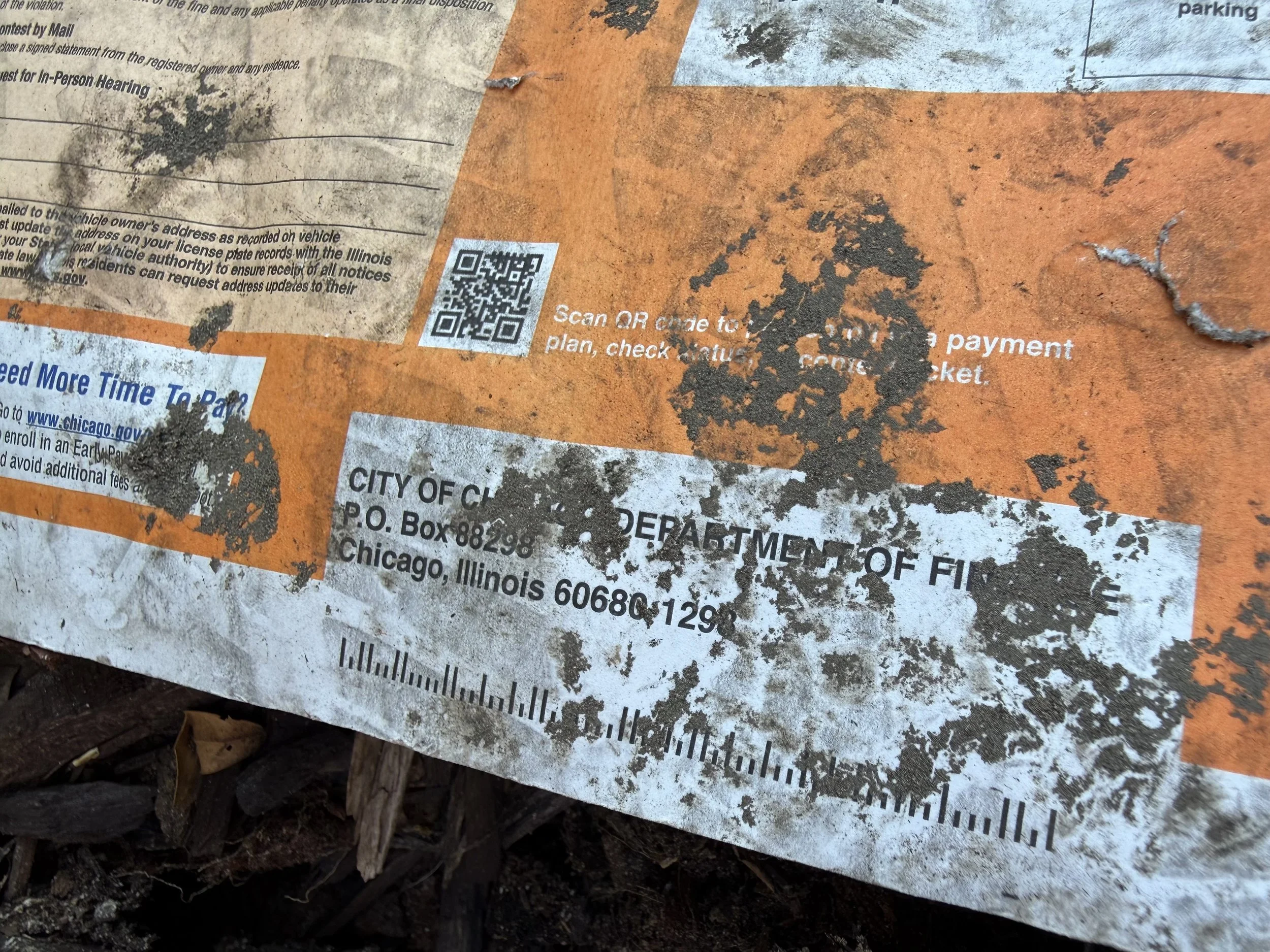
A dirt-covered envelope for a Chicago Department of Finance parking ticket was found discarded on a sidewalk in the South Loop neighborhood of Chicago on Tuesday, July 7, 2026. (Ariel Cheung/City Bureau)
Few policy documents have a more direct impact on our lives than the city’s annual budget. It determines whether the streets and lead water pipes on your block get fixed, how much you pay for grocery bags, and how infrastructure we all share like hospitals and emergency services get funded.
The budget is a picture for how we choose to pay — and who pays — for the city we share.
Earlier this year, we decided to refocus City Bureau’s service journalism on closing information gaps that affect affordability in Chicago. In the next couple months, we’re rolling out our first big project, a direct response to a unique dimension of this year’s budget: City Council’s decision to approve an unprecedented sale of at least $1 billion of individual debt — most of it from parking tickets and red light cameras — to private collectors to close a $90 million gap in its budget.
Unless new policy action is taken, existing debt relief programs for low-income residents won’t apply to debt that gets sold, as it is “no longer owed to the City,” the Department of Finance told Sophia Kalakailo, City Bureau’s community accountability reporter.
By the city’s own timeline, this debt sale could be just months away (although there have been a few stumbling blocks). We are working to get people information they can use to manage this debt before collectors start calling: what your rights are, how to stop predatory collection tactics, and how to get help from legitimate organizations around the city.
This is also happening against the backdrop of Chicago’s notoriously messy books. A report from the city’s Inspector General published in April found that no one knows exactly how much debt people owe the city, the city is poor at collecting what it is owed, and much of the debt is essentially uncollectable.
Importantly, the burden of both the debt and its mismanagement falls hardest on low-income residents — especially Black residents in specific neighborhoods on the South and West sides. That’s the context in which City Council voted to sell a big pile of that debt to private collectors for roughly nine cents on the dollar.
Debt is also foundational to how the city works. Most affordability conversations focus on what things cost — food, gas, rent. But financial health is more than what we spend; it’s also what we earn, what we own, and what we owe.
The history of debt has shaped Chicago in profound ways, including through the legacy of redlining and contract buying. The map of debt eligible to be sold is a map of economic burden — heavily concentrated in neighborhoods such as Englewood, West Garfield Park and North Lawndale.
The median net wealth of a Black household in Chicago is zero dollars, meaning it has as much debt as it does money, property or other assets, according to the Chicago Urban League.
There is no serious conversation about affordability that doesn’t go through debt.
What we’ll be doing
We’ll be creating practical resources Chicagoans can use to navigate their debt — covering relief programs, how to spot scams, and what your rights are when collectors come calling. We’ll be canvassing cars with flyers and training others to do the same. We want to partner with community organizations to share information and host debt clinics, and we’re producing videos with useful, actionable advice.
We’re also exploring whether it’s possible to help negotiate individual debts down and share publicly what we learn. (Are you a lawyer who'd be willing to help? Hit us up!)
We’ll be tracking results to understand which approaches are having the most direct impact. And there will be reporting — when we find things that merit a bigger conversation about the city’s fiscal choices or who bears the cost of a broken budget strategy, we'll write that too. But it will be built on a foundation of useful information. The story about the problem comes second to the information that helps solve it.
… and what can you do?
To join us in this work, follow us on social media and sign up for our newsletter to see the work as it comes out and learn about upcoming events. Look out for upcoming Documenters trainings if you want to help share information about city debt in your community. And learn more about our newly relaunched Civic Information Fellowship if you want to practice this kind of journalism alongside us.
When we say affordability and debt are a public interest issue, we mean it’s everyone’s business, and addressing it is a collective project. Our biggest hope for our journalism is that it will help us realize and work toward the shared interest we have in a city everyone can afford.