
How the rise of AI made us more confident in our model—not less.
By Jody Chong
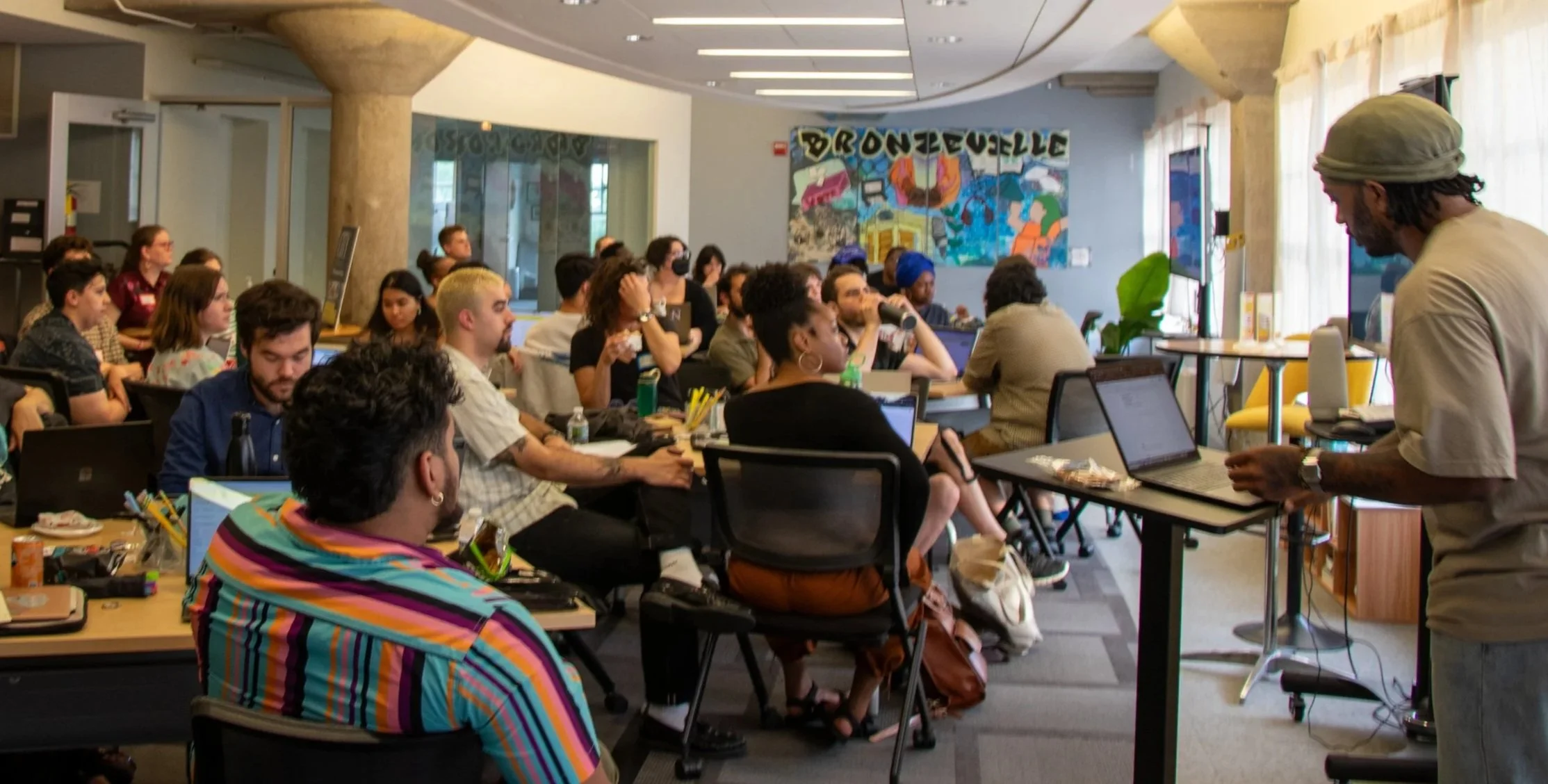
Chicago Documenters attend a local orientation at City Bureau. (Photo: Grace Del Vecchio)
A couple of weeks ago at AJPalooza—a convening of local news leaders hosted by the American Journalism Project—nearly a dozen people asked me some version of this question: “With AI transcription, why does the Documenters program still matter?”
I loved getting this question. Not because it's easy to answer, but because it's been very clarifying for us at City Bureau. The rise of AI has been really helpful to our thinking about the Documenters program because it’s forced us to articulate more clearly what the program has always been about, and build on it with new intention.
The Documenters program was never solely about generating public records of local government meetings, though this is one output of Documenters’ work. It's about creating real, accessible pathways for community members to learn about and participate in civic life and building the infrastructure to support that participation in communities all around the country. We’re equipping residents to understand and shape local public systems and to do this, we know that trusted relationships and local, lived experience are the key.
There is a fundamental difference between having a transcript of what was said in a meeting, and having a community member in the room where decisions are being made. Documenters bring lived experience, local relationships, and judgment to their work. They notice what matters to their specific community. They know who needs to hear it and how to reach them. There's also an accountability dimension that transcription software simply can’t produce. Across the country, we've seen government bodies respond differently when Documenters are present. Being in the room matters—not just for the record, but for what it signals to the people making decisions.
It’s also worth noting that even now, a significant number of local meetings go entirely unrecorded—and AI transcription tools are powerless in those situations. Documenters go where AI can’t. They show up, record audio, and document what happens, creating a public record that wouldn't otherwise exist. And their presence does more than capture information: at meetings like Chicago’s hyperlocal Police District Councils, which Documenters cover regularly, officials see and acknowledge Documenters and community members in the room. That consistent presence helped us successfully advocate for better communication from the city about meeting times and cancellations. Last year a research study of Grand Rapids Documenters found that Documenters notes outperformed official government records on accessibility, readability, and inclusion of public voice. That’s not a coincidence—it's the whole point.
Our recently released 2026–27 strategic plan charts an evolution that builds on the program’s strengths: from equipping people to document local meetings, to equipping them to also distill and distribute information. We’re designing new assignment types that help Documenters identify the most actionable information from public meetings and get it to their neighbors in ways that actually land—a post, a flyer, a conversation at a community event. The goal isn’t a better transcript. The goal is more people connected in a community, more informed and equipped, more able to act together in civic life.
This is where we get excited about AI—to empower Documenters and amplify their work. With an incredibly rich repository of over 13,000 observations from more than 6,000 Documenters spanning 25+ municipalities, generative AI offers a revolutionary opportunity to surface patterns, connect dots, and synthesize insights across those observations, making them more accessible and actionable than ever. We’re actively piloting our first product to use generative AI, which helps Documenters get deep context from past meeting notes in preparation for upcoming meetings, and equips them to navigate complex government environments with confidence. That’s AI in service of the mission.
We’re excited about and committed to using AI to do what AI is good at, in service of what people are uniquely good at. AI tools won’t tell you which moment in a three-hour long meeting affects your street, or who in your community should know about it, or help your neighbors get involved. For example, a Documenter at a Chicago City Council meeting noticed that community members were filling the room to speak out about Peoples Gas rate hikes—and flagged that the Illinois Commerce Commission, not City Council, is actually where those decisions get made. And Documenters regularly flag accessibility barriers at meeting buildings: a bathroom that's impossible to find, a staff member who didn't know where to direct them, a door that should have been open. These are the details that shape whether civic participation is actually possible for most people—and they only surface because a human being was there.
No algorithm can replicate a neighbor who is accountable to their community, who shows up because they care, who can look someone in the eye and say: “here’s what happened at that meeting; here's what it means; and here's what you can do about it.” That is the foundation of trust, and right now, civic trust is what democracy needs most.
Our program model is scalable in a way that’s truly rare—deeply local in each community, and operating across 20+ cities simultaneously, with each site learning from the others. And this is part of why I’m so energized by our new strategic plan: it’s really leaning into our unique scale in ways we haven’t yet fully leveraged.
So when people ask me whether AI makes Documenters obsolete: no. It makes the program's purpose and value clearer and makes Documenters more powerful than ever. We were never just trying to produce meeting records. With local news and civic partners across the U.S., we’re building a movement of people who are genuinely equipped to support their communities with critical information and shape the places they live. AI tools may help us get there faster, but they can’t get us there alone.
Read more from our Director of Product, Eve Lacivita, about how we’re exploring AI while keeping people at the center.
Support our work by becoming a monthly donor.
City Bureau's Documenters Network operates in 20+ communities across the country. Learn more at documenters.org.