
Inner-City Muslim Action Network’s Green ReEntry program brings together younger people and elders for mentorship and community care. Chief Executive Director Alia Bilal discusses how they blend spirituality, justice, healing and community organizing.
By Marium Asif
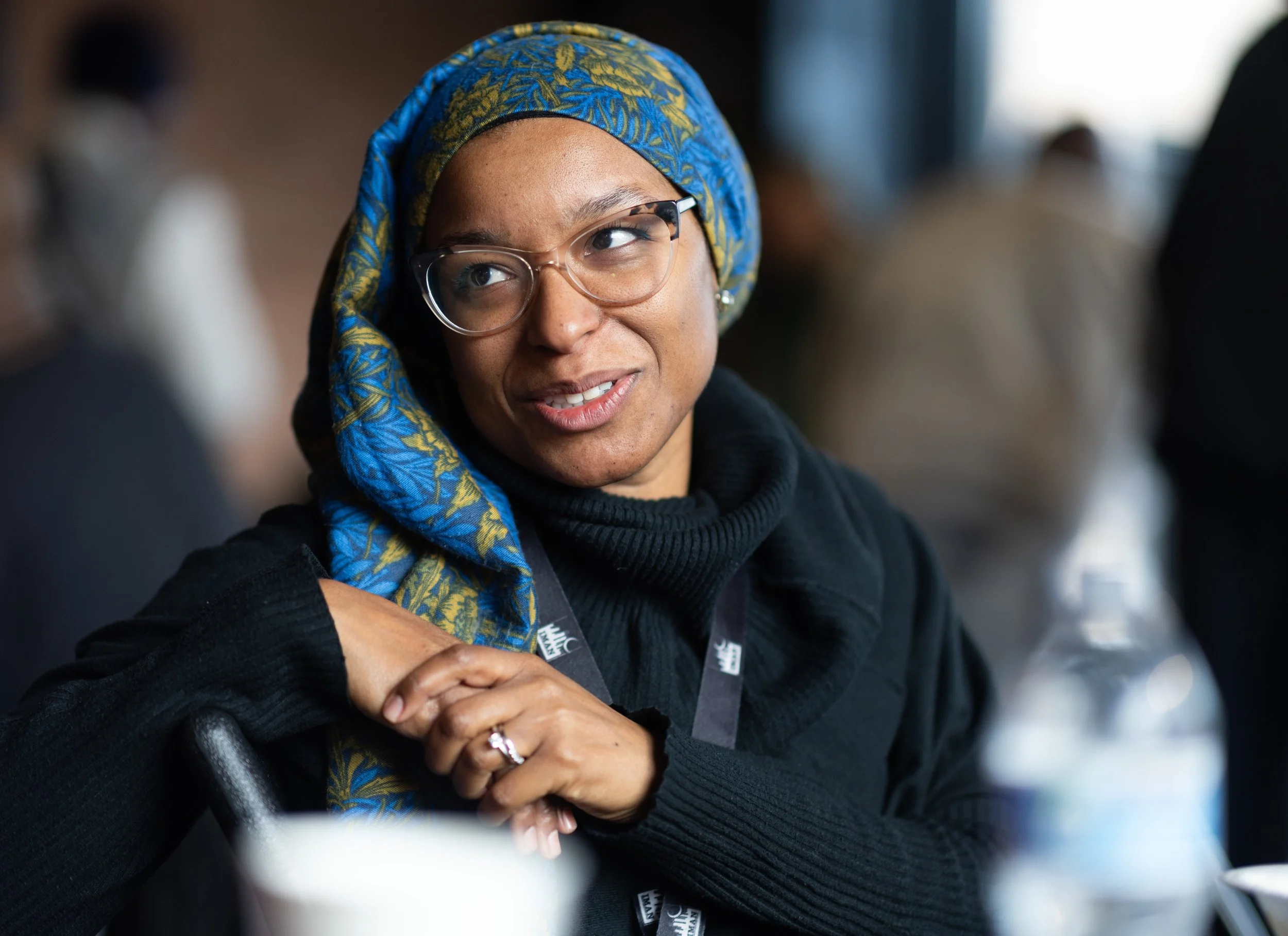
Alia Bilal, chief executive director at IMAN, talks with a parishioner while eating breakfast following a morning prayer service at the Inner-City Muslim Action Network in Chicago’s Englewood neighborhood on Saturday, Oct. 25, 2025. (Talia Sprague/for City Bureau)
For Alia Bilal, the most important part of community organizing is rooted in faith and built across generations.
She grew up on Chicago’s South Side and attended an Islamic school in suburban Bridgeview, an area now often called Little Palestine. It was a tight-knit community, “kind of an Arab enclave” with Palestinian and Syrian families who ran corner stores and gas stations in nearby predominantly African American neighborhoods. But people rarely built relationships across races and ethnicities.
When the founders of Inner-City Muslim Action Network visited her school, their message stayed with her about connecting the Muslim community to the struggles South Siders experienced. After volunteering throughout college, she joined the organization full-time in 2009.
As chief executive director of the West Englewood-based group, Bilal helps lead programs that connect spirituality with justice and healing, including Green ReEntry, which supports people returning home after incarceration by providing housing, job training and mentorship. Younger participants work alongside elders who have spent years incarcerated, forming bonds of mentorship and care.
These connections often fill the gaps left by generations of incarceration and separation, Bilal said. Many young men grew up without fathers, while many elders in the program spent decades away from their children. Bringing them together allows both to find healing in shared growth.
Bilal spoke with City Bureau about how IMAN’s faith-based organizing sustains belonging and fosters intergenerational relationships on Chicago’s South and West Sides.
This conversation has been edited for length and clarity.
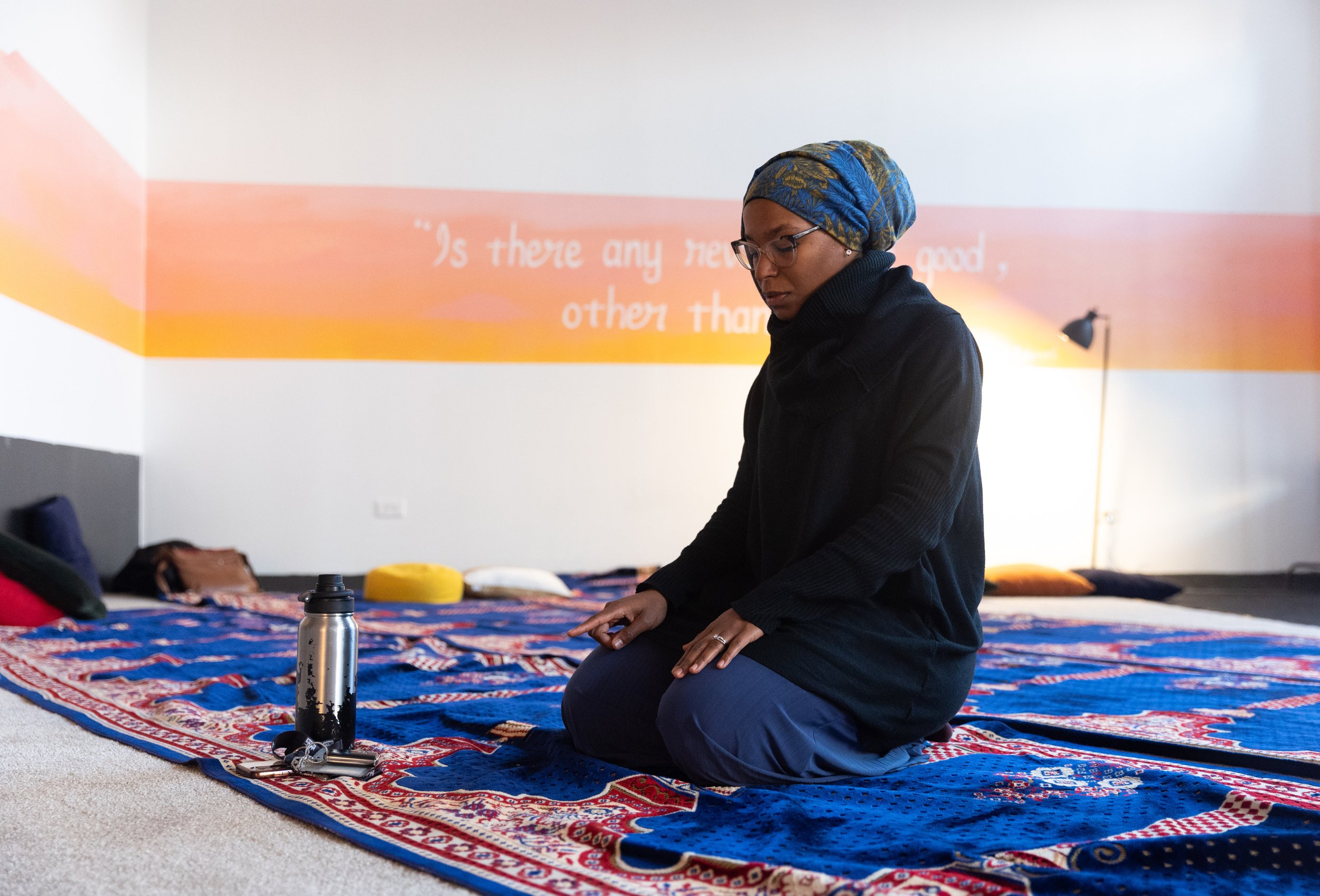
Bila prays during a morning prayer service at the Inner-City Muslim Action Network in Chicago’s Englewood neighborhood on Saturday, Oct. 25, 2025. (Talia Sprague/for City Bureau)
What first drew you to IMAN?
Well, IMAN came to me. In elementary school, we were visited by a couple of the founders of IMAN and they were talking to us about getting involved in this new effort to ensure that the American Muslim community got more connected to and more felt more responsibility for the issues that people in neighborhoods...were facing.
I attended my first IMAN event, “Takin’ It to the Streets," in 1997 at Marquette Park. That was the first time that I had seen Muslims, Christians, Black folks, Arabs, Desis, Asians, Latinos, all together, enjoying music, food, good art, but also talking about issues that impacted people that primarily looked like me in neighborhoods that were like the neighborhoods that I came from. And it was the most refreshing thing. "
I told myself after leaving that festival that someday I’m going to work for this organization.
How has IMAN built and sustained intergenerational relationships?
IMAN is an extremely diverse place, a place where you’ll find anyone from young people and people that are coming from my parents’ generation that are working alongside us at the office and in various roles.
We’re a space that is always striving to bring the kind of representation of the communities that we serve onto the staff and onto the team. That’s a natural way to bring that kind of intergenerational mix. But it’s also a place where we try to be intentional about the kind of spaces we create, intentionally creating spaces where people from younger generations are intentionally placed with people that are our pioneers, as we would call them once upon a time.
IMAN takes a faith-based approach to its programs. How does that shape your work?
Healing is multifaceted. Some people don’t only need jobs and job training. They need to be healthy, they need to have good food, they need access to creative outlets. They need to be activated to be real, contributing members of their society and civic life. That’s something that IMAN really prides itself on.
We have always been upfront, unapologetic, open about our rootedness in our Muslim tradition, really helping people to understand that the success we’ve had over the last 30 years, the achievements we’ve been able to make, that the faith thing is not incidental.
And that faith component for us — if you took that out of the formula and you had all the holistic stuff, the [the Go Green Community Fresh Market neighborhood] grocery store, the programs — it still wouldn’t work. It wouldn’t take.
People are drawn to spirit in general. They recognize that there’s something bigger than themselves. And I think we’re just very open about the fact that we want people to tap into that when they’re here, and that that feels resonant.
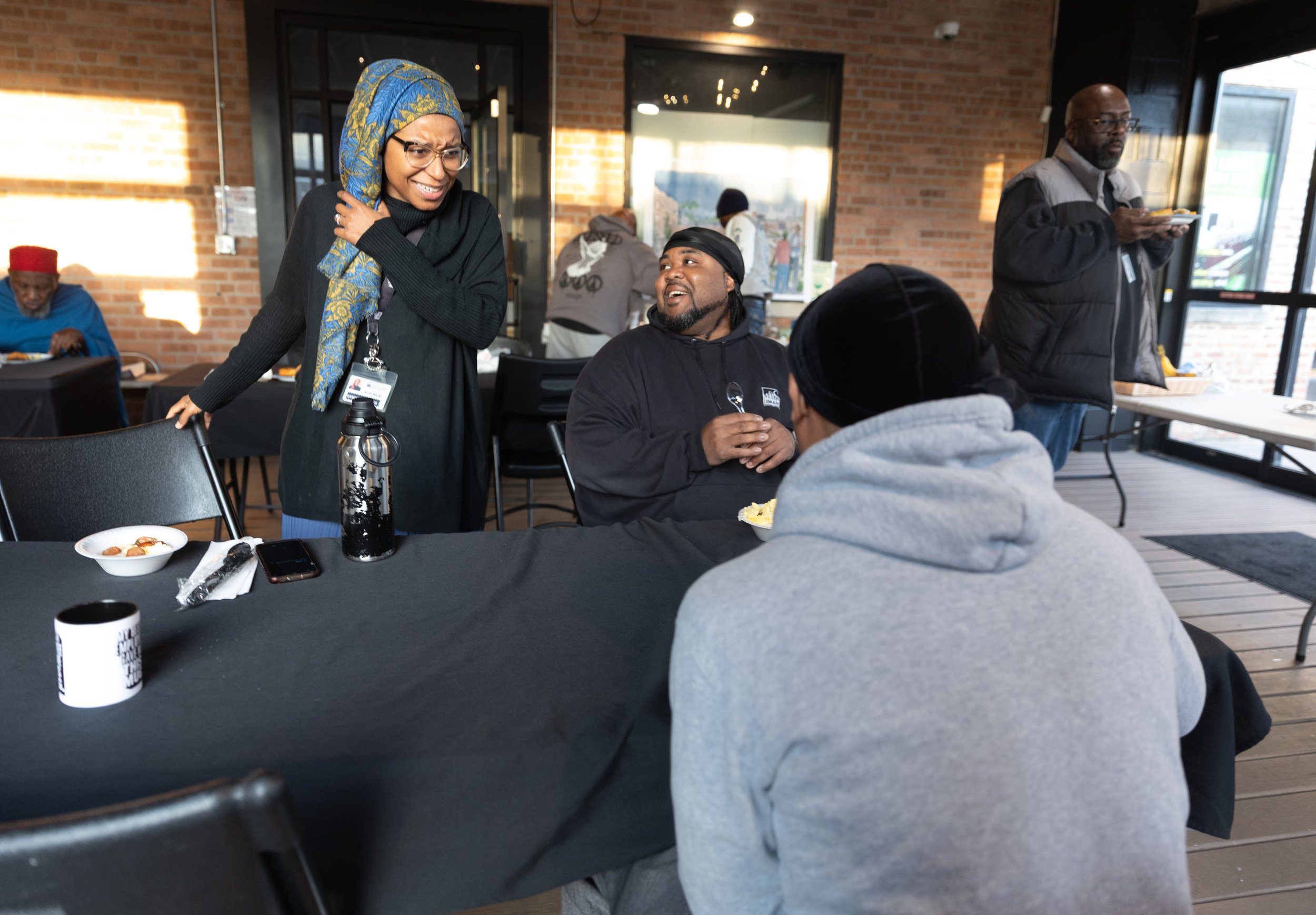
Bilal talks with parishioners having breakfast following a morning prayer service at the Inner-City Muslim Action Network in Chicago’s Englewood neighborhood on Saturday, Oct. 25, 2025. (Talia Sprague/for City Bureau)
Why do participants thrive when they're together across generations?
Given the dynamics in a city like Chicago, in a country like the United States of America that has incarcerated so many millions of particularly Black and Brown men, so many young men these days grow up without their fathers. Likewise, so many of the men that have gone away to prison for many years and that are now coming home … their children grew up without them.
One of the really beautiful things that we see when we have those two populations together is that the pioneers in that space, the elders in that space, end up filling some real [needs] that the young men and women have needed filled, and vice versa.
The 18 to 25-year-old category is typically not made up of many men who have spent a long time in prison — they’re so young. So the elders that have spent that time are really able to guide them in ways that they didn’t have a figure to guide them before. To say, “hey, listen, I went through that. You don’t want to go through that, take another route. This is another route.”
It’s been a really invaluable experience to be able to have both of those generations in the same space.
What has IMAN learned about building generational change?
We see [it] as foundational to our work: you can't build community without both the wisdom of the elders and the vitality of the youth, and everything in between — we would never want to. We never want to envision a community that does not incorporate both elements very intentionally. We recognize how indebted we are to the pioneers who have made all of this work possible.
Marium Asif is a creative writer, poet and journalist from Karachi, Pakistan. A graduate of Habib University in her hometown, she moved to the United States in 2023 to pursue a master’s degree in creative writing from the School of the Art Institute of Chicago. She also is working on a novel based on Pakistani folklore and Abrahamic mythology. Asif is part of the Fall 2025 cohort of the Civic Reporting Fellowship.
Support City Bureau’s Civic Reporting fellowship by becoming a recurring donor.