From after-hours recreation to mental health care, youth programs on the West and Northwest Sides remain a lifeline to children and families in vulnerable neighborhoods. But shifts, threats and cuts to grant programs risk endangering critical support.
By Hector Cervantes

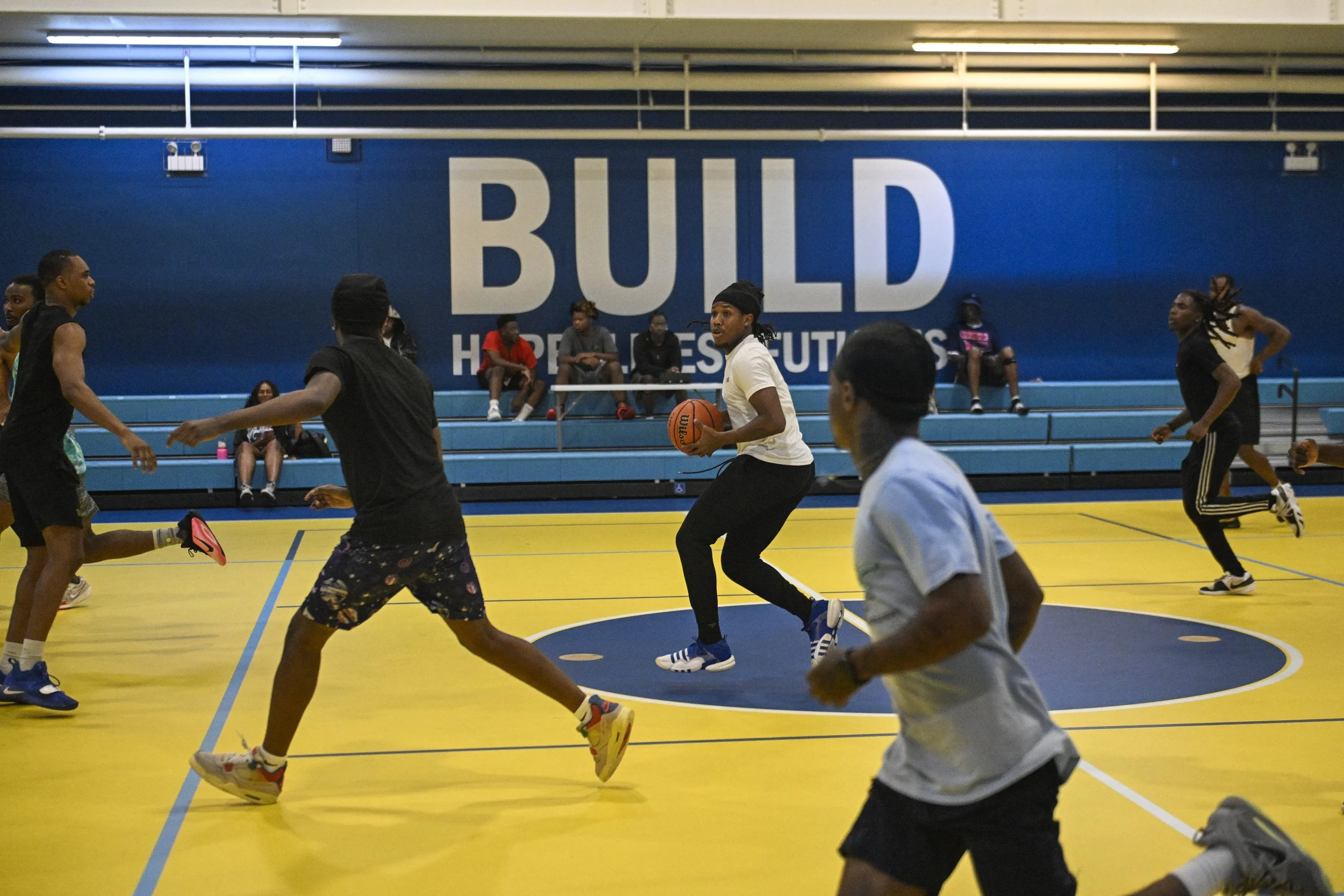
Akeem Goodwin goes up for a shot during a scrimmage at Midnight Basketball on on July 24, 2025. The games, hosted by BUILD in Chicago’s Austin neighborhood, are a free late-night program for young men. (Zoe Davis/for City Bureau).
The sun has set, and the gym pulses with energy at Midnight Basketball in Austin. Along parallel walls, bold letters spell out BUILD, with the words “Hope, Lives, Futures” painted just beneath — more than a slogan, it's a mission in action. The free, late-night program offers young adults a structured alternative to street activity through full-court games and community connection.
Dwayne Flowers, from Garfield Park, is a regular and helps out with various tasks. The sport has helped him avoid negative influences and build lasting friendships. He started playing at Prairie State College in the fall.
“I'm not gonna sugarcoat it — the West Side is dangerous. You got kids with guns, doing drugs. I wasn't interested in that. I had great parents who tried their best to keep me away from all that. Basketball gave me something else,” Flowers said.
On the West Side, Broader Urban Involvement and Leadership Development, or BUILD, is a nationally respected force in youth development, gang intervention and violence prevention. But the 56-year-old organization could lose as much as $4.5 million in federal funding — roughly 20% of its budget — because of federal proposals to cut or eliminate funding from the types of youth development, violence prevention, substance abuse and mental health, and DEI-focused programs that BUILD relies on, as well as broader federal shifts that undercut community-based services for marginalized communities.
Keyonte Holmes handles the ball during a scrimmage at Midnight Basketball on July 24, 2025. (Zoe Davis/for City Bureau).
BUILD is not alone. Funding for nonprofits is getting tight because of government crackdowns, increasingly competitive philanthropic giving , or shifting priorities for corporate givers. Some youth organizations serving West Siders are increasingly leaning on private donors, partnerships and other sources to continue supporting vulnerable communities and the young people who count on their programs, leaders told City Bureau.
Ron Culp, a professional in residence in public relations and advertising at DePaul University, said programs tied to diversity initiatives “are being scrutinized at levels never seen before.”
“Some are being broadly categorized as DEI-related when they actually aren’t, as they are far broader and more important in what they do and should be maintaining support for,” Culp said.
Nonprofits are adapting by focusing on local funding, reducing program overlap and strengthening donor relationships.
“For the next several years, the main potential increase in funds for nonprofits is going to come from private donations. It’s not going to come out of corporate foundations that are tightening their belts. They’re becoming more and more selective about where their donations go, focusing on how it helps the company achieve its goals,” Culp said.

Cordero Worthy, age 12, and Elijah Johnson, age 11, play basketball during a Boy’s Night Out program at Sidney Epstein Youth Center in North Lawndale on Friday, July 11, 2025. (Talia Sprague/for City Bureau)
‘We’ve found a way to keep programs funded’
BUILD works with youth in Austin, Garfield Park, and Humboldt Park, where gun violence, trauma, and limited resources are ongoing challenges. Its programs include school-based and street-level intervention, after-school and weekend activities, summer camps, mental health services, job and college readiness, sports, arts and a working urban farm. BUILD also provides food, legal aid, and conflict mediation for youth and families.
BUILD has received federal grants through the Substance Abuse and Mental Health Services Administration under the Department of Health and Human Services, TRIO via the Department of Education, and the Office of Justice Programs under the Department of Justice, Chief Program Officer Monique Draper said.
President Donald Trump’s administration has withheld or plans to slash funding for all three of those programs, prompting a flurry of lawsuits and pushback:
Substance Abuse and Mental Health Services Administration, the country’s main mental health agency, is slated to lose $1 billion of its budget under Trump’s budget proposal. It also was rolled into a different division combining several agencies. In 2023, BUILD received nearly a $650,000 grant to expand its full-service, mobile behavioral health unit, records show.
TRIO programs provide outreach and support for students who are low-income, first-generation or have disabilities. Grants go to universities and colleges, public and private agencies, as well as community organizations that serve these students. The Trump administration has frozen an estimated $660 million in funds for more than 2,000 grant programs as of September, Inside Higher Ed reported. BUILD has consistently received funding through TRIO’s Talent Search program, including $288,470 grants the past two years, according to the Council for Opportunity in Education.
Trump’s administration cut at least 365 grants administered by the Office of Justice Programs, affecting programs that support victims of crime, among others. BUILD received $1.5 million in fiscal year 2024, one for serving crime victims and another to address school violence, records show. Illinois was among several states that sued to block the federal government from restricting the money. In October, the feds abandoned their plan to withhold the money.

Traemont Miller (middle) operates the scoreboard during a Midnight Basketball session on July 24, 2025. (Zoe Davis/for City Bureau).
BUILD’s key programs could lose federal funding over the next three years, Draper said. Leaders are reviewing their fiscal year 2026 budget to identify where they may be able to slash 10% of costs, which could mean cutting staff, programs or services.
The organization is trying to make up some of the difference through private donations and other government grants, Draper said. The group raised over $800,000 at a fundraising gala in April, where former CEO Adam Alonso said BUILD would continue its work despite the “chaos and fuckery” threatening its federal funding, the Austin Weekly News reported.
“We’ve had some conversations with private endowments and funders, and we want to build a $50 million nest egg so we have the funding needed to provide support,” Draper said. “That may mean widening our network. What does that net look like, and how can we all work toward and move in the same direction?”
Funding is stable enough for now for Midnight Basketball to function, but it could become unstable in the coming years as philanthropy and government support remain unpredictable.
“We have continued our programming. There has been no disruption to date in services for families. Right now, we’ve found a way to keep programs funded so we can continue delivering those services — and so far, nothing has been impacted,” Draper said.
Demarion Davis, 20, comes to BUILD to work out and play ball at Midnight Basketball. He values the community and support system that BUILD provides, saying it helps him make better choices. His goals are to stay off the streets, build discipline and surround himself with positive influences that help him grow.
“I love to come up here, not even just for basketball, just to see everybody I know who is doing good,” said Davis, who lives in Austin. “There’s a lot of people who don’t really have nobody to look up to. But here, it’s so many people you can talk to. People really look out for you. Without this place, it’ll definitely harm the community.”
Northwest Center, a housing, financial literacy and social services organization in Belmont Cragin, also is facing funding uncertainty due to federal grants.
Northwest Center receives roughly $100,000 annually through the Medicare Enrollment Assistance Program grant, (otherwise known as MIPPA) which supports most of its benefits-related services, Executive Director Angela Fontes said. MIPPA grants are designed to help states do outreach to low-income residents and help them save money on Medicare costs.
Northwest Center’s most recent grant expired August 31.
Federal funding was allocated as of the fall, but it still wasn’t clear how much money that was or when Northwest Center would be able to apply for it, Fontes said. Federal records show the Illinois Department of Aging received about $812,000 through the Medicare Enrollment Assistance Program in mid-September.
“Good news, but with this administration we’ll believe it when we see it,” Fontes said in an email.
If more money doesn’t come through, the center may need to reduce benefits intake staff from two full-time employees to half a full-time equivalent.
Already the group has had to cut back because of the uncertainty. Typically the group has three people working connecting people with resources for the Supplemental Nutrition Assistance Program and Women, Infants, and Children, as well as Medicaid and Medicare. Now, they only have one. In November, SNAP benefits were paused because of the government shutdown, and over 360,000 low-income Illinoisans could lose their benefits next year because of expanded work requirements.
“We are in a position where we definitely don't want to stop doing the work, and yet we're not really sure how we're going to get that funded,” Fontes said.
The majority of Northwest Center’s funding comes from the city of Chicago, which has honored existing grants and advocated for federal funding. The organization also is adapting to expiring pandemic-era funding which helped expand work around urgent health needs.
“There was this huge spike of funding during the pandemic that has been sunsetting, so these additional reductions just add to the need to get smaller, fast,” Fontes said in an email. “For us, getting through is really about leaning on our foundation and corporate funders, and working with our local elected [officials]. We are so blessed to have the support of the Alders in the wards we touch, and our state representatives to maximize every dollar we receive.”
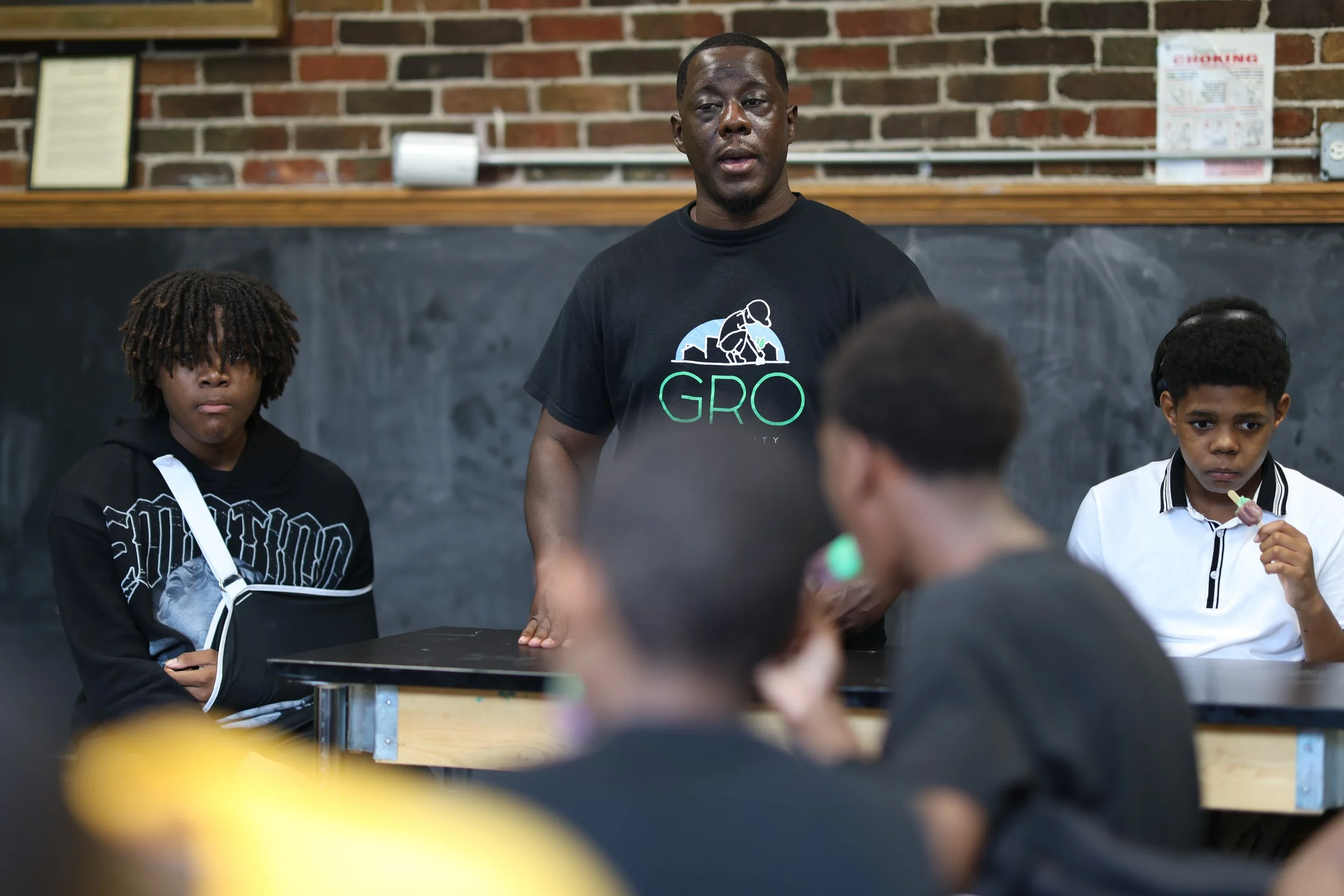
Zack Hary of God Restoring Order (GRO) Community speaks to participants during a Boys Night Out program at Sidney Epstein Youth Center in North Lawndale on Friday, July 11, 2025. (Talia Sprague/for City Bureau)
‘The Work We’re Doing is Saving Kids’ Lives’
Chicago Youth Centers, operating since 1956, has endured many cycles of fluctuating funding.
The nonprofit provides early learning, out-of-school and after school programs, and summer camps for toddlers to teenagers primarily on the South and West Sides. They have 19 centers throughout the city.
Much of the organization’s funding came from the United Way as recently as the early 2000s. “Programs were basically free and more robust for our families,” CEO and President Tina Ayala said.
Like many nonprofits, CYC got an influx of support via federal COVID grants. That allowed the group to provide full day programs for its kids, as well as activity kits and supplies to deliver to families.
“We were able to serve more children and families virtually than we were able to fit in our facilities. So as crazy as it may seem, COVID was very successful for CYC because we were able to reach so many youth and families across the entire city,” Ayala said.
They, too, have seen threats to consistent funding streams, both at the state and federal level.
In July, President Donald Trump’s administration froze over $1 billion in 21st Century Community Learning Centers grants, the main federal funding stream for after-school programs. Those funds were released after about three weeks, but one education advocate told ABC News said the delay forced some summer programs to shut down and afterschool programs to call off plans to open for fall.
CYC typically receives several grants through the program, including over $3.1 million in 2025.
Teen REACH, funded through the Illinois Department of Human Services, helps organizations provide critical after-school services to at-risk youth ages 11 to 17. CYC lost its Teen REACH funding last year, despite receiving a high score on its application, Ayala said. State records show the organization last received a $149,000 Teen REACH grant that expired in 2024.
The organization also did not receive grants this year through the Illinois State Board of Education to support child and family mental health. Chicago Youth Centers had received the grants going back to 2022.
Much of CYC’s staff is part-time, which limits the scale of the programs they can run. That loss of funding means leaders have to seek out more partnerships to provide spaces for their programs, and money for full-time staff, nutritious foods and field trips.
“We have been able to keep our programs open for the past year and pivot, but we are still really looking for individual and corporate sponsors to make up that [money] that we had lost,” Ayala said.
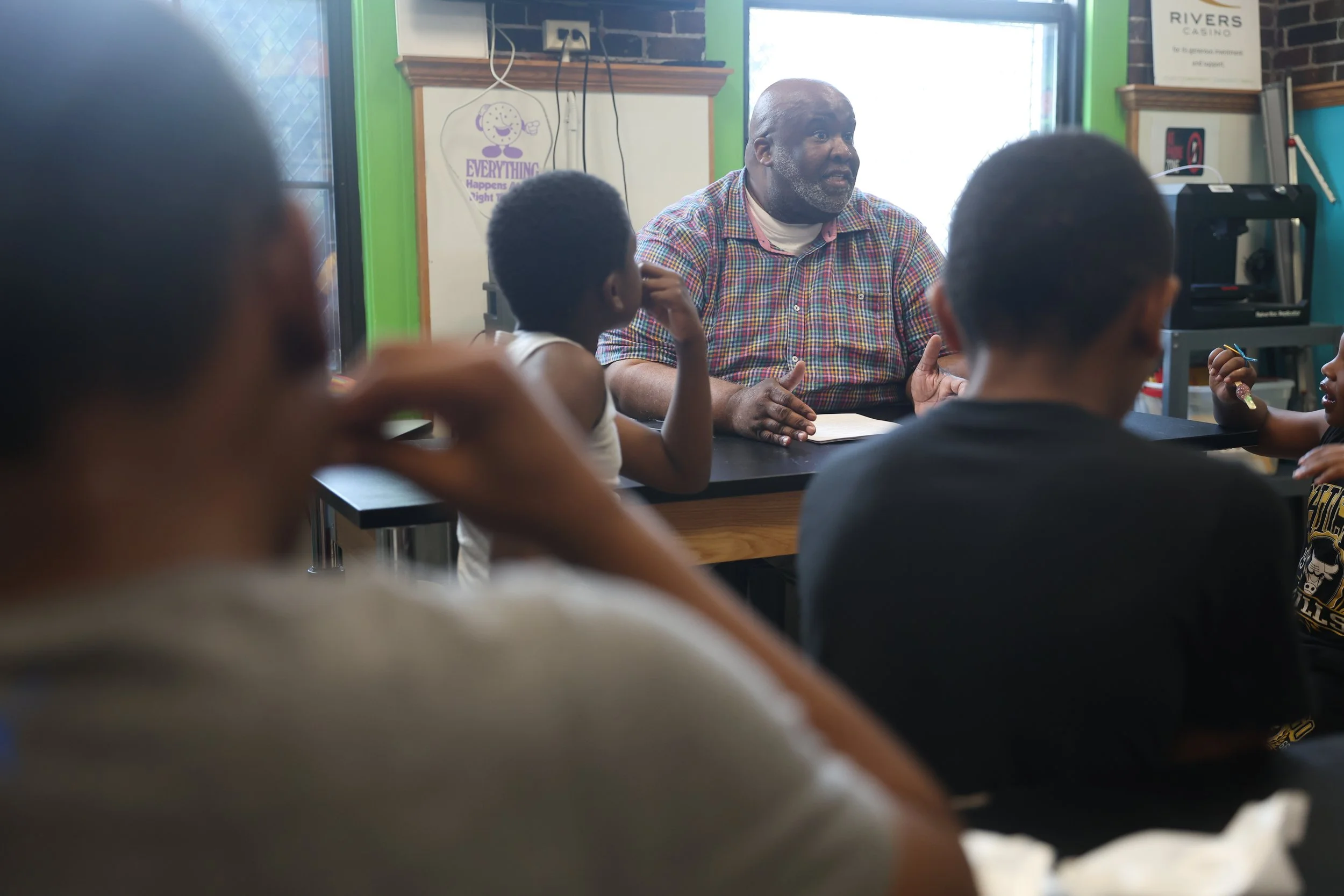
Clarence Hogan (center) speaks to participants during a Boys Night Out program at Sidney Epstein Youth Center in North Lawndale on Friday, July 11, 2025. (Talia Sprague/for City Bureau)
Programs inside the group’s North Lawndale center give insight into what is at stake.
The CYC-Sidney Epstein Youth Center offers learning resources such as a Maker Lab, community garden, computer labs, classrooms and a gym. The center serves over 200 children ages 3 to 18 annually.
The youth center collaborated with God.Restoring.Order (GRO) Community to host a Boys Night Out event. GRO provides trauma-informed care to boys and men of color ages 5 and up, promoting emotional literacy and healing.
At the event, a group of teens gathered inside a classroom and quietly focused on a journaling exercise to explore their identities and emotions beyond anger and happiness. One brick wall featured a vibrant CYC rectangle painting, bursting with blue, orange, red, yellow, green, and purple — an energetic backdrop to a space designed for growth and expression.
Affirming messages posted to the walls surrounded them: “Sometimes it just takes time.” “Black Power.” “All Power to the People.”
“We’re coming in, providing therapy, and showing them how to express their feelings and emotions in healthy ways,” said Zackhary Felton, a GRO therapist who facilitated the event. “We let them know it’s okay — it’s okay to feel sad, to cry, to feel things deeply. These emotions are normal. It’s human to express them. When I talk to my kids, I’m always teaching them coping skills.”

Amar’e Ross, age 11 (center-top), Cordero Worthy, age 12 (right) and Elijah Johnson, age 11, (left) fill out worksheets during a Boys Night Out program at Sidney Epstein Youth Center in North Lawndale on Friday, July 11, 2025. (Talia Sprague/for City Bureau)
Events and programs like these provide vital community support to not only the children in their program, but their families, too, Ayala and Center Director Clarence Hogan said.
“We believe that the work that we do directly and indirectly affects poverty, violence, crime, pregnancy rate — all of these things that don't seem to have a direct path to after-school programs, but they do,” Hogan said. “So if we decrease the number of kids that we serve or families that we engage because of finances, it's going to exponentially change the trajectory of a young person's life. If we stop having programs in North Lawndale, I dare to say it's gonna be catastrophic.”
CYC also supports parents with workforce development, resume building and job searching. After-school care and their summer programs are a critical piece to the broader work of helping whole families, Ayala said.
“The majority of our parents now are working. They rely on us to pick up their children from school and then keep them in our centers until at least 7 p.m. How many families would be able to continue working if they didn't have us as their support?” Ayala said.
Tamar Shelton, 13, has been involved with the Sidney Epstein Youth Center since fourth grade.
“We went skiing in February, then we went on field trips, like to Chinatown. It was fun. We just hope that at CYC, we come together as a community to show love and spread love, because not everyone has the opportunity to go home and do things like that,” Tamar said.
Timothy Johnson, 14, said activities at the center helped him come out of his shell, make friends and explore handball, hockey, soccer and arts and crafts. But the skiing trip to Wisconsin was his favorite.
“They let us go on higher and better slopes. I was pretty good at it, even though it was like my first time,” Timothy said.
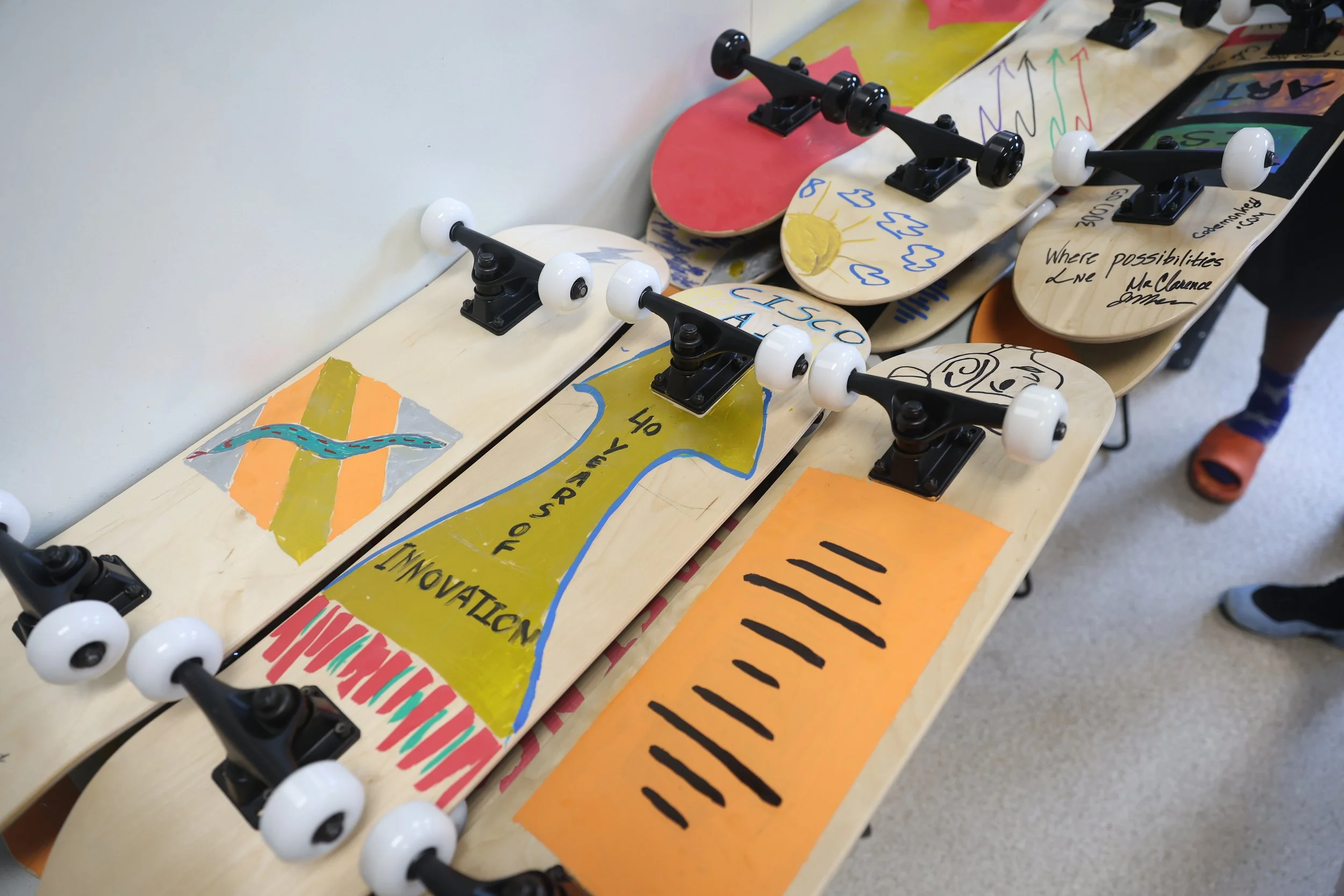
Skateboards are seen in a classroom during a Boys Night Out program at Sidney Epstein Youth Center in North Lawndale on Friday, July 11, 2025. (Talia Sprague/for City Bureau)
Losing reliable federal support for nonprofits and youth investment calls into question society’s shared priorities, said Kate Cooper, associate professor of communication at DePaul University. Private funding often depends on the priorities of a few individuals, whereas federal funding represents a broader, collective commitment, she said.
“If we’re not able to rely on federal funding for nonprofits or investment in youth, it raises the question of what we are collectively committed to as a society,” Cooper said. “Public funding can be difficult to secure. Sometimes, government funding gets a bad reputation because of all the hoops you have to jump through. But it’s important that it’s there — that’s money the public is providing,” Cooper said.
Collaboration, creative fundraising and strong networking are key in a shifting landscape, Cooper said.
“Continue making the case for why your work matters in the current. Continue to tell people why this money matters — why federal contributions matter, why individual contributions matter, why personal contributions beyond money, perhaps in the form of time or volunteer labor, matter. It's an important job to continue to educate the public on the important role that they provide.”
And organizers have a powerful story to tell about why their work is important.
“Hopefully people see that the work we’re doing is saving kids’ lives, right?” Felton said. “Instead of being out in the streets, they’re here playing basketball. They’re learning coping skills, they’re eating, having fun with other kids — instead of being out there. So I hope the higher-ups and politicians see that we’re helping kids and saving lives.”
Hector Cervantes is a community and freelance reporter. Raised in the Chicago suburbs, he graduated from DePaul University with a bachelor’s degree in communication and a master’s in journalism. Cervantes has been published at Growing Community Media, Cycling Weekly, Restart and the Chicago Sun-Times.
He participated in City Bureau’s Civic Reporting Fellowship program in spring 2025.
Support City Bureau’s Civic Reporting fellowship by becoming a recurring donor, and check out more of our fellows’ work.