
From makeshift studios on the South Side to the bright lights of Downtown runways, young entrepreneurs are redefining fashion as a movement inspired by community, vision, and empowerment.
By Robyn Meurkson
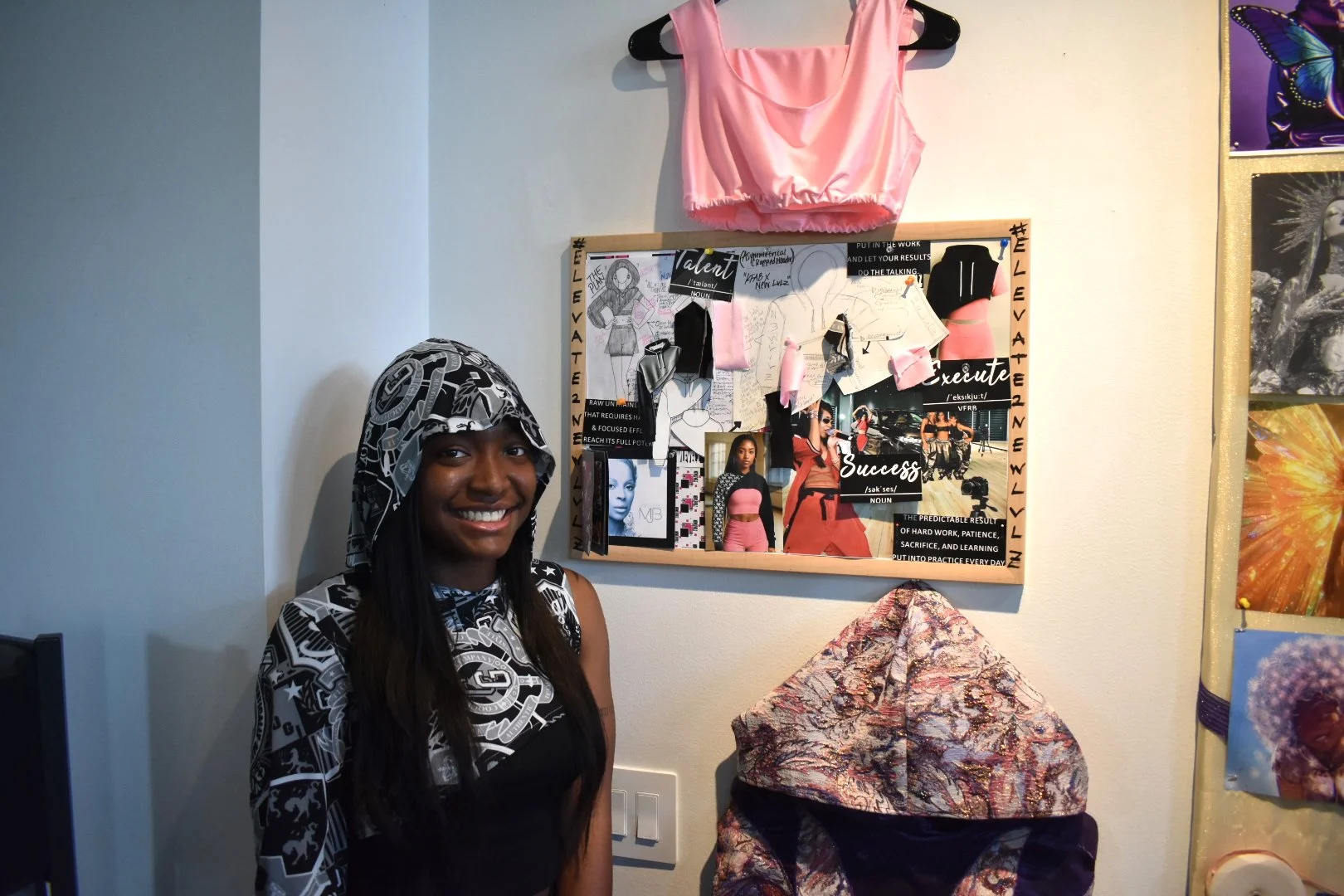
Kayla Perkins, 20, poses for a photo in front of samples and a vision board of her fashion line at a showcase Saturday, August 23rd, 2025. Perkins is part of a design program at Cre8 Space in South Shore, which trains young designers in fashion entrepreneurship and AI textile workforce development. (Kaelah Serrano/for City Bureau).
At 20 years old, Kayla Perkins is already a veteran in the Chicago fashion scene. She began sketching designs at seven, launched her own brand at 11, and now works as a fashion production and marketing intern at CRE8 Space, a fashion entrepreneurship and AI textile workforce development program on the South Side.
Fashion helped Perkins build her self-esteem. She credits her mom for encouraging her, finding local opportunities for Perkins to perfect her craft, network and promote her creations, and providing the earliest financial support for the budding businessperson.
“Me getting into fashion — her putting me in these different programs or in different groups where I can be immersed with other youth and really live out what I love to do and push me to that limit — allowed for me to be more outspoken, allowed for me to be more creative, to be less afraid of being authentically me and embracing my creativity in fashion,” said Perkins, who grew up in Bronzeville and Austin.
For some young designers on the South and West sides, fashion is more than just runway; it’s about defiance and revival. Young fashion entrepreneurs are redefining style as a tool for self-determination, using their work to reflect both cultural pride and economic stamina.
Largely self-funded, these creators are cobbling together side gigs, crowdfunding, personal loans and other support to fuel their work. Some get training and opportunities to work with experienced professionals at incubators and hubs such as Cre8 Space and FashionBar Chicago in the Loop.
Perkins is among many young Black and Brown creatives transforming their personal passions into enterprises, often without traditional funding, formal design degrees, or industry connections. Instead, they’re leaning on community, collaboration, and a vision to merge their way into the future of fashion.
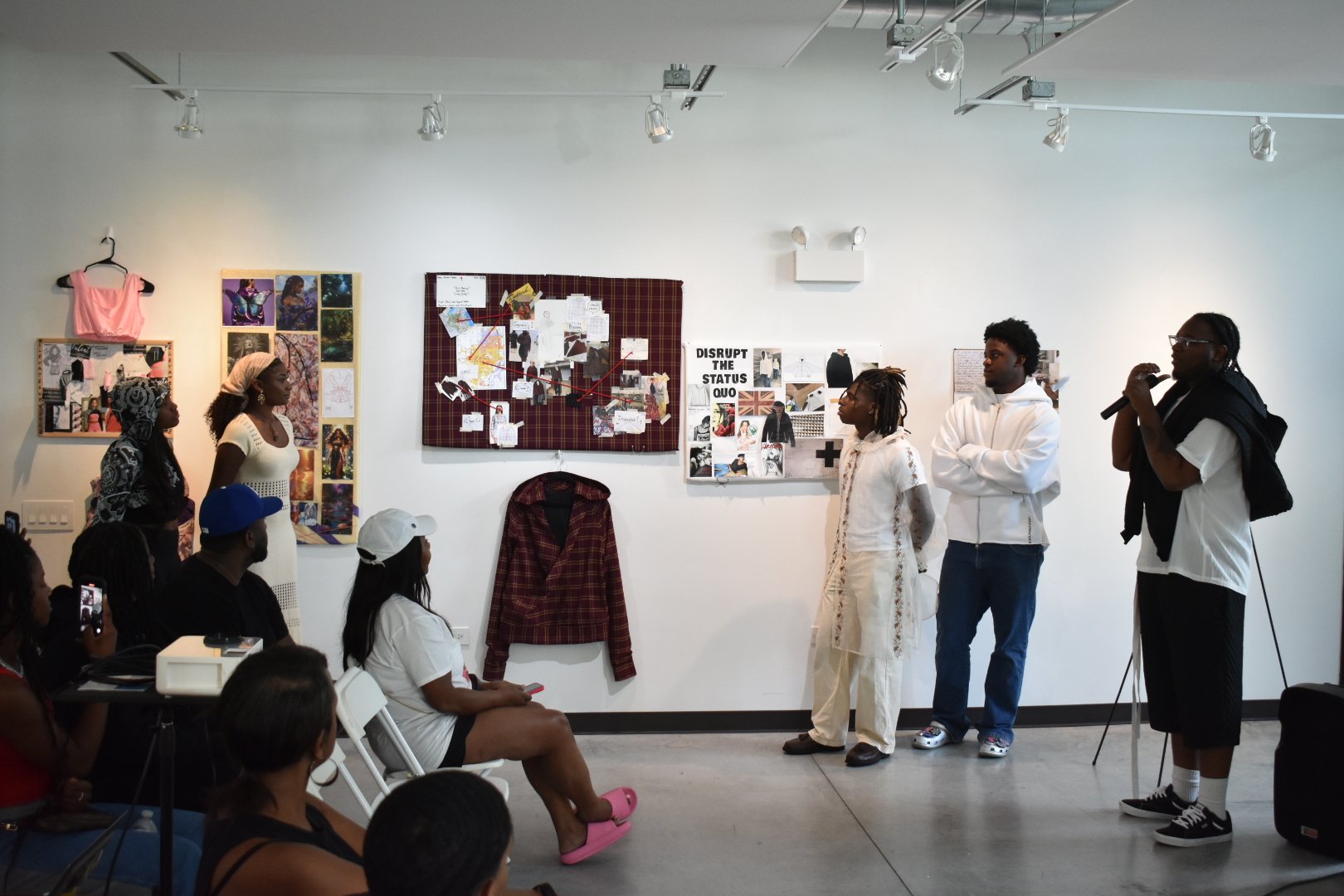
Kayla Perkins (far left, black-and-white hoodie) joins other young designers at Cre8 Space for a showcase of their designs and sketches on Saturday, August 23, 2025. (Kaelah Serrano/for City Bureau).
A Childhood Dream Turned Vision
Perkins’ love for fashion began in the simplest of ways: she would often sketch in the margins of her notebooks, doodling of outfits she imagined herself or her friends wearing, but it didn’t stay on paper for long.
That same year, she entered and won a children’s design contest with Angela King Designs, a Texas-based company specializing in cheerleading, dance, and stage performance wear. As a junior designer, Perkins sketched three designs for her own dance costume. Staff at the company selected her white-and-pink design with metallic purple accents, produced it and sent it to her in Chicago. The experience was life-changing.
“I got to wear my own design and see it come to life,” she said. “From that moment, that's how I knew I really loved fashion design.”
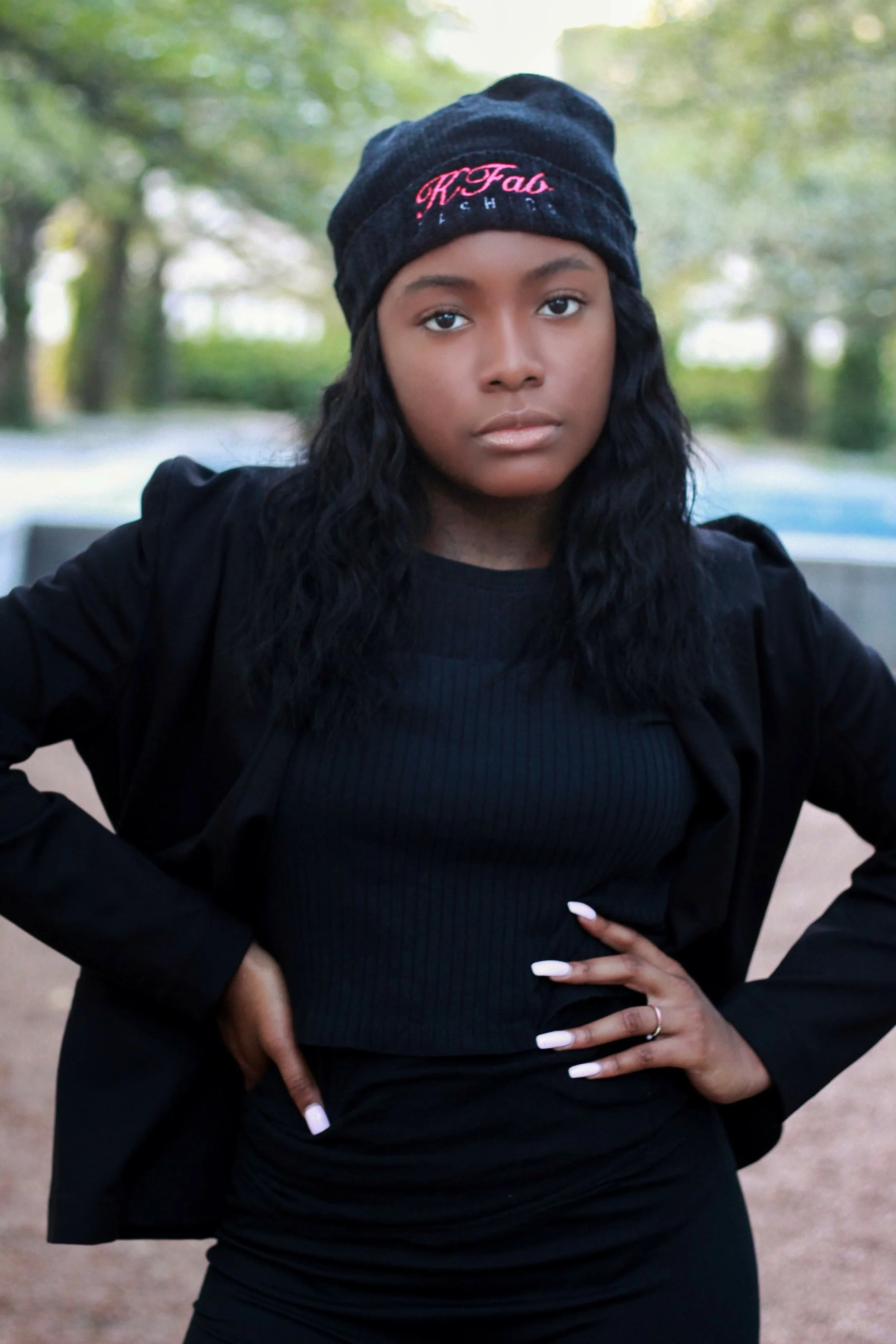
Kayla Perkins models for her own online brand, KFabs Fashion. (Provided/Kayla Perkins)
She enrolled in a youth program at the School of the Art Institute of Chicago when she was 10, learning basic sewing and producing her first garments. The next year came the launch of Kfab Fashions, meaning “Kayla is Fabulous.” At first, it was just t-shirts and small accessories, things she could make with a child’s allowance and the occasional parental contribution. Her early designs reflected boldness and color, pieces meant to stand out in the crowd, she said.
Because of CRE8 Space, Perkins' role stretches far beyond a traditional internship. The South Side fashion hub is a training program and vocational school that gives young designers a chance to learn every part of the industry under one roof. This means she’s not just sewing samples or shadowing instructors, she’s sitting in on branding talks, watching marketing plans take shape, and seeing how small labels build an audience from the ground up.
“Where I get a lot of the real behind-the-scenes of mass production, of garment construction, cut and sew; really getting that full feel of what it's like being in the fashion industry at a fast pace and learning those different processes.”
Her artistic inspirations come from Black culture, particularly ’90s and early 2000s hip-hop. Perkins wants her work to merge her passion for dancewear with her love for streetwear. She currently sells her work online and through community pop-ups, often modeling the pieces herself. She hopes her work will help other young people feel the affirmation she gets from fashion and creativity.
“My legacy would be to teach youth, let them know that they do matter, that they are seen, that they're beautiful, that they can do anything that they want to do as long as they have that drive, that perseverance, and keeping faith in God that everything is going to work out in their favor — but most importantly, staying true to themselves,” she said. “If you can't stay true to yourself, then no one is going to believe in you, no one's going to invest in you. So it really starts with believing in yourself to get to where you want to be.”
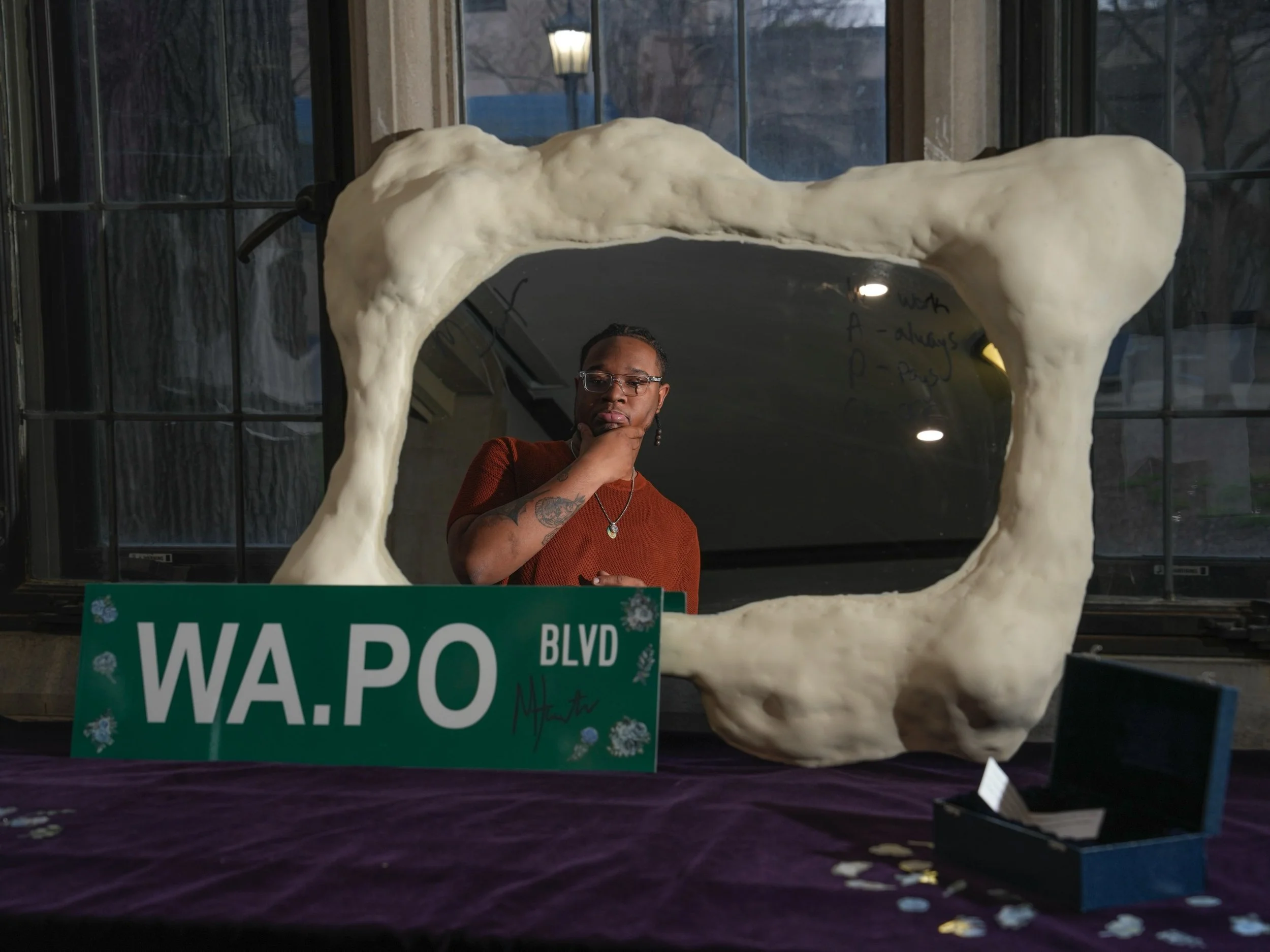
Michael Hunter launched his fashion brand WA.PO. (Work Always Pays Off), giving casual with a ’90s flair. Starting design work as a kid, he learned more technical skills at Dominican University, where he was also introduced to Cre8 Space. (Provided/Michael Hunter)
Finding Brand Through Pain, Passion, and Sacrifice
Michael Hunter’s relationship with fashion emerged from pain and persistence. In a cramped apartment studio filled with denim scraps, hoodie prototypes, and a beaten-up secondhand sewing machine, the 24-year-old is building his brand WA.PO — Work Always Pays Off. The period in the name represents the time between the work and the payoff.
Hunter grew up in Rockford, Illinois, where his mother worked as a fashion merchandiser and manager at JCPenney. Like Perkins, he started his creative ventures when he was in grade school.
He endured severe bullying as one of the few Black kids in both elementary and middle school. Confiding in his father, he urged the younger Perkins to “put my pain to my passion.”
“I loved creating graphics, and I loved creating pictures and putting pictures together and putting those on clothes. I knew I wanted [to do] fashion when I got older,” he said.
In 2022, when Hunter arrived at Dominican University in River Forest, Illinois, he was introduced to CRE8 Space. It was his first exposure to sewing, pattern cutting, and working with fabric on a larger scale.
CRE8 Space runs seasonal cohorts for aspiring designers. Students learn everything from garment construction to business planning, marketing, and content creation. They gain access to mentors, studio space, and the chance to present their collections.
“They taught us how to craft a business, business, a business plan, and how to create our own graphics logos.”
Hunter joined his first cohort in October 2024, where he learned how to craft a business plan, and create graphics and logos. He also connected with CRE8 founder Dondre Smith and his mentor, Miss Jones.
“They all make me feel like I belong, that my voice has a place there,” Hunter said. “[Miss Jones] embraced all of my ideas. She's tough on me, but that's for a purpose.”
His style is casual with a ’90s flair. He takes his inspiration from the decade’s baggy clothes and flannels, while denim elements are inspired by Hunter’s upbringing. His retail shop is offline, but his 2025 collections included denim pieces, a Naruto-inspired cloak, button-ups and a hand-painted jacket. He teased a new collection in 2026 on his Instagram.
Hunter’s journey into the world of fashion hasn’t been glamorous. He has worked as an Uber driver, using nearly every dollar he earned to bankroll his brand.
“I had a photo shoot two years ago … I piled all my money into that photo shoot because I was trying to get my camera so I can take the pictures. So all my money went into that,” Hunter said. “I think for about two or three weeks [after], I couldn't really get groceries.”
The process of finding resources to grow their businesses can be “grueling,” Hunter said, adding that entrepreneurs like him “aren’t always taught” about what support might be available to help them.
For Hunter, the toughest part of building his brand has been learning to stand out in an oversaturated field where “everyone has a brand” and the competition is relentless. The challenge, he says, isn’t just finding the hours or the resources — it’s carving out a distinctive voice, and proving why his label deserves to hold its own despite a crowded landscape of emerging designers.
“There's a lot of competition out there. The biggest thing is really trying to carve out my voice and carve out my brand, and why my brand should stand tall too amongst all of the competition,” Hunter said. “The impact that I want WA.PO [to have is] to be a helping hand and a voice for people who don’t have the confidence to speak.”
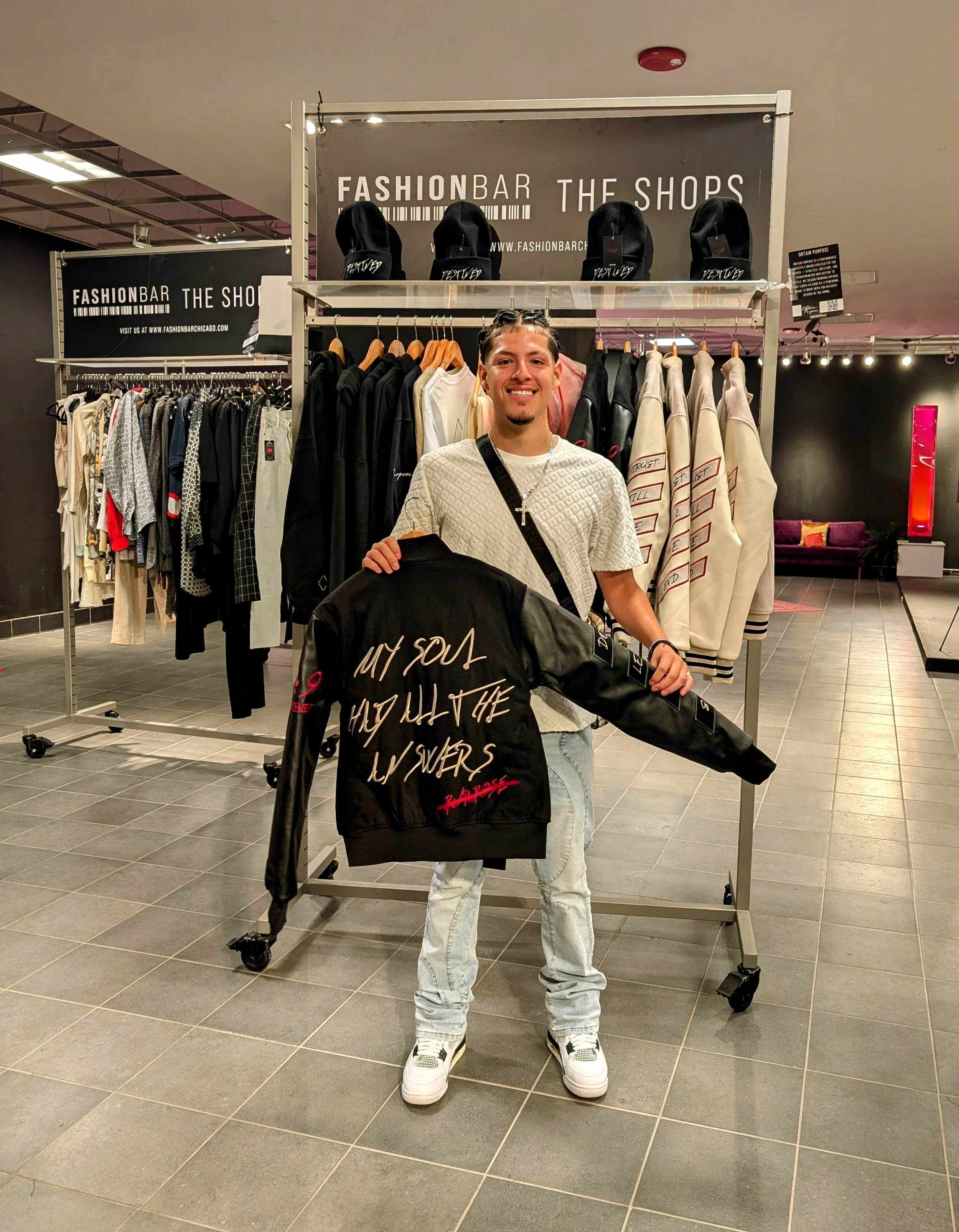
Joseph Duarte stands in front of items from his clothing brand, Obtain Purpose, at FashionBar Chicago on Thursday, July 10th, 2025. Duarte launched the collection with his brothers, and sells varsity jackets, t-shirts, and hoodies. (Robyn Meurkson/for City Bureau)
Turning a Purpose Into a Brand
For 20-year-old Joseph Duarte, fashion is inseparable from family.
Duarte co-owns Obtain Purpose with his older brother Anthony Duarte. The Duarte brothers grew up as athletes, always pushing themselves and others to chase their dreams and goals.
“I feel like that’s what life is all about: obtaining your purpose,” Duarte said.
Growing up in Little Village and suburban Romeoville, Duarte was a junior in high school when he and his brother made their first item: a simple white tee with their Obtained Purpose logo pressed on using a cricut machine and skinny black vinyl.
“My friends were like, ‘I like the name; let me get one,’” Duarte said. “And we made a collection with it, different colorways, and we sold them.”
Like Hunter, the Duartes funded their brand out of pocket when they started. When they produce new designs, they order products in bulk, which creates the financial pressure to sell all of those items or take a loss.
Duarte works independently as a photographer, videographer, social media manager, and content creator, gaining both visibility and mentorship through his projects. He’s also involved with FashionBar Chicago, which supports designers by organizing runway shows, workshops, and fashion programming throughout Chicago.
“I didn’t just wait for opportunities,” Duarte said. “I looked up local pop-ups, paid for a table, and put myself out there. That’s how I found FashionBar.”
“The city has resources if you look for them. But more than that, you have to be your own resource. Your mind, your ambition that’s what gets you here,” he added.
The Duarte brothers plan to evolve Obtain Purpose into a performance lifestyle brand by sponsoring athletes, producing digital content, and expanding into community partnerships. They also want to keep prices affordable.
His advice for other young designers?
“If you don’t know something, Google it. Watch a YouTube tutorial. Ask the person next to you,” he said. “There’s always something to learn if you’re willing.”
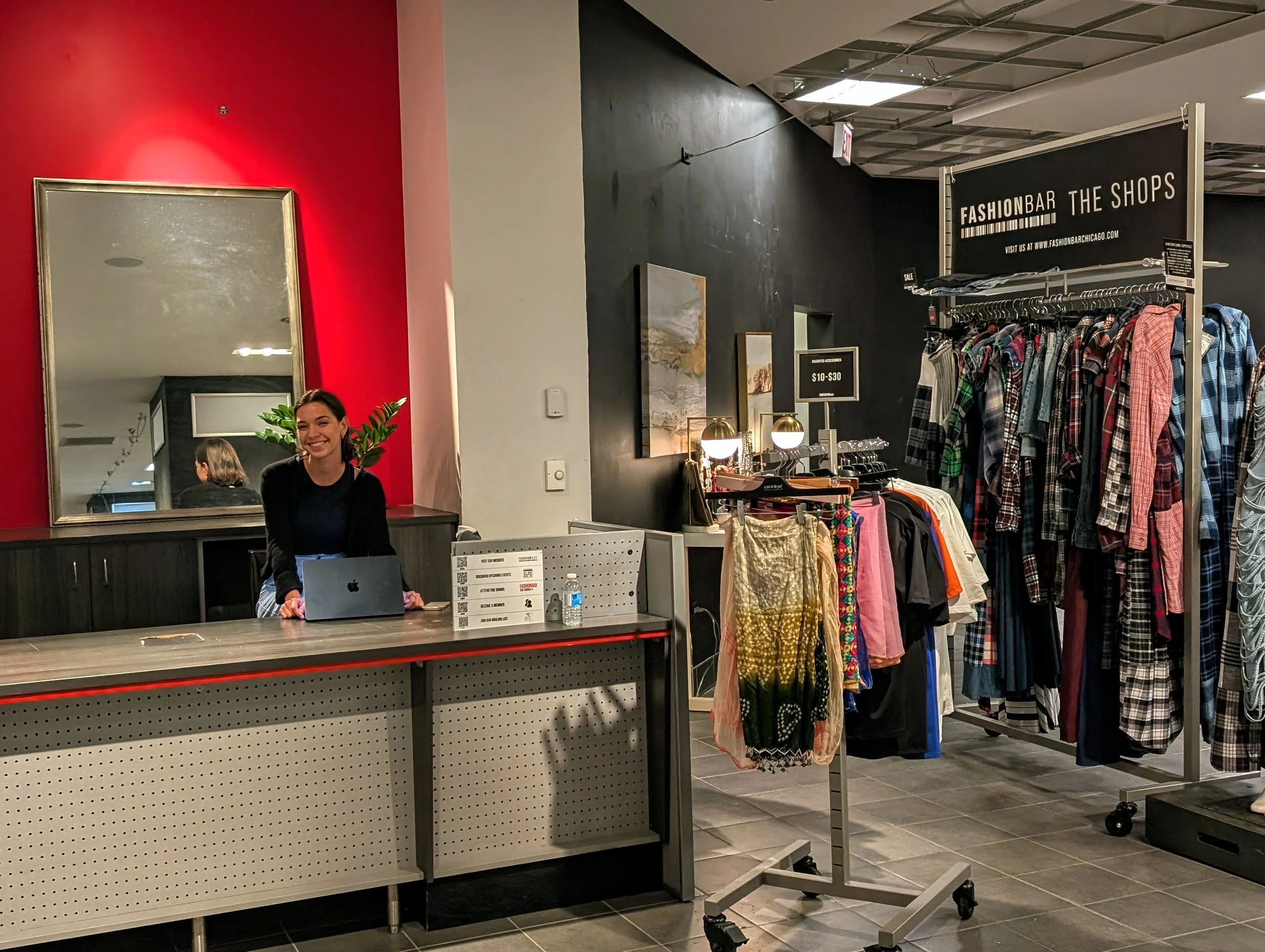
Sam Udoni works the front desk at FashionBar Chicago. The 16,000-square-foot studio in the Loop functions both as a fashion workspace and a consulting hub, while also serving as a pop-up venue for emerging designers and models. (Robyn Meurkson/for City Bureau)
‘We are the future of fashion’
Individual determination fuels young designers, helped along by organizations such as CRE8 space and FashionBar Chicago.
FashionBar’s 16,000-square-foot studio in the Loop functions both as a fashion workspace and a consulting hub, while also serving as a pop-up venue for emerging designers and models. CEO Tony Long and his team regularly bring in CPS students as young as eight to tour the space, introducing them to branding, photoshoots, website development, and potential business opportunities.
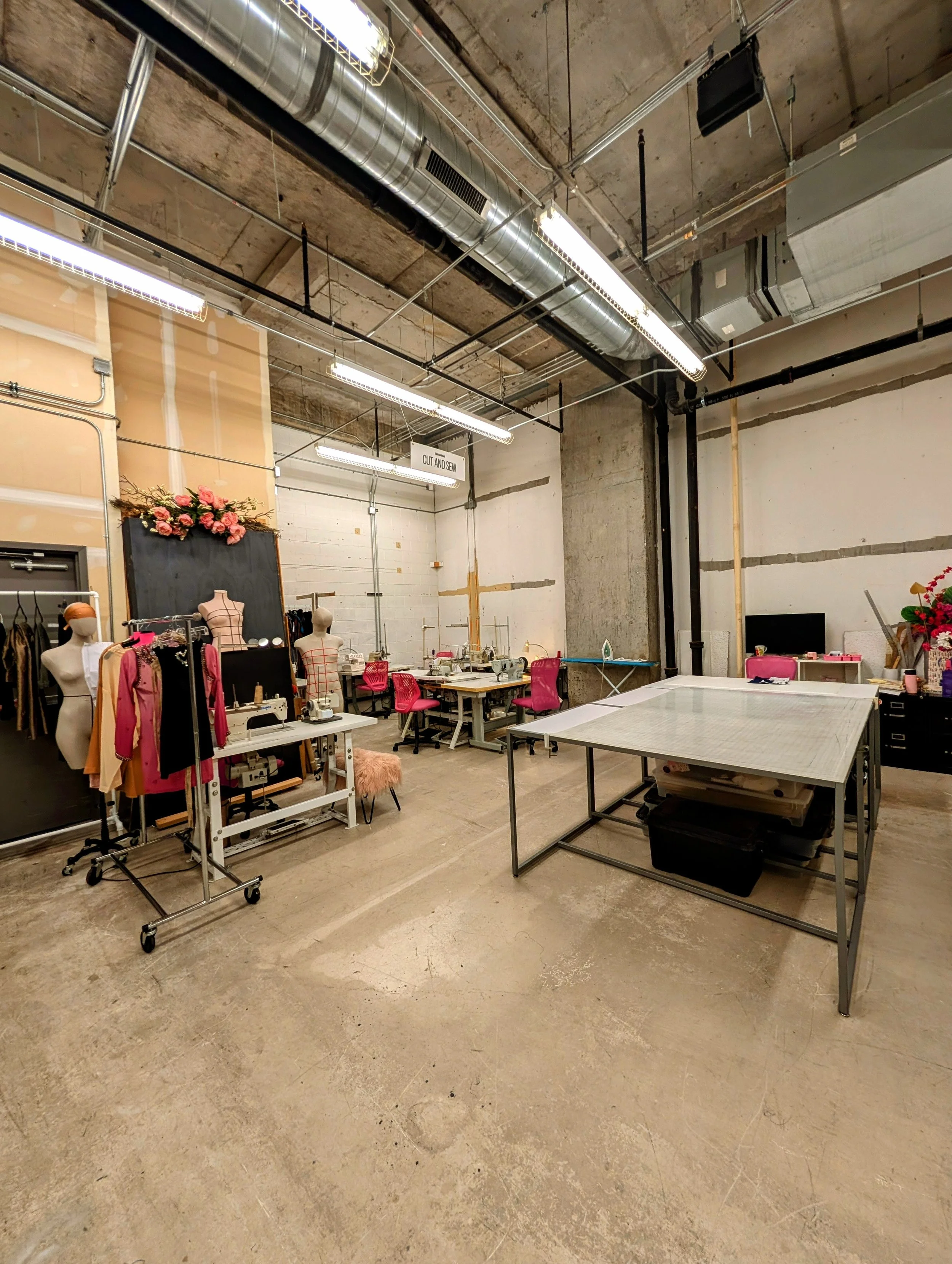
Inside FashionBar Chicago’s cut-and-sew studio on Thursday, July 10th, 2025. (Robyn Meurkson/for City Bureau)
“Chicago is pretty diverse, Chicago is pretty culturally driven, and Chicago is very inclusive. Long said. “Our goal is to make sure that Black and Brown, trans, and non-binary people have access to the same services that someone else that a non-minority can access.”
Sharaun Brown, founder of Model Tribe, a Chicago modeling school with an emphasis on self esteem and personal wellness, and a member of the Fashion Alliance Board along with FashionBar, said this kind of development helps ensure young entrepreneurs can fully benefit from their work.
“So many times individuals are cut out of opportunities, while their creativity is being colonized and repackaged elsewhere,” Brown said. “That’s why diversity, equity, and inclusion are so important. They help communities profit from their own creativity, rather than watching others profit off of it.”
From sewing machines in basements to pop-up shops in Loop storefronts, Perkins, Duarte and Hunter are using the tools, support, space and fellowship they’ve got to achieve their visions.
“We are the future of fashion, we are the future of so many things in the innovative and creative atmosphere. And that shouldn't be silenced, it shouldn't be stripped away from us, it shouldn't be censored. We should have a space, or multiple spaces, that we can thrive and really perfect our craft and celebrate instead of [competing] against one another, and celebrate everyone in their creativity and individuality because that's how you grow as not just a community, but as individuals,” Perkins said.
Robyn Meurkson is a freelance reporter. She has written for Growing Community Media and Blacktivity News, and has been a Documenter at City Bureau since 2022, contributing to City Bureau DNC coverage. She was a Civic Reporting fellow in spring 2025.
Support City Bureau’s Civic Reporting fellowship by becoming a recurring donor, and check out more of our fellows’ work.