City Bureau teamed up with ranked choice voting proponents for a night of pizza and discussion over how Illinois could alter its voting method.
By Abena Bediako
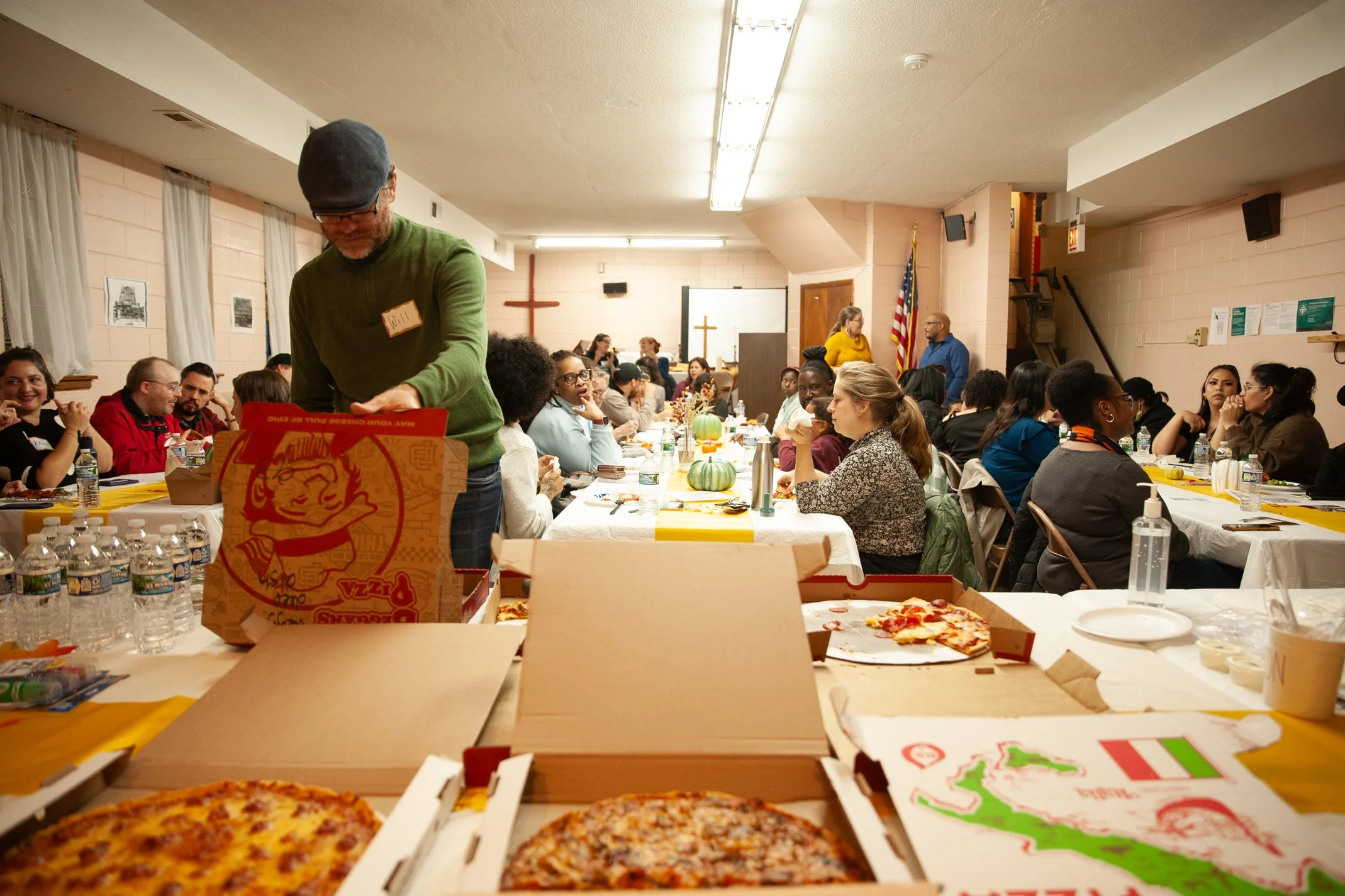
City Bureau’s Documenters Summit concluded with the Great Chicago Pizza Election, where attendees ranked their favorite pizzas and learned about ranked-choice voting at Hartzell Memorial United Methodist Church in Chicago’s Bronzeville neighborhood on Wednesday, Oct. 22, 2025. (Davon Clark/for City Bureau)
There are many arguments Chicagoans have when it comes to some of its most popular elements — and perhaps one of its most controversial is which pizza reigns supreme.
The breadth of great options and styles across the city makes it nearly impossible to land on one definitive choice. There’s deep-dish and tavern-style, myriad toppings, not to mention the eclectic twists to the classic recipe of crust, cheese, and sauce.
But what if Chicagoans had the opportunity to vote for the best pizza in an election?
City Bureau joined with Reform for Illinois and Common Cause Illinois to offer Chicagoans a chance to cast their ballots for the city’s greatest pizza, while also learning how a different method of voting — by ranked-choice ballots — could be a way to energize voters and improve upon the status quo. The Oct. 22 event took place at the conclusion of City Bureau’s 2025 Documenters Summit and attracted Chicagoans and visiting Documenters alike.
The Breakdown
In the basement of Bronzeville’s Hartzell Memorial United Methodist Church, 3330 S. King Drive, participants stroll in, and the scent of Italian spices immediately hits their noses.
More than 30 Chicagoans sit among three tables festooned in autumnal decor. The faded pink brink, brass chandeliers, and crosses sprinkled across the room create the perfect ambiance for fellowship — exactly what a church was designed to do.
Near the kitchen, boxes are laid out from five of the city’s top pizzerias: Beggars, Italian Fiesta, Lou Malnatis, Novel Pizza, and Gino’s East, nominated by attendees. There’s a range of veggie toppings, sausage, pepperoni, and of course, standard cheese. Once everyone has grabbed a few slices for a taste test, the main event begins.
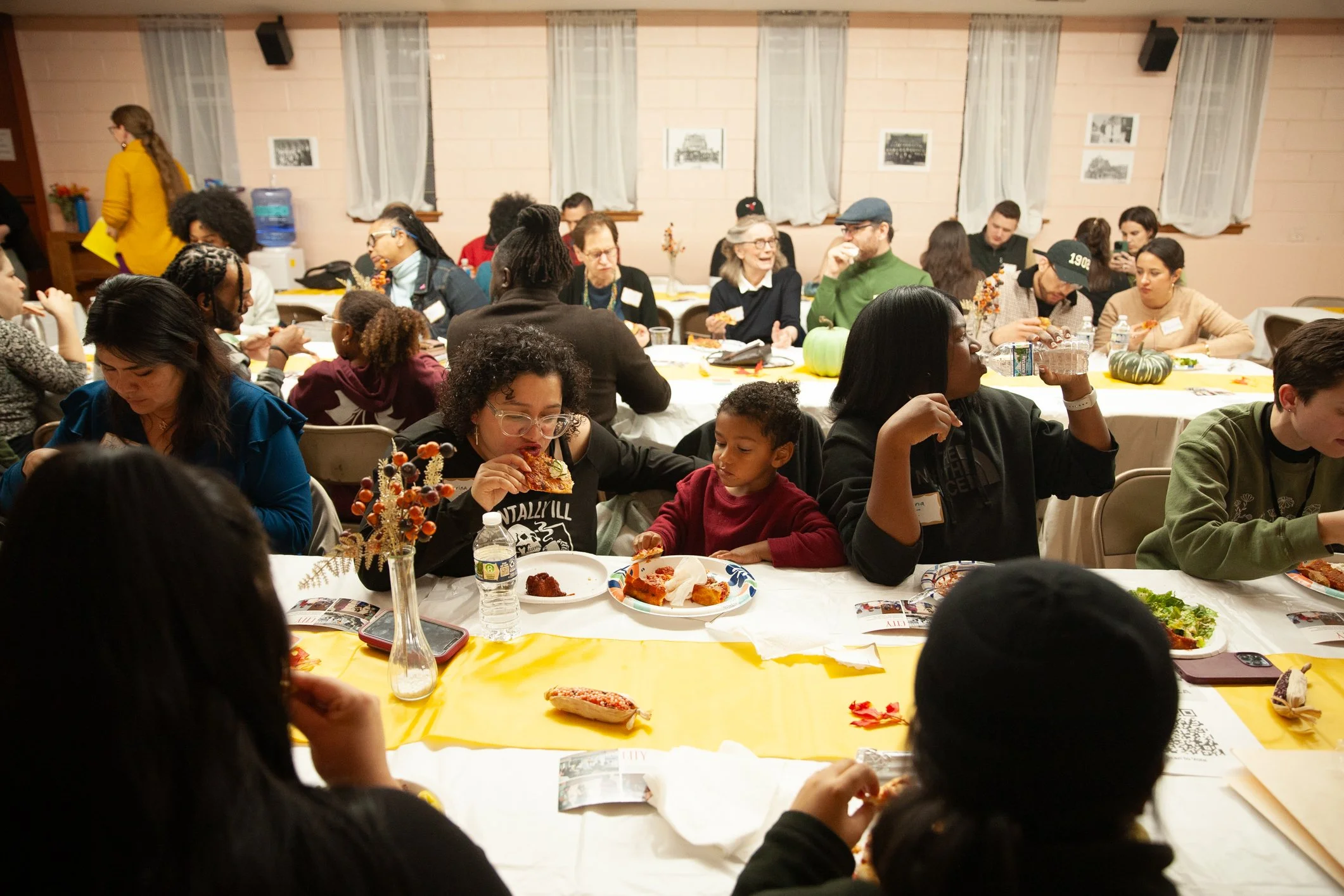
Great Chicago Pizza Election attendees eat pizza and converse in the basement of the Hartzell Memorial United Methodist Church in Chicago’s Bronzeville neighborhood on Wednesday, Oct. 22, 2025. (Davon Clark/for City Bureau)
Three panelists take the stage to break down ranked choice voting and what it would look like in an Illinois election cycle.
“Ranked choice voting is where, instead of just taking whoever gets the highest number of votes, we’re actually going to look at people’s second choice, third choice, maybe even fourth choice, so that we’re getting a little bit more of a consensus candidate,” said Elizabeth Grossman, executive director of Common Cause Illinois.
Grossman explained the audience might have a favorite pizza, but that doesn’t mean they’re ambivalent about the others. Rank choice voting allows those other preferences to be taken into account after a voter’s first choice is ruled out. As candidates with the fewest votes are eliminated from the race, those voters’ second or third choices become votes for the remaining candidates.
Ranked choice voting has been gaining traction across the United States over the past decade, although the concept first surfaced long before that. Maine and Alaska use ranked voting in statewide elections, and a handful of cities have adopted the format as well — including New York City. The Big Apple’s contentious mayoral primaries in June led to the eventual election of Zohran Mamdani this fall.
In Illinois, Evanston residents voted overwhelmingly in 2022 to implement ranked choice voting, but the suburb has since been entrenched in legal gridlock with the Cook County Clerk’s Office over whether it requires a change in state law to implement. Skokie, Oak Park, Naperville, Berwyn, and Peoria have also either approved or had calls for a vote on the alternative method, according to a January article from the Chicago Tribune.
But not everyone is sold on the concept.
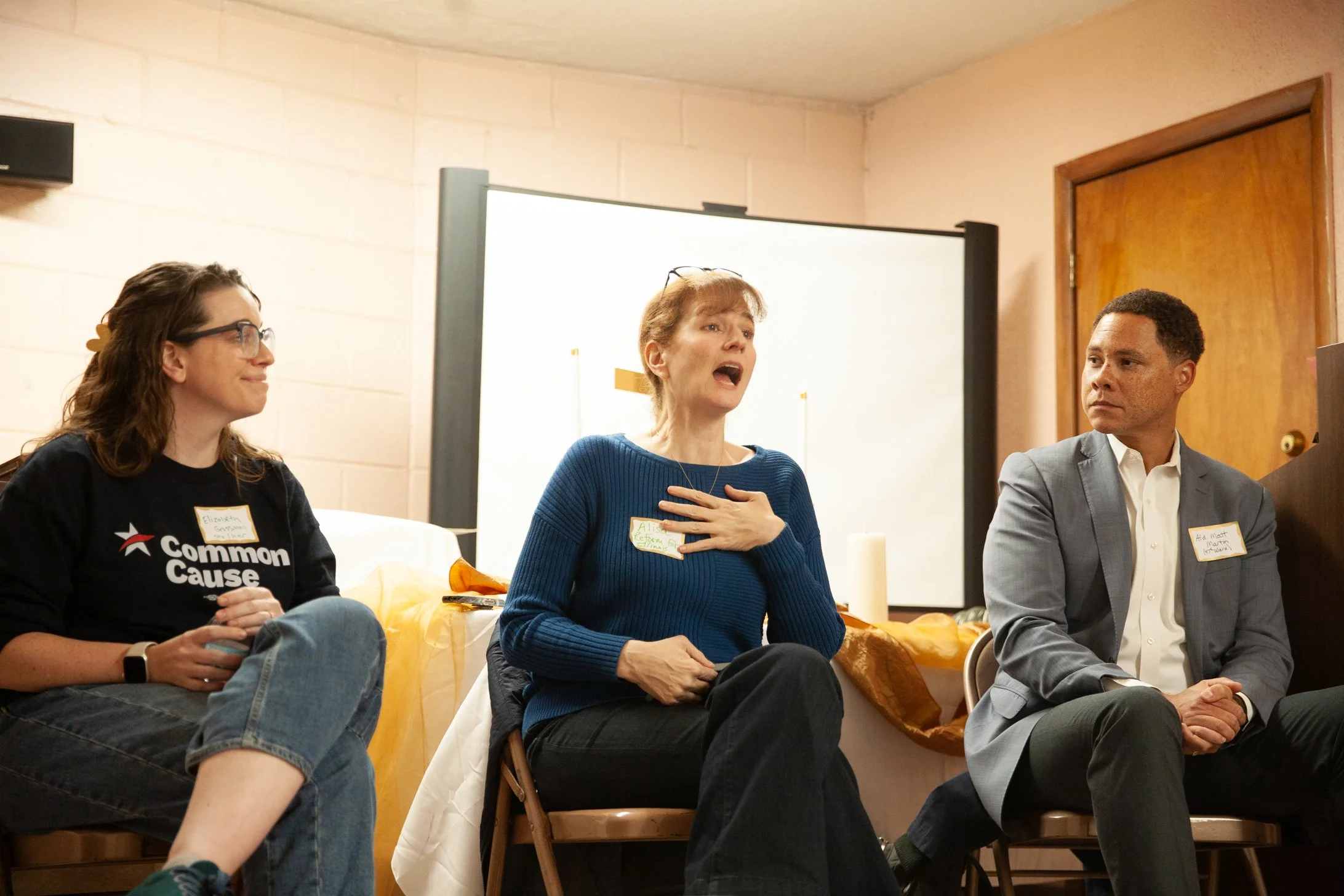
(From left): Elizabeth Grossman, Alisa Kaplan and Ald. Matt Martin (47th Ward) spoke during the Great Chicago Pizza Election to discuss ranked choice voting and support for the alternative voting system in Illinois. (Davon Clark/for City Bureau)
“A lot of people are comfortable with the status quo. They’ve come through a system that they’ve become comfortable with, and [for] many of them running for office, it’s not their first or second time, and they have an incumbency advantage,” said Ald. Matt Martin (47th).
Martin, a second-term alderman whose ward encompasses all or parts of Lincoln Square, Lakeview, Uptown, and North Center, has been a proponent of ranked choice voting for years. In 2023, he introduced an ordinance calling on the City Council to look into the change for Chicago elections.
Political parties backing one candidate might prefer to retain existing voting systems where a pool of opponents would split the vote and allow the establishment candidate to win with the largest single portion of votes, said Alisa Kaplan, executive director of Reform for Illinois, a nonprofit research organization that advocates for more transparency and accountability in government.
With ranked choice voting, voters don’t have to hedge their bets on a candidate they think is most likely to win — they can rank their favorite candidate first, even if it’s a long shot, and still support their secondary choices, as well, she said.
“The establishment can take advantage by splitting the vote,” Kaplan said. “Rank choice voting upends the whole system, and they lose control.”
The Sales Pitch
Once advocates had outlined their reasons for supporting ranked voting, it was time for attendees to vote in the Great Chicago Pizza Election. Spokespeople for each pizzeria took to the stage to explain why their pizza was the best.
Each spokesperson came with heavy facts. It became clear that describing the history of each establishment, as well as its relationship to Chicagoans' taste buds, played a major role.
The representative for Gino’s East provided an anecdote describing her family’s love for the popular pie and how it encouraged them to travel by two buses just to bring home a box. Everyone on the bus, she said, would beg her mother for a slice.
Novel Pizza backer Brenda Soloro, meanwhile, came with a persuasive and impassioned argument that may have helped tip the scales.
“They serve traditional new innovative styles inspired by immigrants … while building community, showcasing culture, and celebrating the city’s creative energy,” she said.
The Vote
In the end, Novel Pizza won. Participants used Rankedvote.co to cast their ballots. Beggars Pizza ran a consistent race, but was eliminated in the penultimate round. Novel Pizza won with 24 votes, and Gino’s East closed out at second with 22.
“I’ve heard of ranked choice voting before, but I didn’t quite understand how it worked,” said participant Adrianna McGinley. “If it were ever on the ballot, I would probably vote for it.”
Ranked choice voting can be a complicated method to digest, but it went down smoothly with a few slices of pizza to show the way.
Abena Bediako is a Chicago-based journalist and 2024 alumna of City Bureau’s Civic Reporting Fellowship, where she covered immigrant labor issues. She was most recently a McCarter Fellow for WTTW and graduated from DePaul University.