Artist Zahra Baker came up in “a system of care” before the HIV/AIDS epidemic decimated communities. With health crises and cultural shifts disproportionately affecting Black, queer Chicagoans, Baker says forming lasting relationships is crucial now more than ever.
By Amari Davis
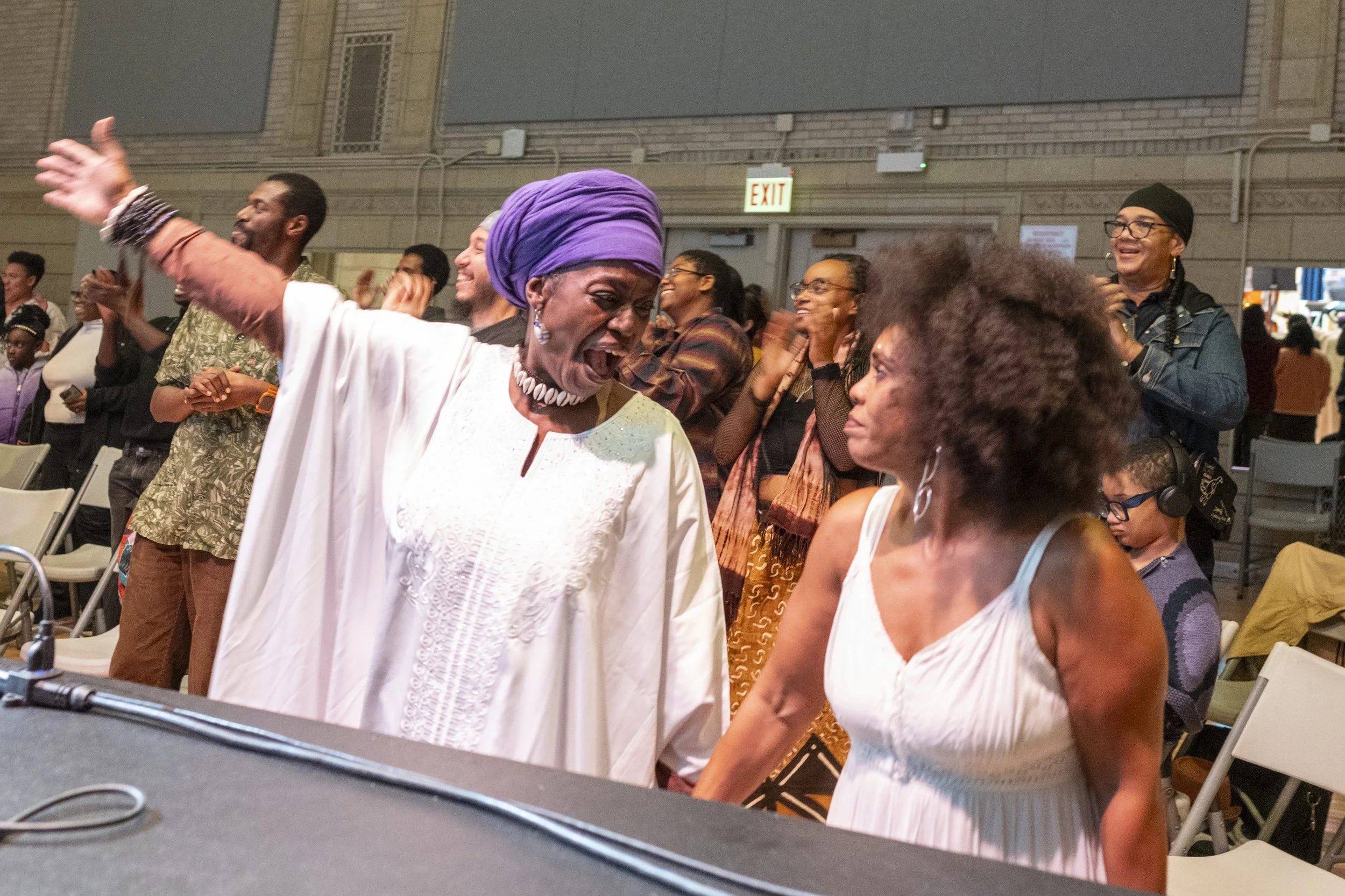
Zahra Baker (left) sings and celebrates during “This Black is Me” at Douglass Park in Chicago’s North Lawndale neighborhood on Nov. 7, 2025. The storytelling and musical event was in homage to Callie Guy House, a leader in the movement for reparations for formerly enslaved people. (Dylan Connell/for City Bureau).
Zahra Baker’s voice carries healing and reckoning. As a multidisciplinary artist, she fills every room with it by weaving warmth, remembrance and determination into the sonic echoes of her storytelling and traditional Black spirituals.
Born in Louisiana, Baker was separated from their six siblings and raised in Indiana with their uncle and aunt. As a young Black queer woman, they found community among fellow artists, peers and elders living in the same building. Then came the HIV/AIDS epidemic, a “fire” that tore through their community.
Baker has spent over 30 years as a teaching artist in Chicago, becoming a pillar in the arts community and a role model for queer youth. She has performed on stages from the Chicago Jazz Festival and Elastic Arts, to the National Black Storytelling Festival and World Music Festival.
Now 67, Baker wields their experiences and our collective histories as a balm to those they serve, in hopes of igniting a path to liberation for all.
This conversation has been condensed and edited for clarity.
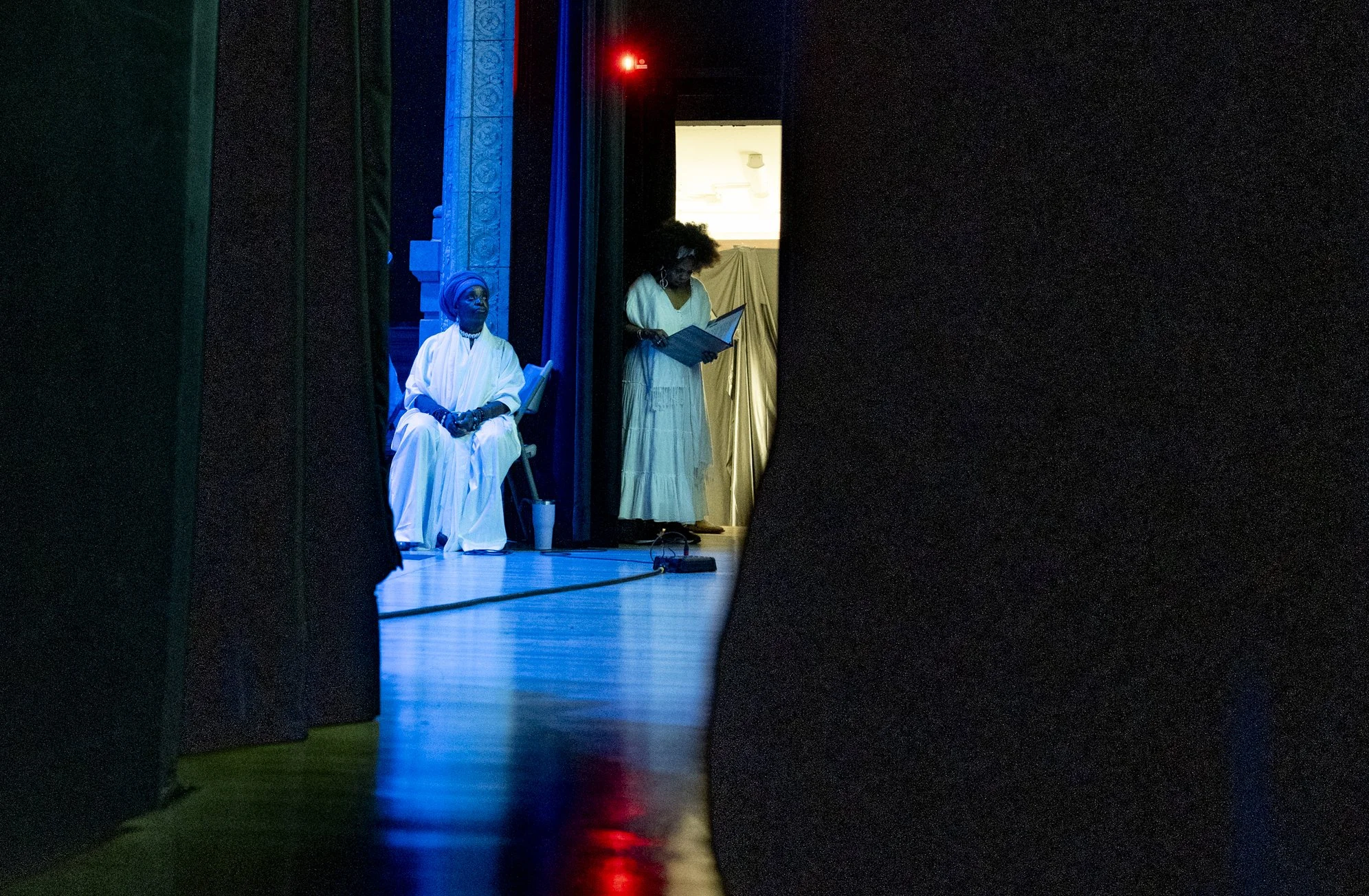
Baker (left) sits on the stage during a performance at “This Black is Me” on Nov. 7, 2025.. (Dylan Connell/for City Bureau).
What was life like for you as a young Black queer woman?
I lived in a Black queer building, basically an artist building in Indianapolis that was a mixture of seniors, women who had been former burlesque dancers and a lot of Black queer men. We lived in community with each other. We would support each other like, “Let’s put our money together and go buy a bulk of chicken; I’ve got some beans, you got some rice, why don’t we cook together and make a big pot and make sure that everybody has enough?”
They had this one couch that they would pass around, so anybody that came into the building and didn’t have furniture…inherited the couch. By the time I got it, it didn’t even have legs on it anymore. But I didn’t have any furniture, so I was grateful to have something. It was symbolic of a system of care, of community, of everybody looking out for each other and making sure that our basic needs were met. And even more than that, our communal needs.
How did the HIV/AIDS epidemic change that?
One night, there was a fire on the outside of the building. […] During that time, I was getting ready for an audition where I needed to know this particular tap dance.[A fellow dancer] decided he would teach it to me then in the parking lot while we were waiting. Then other dancers started coming in being like, “No, you need to know this part. No, it’s like this, pick your head up…” There were about 10 of us in this parking lot doing the time step. It was one of the most memorable moments for me.
I use that story as a metaphor, because shortly after that was when AIDS started happening. They were putting out this fire at the building, meanwhile, there was another “fire” that had started and was moving through the building. I lost a lot of friends during that time period, one by one. That grieving and that anxiety, I was also turning 25, all of that was making me reflect on what I wanted next in my own life. Part of that was making that leap in my artistic career, so I thought, “Let me go to Chicago and then maybe eventually I’ll head to New York.”
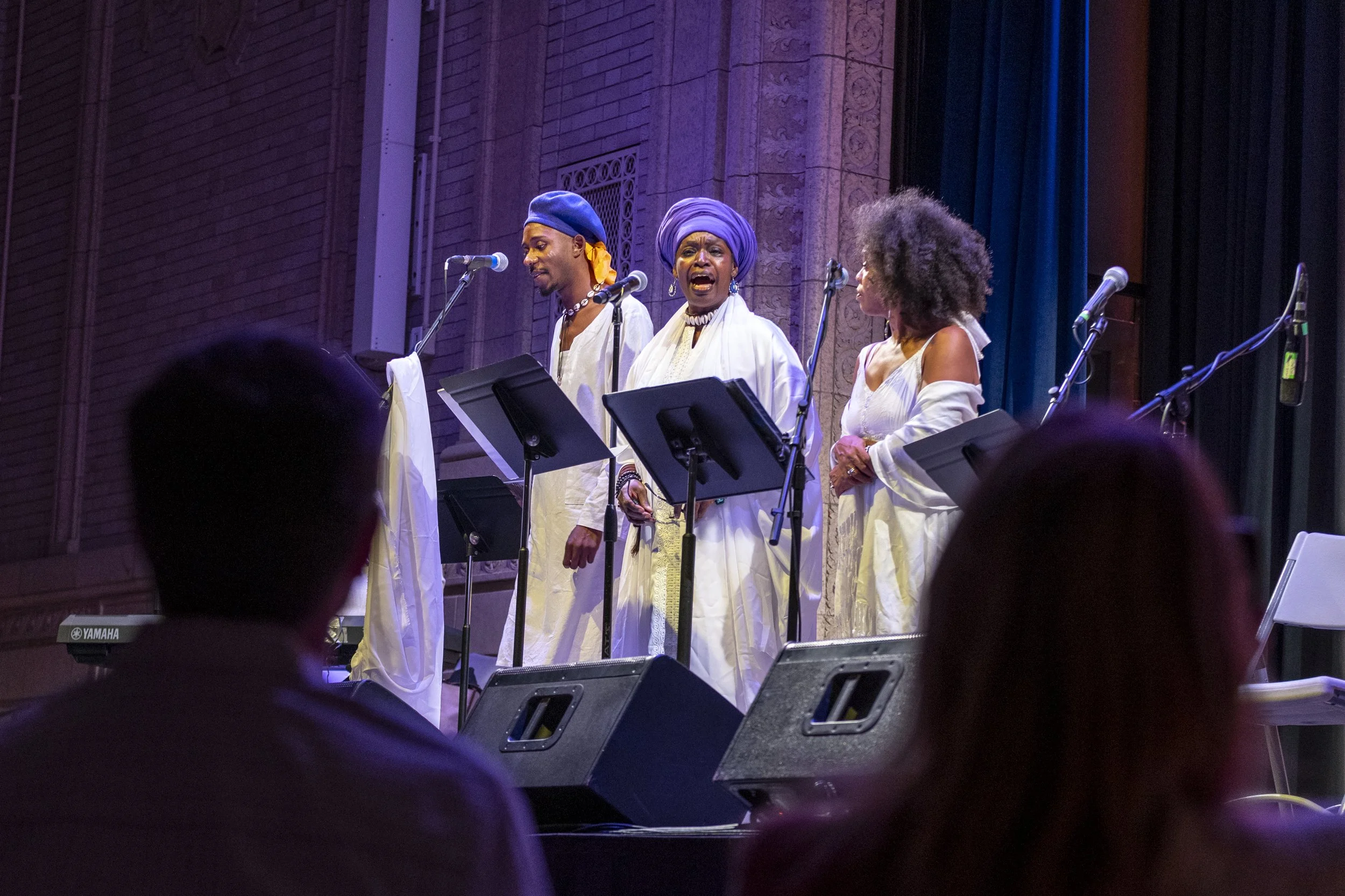
Baker (center) sings at the “This Black is Me” storytelling and musical event at Douglass Park on Nov. 7, 2025. (Dylan Connell/for City Bureau).
What was it like when you came to Chicago?
I had friends here who lived on the North Side who were encouraging me to move with the promise of support. I moved into Boystown around Belmont and Broadway, so I was right in the middle of the gay community.
I was going back and forth to Indianapolis, almost monthly, to funerals to bury people I had lived with in that building. We would have to sit in the back of the church because a lot of their families didn’t want to acknowledge their lifestyle. They were family to us, but we were put in the shadows a lot. … That whole period of loss and grief was really monumental.
Coming to Chicago, I was able to meet people who were activists that were doing work around making people more aware and encouraging people to get tested and trying to share accurate information about it. The end of the 1980s and 90s, I was involved in some way in HIV awareness.
Some felt that the larger organizations raising awareness around HIV/AIDS at the time were largely whitewashed. Would you agree?
Oh yeah. About Face Theatre youth actually did the story I just told you about; they took an excerpt of that and created a performance around it, which is really exciting. I am excited about that because I still feel like most of the stories connected to the loss [are]… not naming my friends. Not naming the Black people and how we were affected by it. I still feel like there are some missing stories.
The people I was working with were Black, so my perspective coming into it was always addressing the needs of Black people. Even though the larger picture may [not have] been inclusive, there have always been people committed to serving our communities.
What’s different or similar about organizing for Black queer communities today?
Some people are letter writers, some people are marchers, some are prayers, whatever it is. I’m not on the fronts anymore, but what I feel is that Black queer people right now are so much more clear than we were.
We also know our history, not only as Black people but as Black queer people, so it feels like there is so much more knowledge and wisdom that the younger generation is working with that is unapologetic. … Like, “I’m not gonna fight with you, these are statements of fact. These are my pronouns, this is how I like to be in the world and if you ain’t got time for that, then I ain’t got time for you.”
Our struggles felt very isolated in trying to be accepted in communities; I don’t feel that with the young people now. I feel like there is a sense of holding [a] safe space for each other in a way that keeps everybody feeling like they can be their authentic selves.
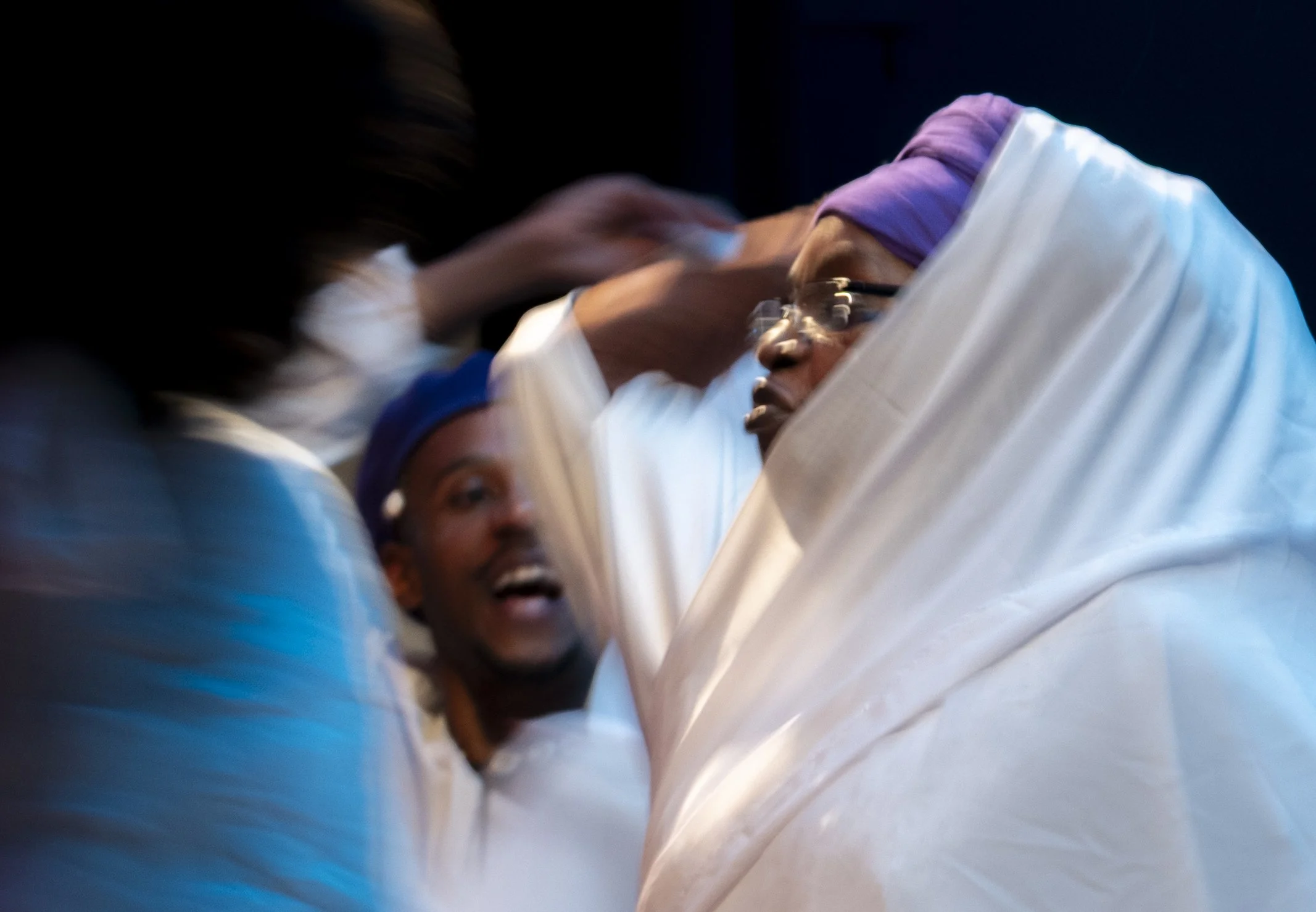
Baker (right) performs at “This Black is Me.” (Dylan Connell/for City Bureau).
What are some things you want to know about younger generations?
I’m curious about the ways young people find to support each other. Where do they find support? I know that there are a lot of struggles. No matter what age we are, we're dealing with emotional struggles, ways to stay connected, build community, increase our knowledge, and, straight up, financially, how to get the bills paid. My concern is, are your needs being met? Where are you getting the support that you need?
I was asking [my spouse] what being around young people does for her. She said it keeps her connected to different perspectives of the world; it keeps her wanting to live and learn more.
The more that we can see people who are going to live beyond us, [the more it] makes it feel like, “I want to live as long as I can. I want to see what happens to you. I want to know what your next stages are and if your visions are realized.”
What are your hopes for the Black queer youth in the future?
I think it circles back around to community care. The imbalance that’s being thrown at us … brings up feelings of rage, anger, fear and a sense of hopelessness. That’s countered with people who are determined to battle against it, so that rage turns into action being the first responders, whistle blowers [and] protectors, which is necessary. It can also lead to burnout, which can be detrimental to our being.
We need that balance of rest and [restoration] so we can continue to do the work. It is really important for us to keep holding onto each other, be there for each other, to keep reaching out. It keeps our hearts open, but it also lets others know they aren’t alone. All we’ve got is each other.
Amari Davis is a poet, writer, artist and educator. Growing up between Humboldt Park and Logan Square, they attended Lane Tech College Prep High School and the University of Houston. They also founded a Black Queer Writers collective in 2024 to create spaces for writers to cultivate their craft. They are part of the Civic Reporting Fellowship cohort for Fall 2025.