In December, City Bureau’s digital equity program dug deep into how Chicago organizations can help communities get the information they need.
By Abena Bediako
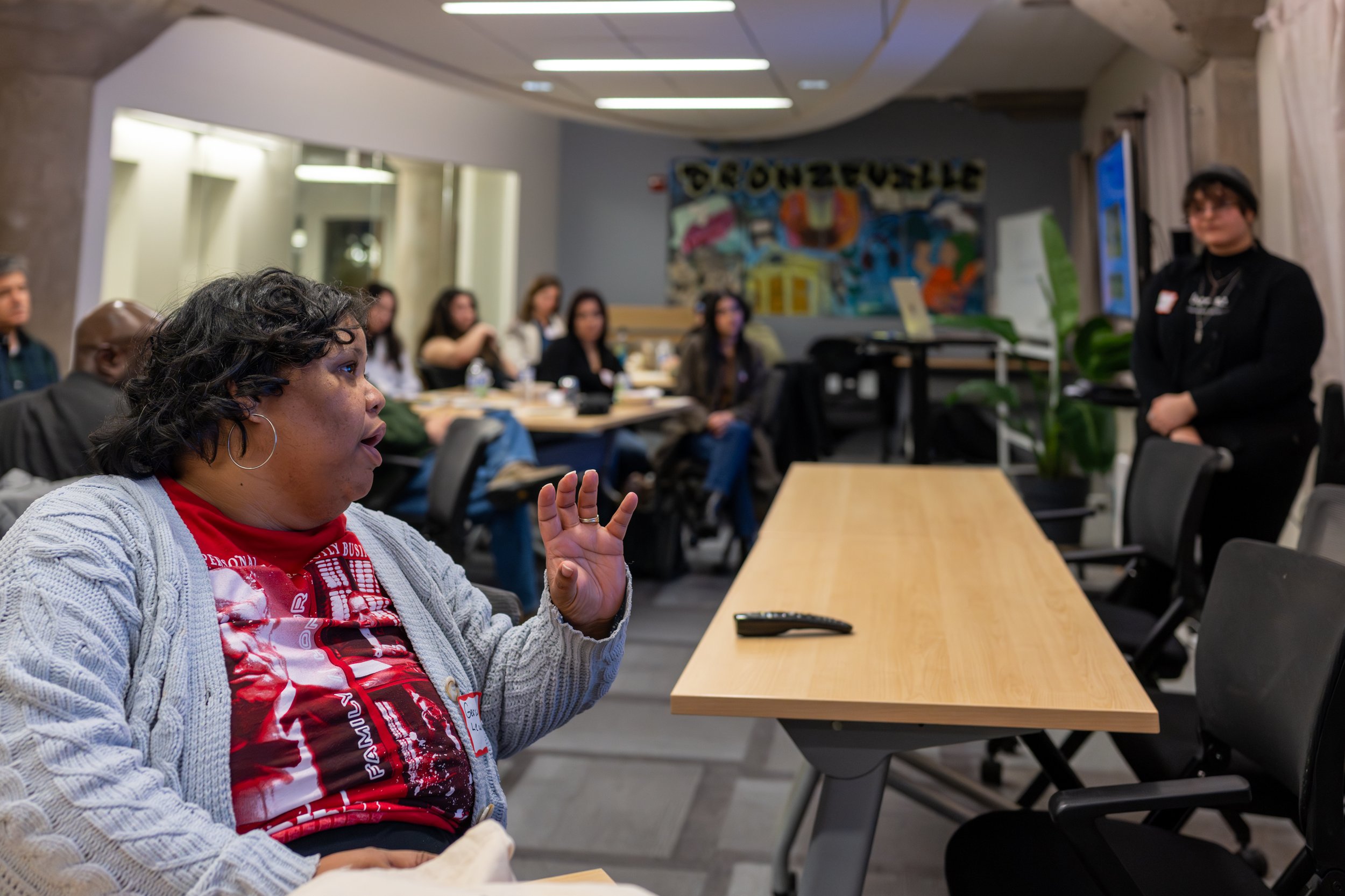
A participant in the Dec. 10 Public Newsroom discusses digital equity at City Bureau’s Bronzeville office. (Dylan Connell/City Bureau)
Editor’s note: December’s Public Newsroom was our first community event focused on digital equity since it became a focus area at City Bureau in 2025. IMPACT program grantees, Documenters, community members, and alumni from the Civic Reporting Fellowship all came together to explore how digital access, news, and civic life intersect. City Bureau’s programs work together to build toward the information system strong communities need, and this Public Newsroom showed what that can look like in action.
In a world that is increasingly online, 14 suburban Cook County organizations have spent the past year exploring solutions to ensure everyone has access to a virtual cornucopia of knowledge.
Their work has been part of City Bureau’s partnership with Cook County’s Digital Equity Initiative, which launched a second round of funding Dec. 12.
In December 2024, the IMPACT Small Grants Program provided more than $172,000 to these suburban organizations to explore new and emerging technology and access to it, along with digital skills training, workforce development and digital media literacy workshops.
The awardees and members of the public gathered at a Public Newsroom event Dec. 10 to discuss the results of their year of work — and what digital equity really looks like.
“Professionally, I want to better understand how digital literacy goes hand in hand with how communities are getting their health information,” said attendee Ishmael Mendoza, 25. “On an individual level, I’m also grappling with larger implications of tech industries in regards to capitalism and what that means.”
Tyra Bosnic, City Bureau’s senior manager of grants and public partnerships, began the discussion showcasing just how essential digital access has become over the years.
“It means we have real-time updates on what’s happening in our community,” Bosnic said. “Things like the Citizen app, even Reddit, have served that action for a lot of people.”
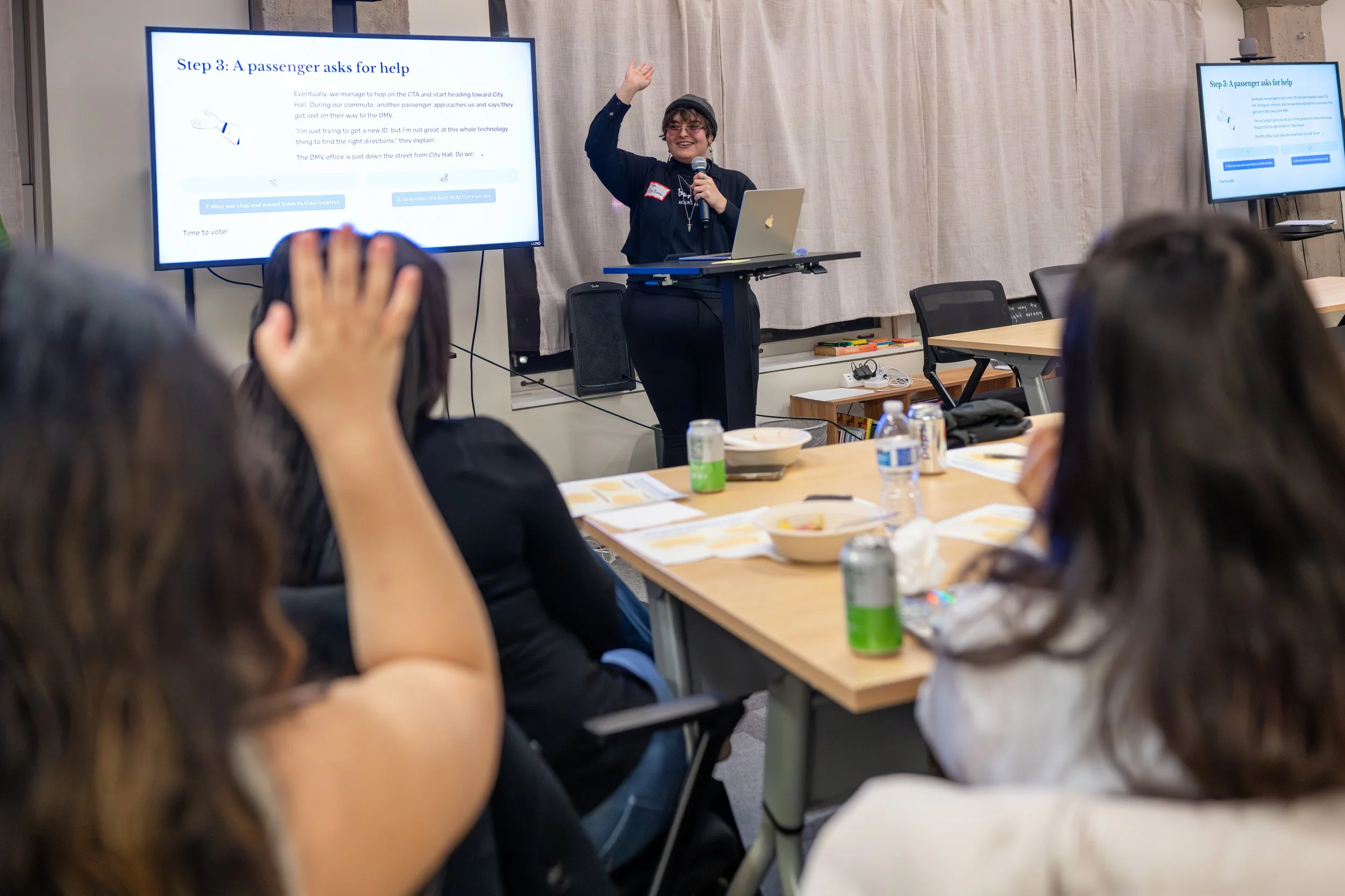
Tyra Bosnic, City Bureau’s senior manager of grants and public partnerships, asks for a show of hands during a discussion on digital equity during a Public Newsroom event at City Bureau’s Bronzeville office in Chicago on Dec. 10, 2025. (Dylan Connell/City Bureau)
Most people — eight in 10 Americans — get at least some of their news from a smartphone, computer or tablet, according to 2025 Pew Research Center data. Major newsrooms across the country are ceasing or reducing print production, meaning their coverage can only be accessed digitally. Public health and safety updates, and basic government information such as policy decisions and press conferences, are also shared online.
But a lack of access to digital information persists; low-income households that struggle to afford Internet access, rural communities with poor broadband infrastructure, older adults unfamiliar with navigating online resources, and people with disabilities are often cited as communities facing digital inequity and subsequent disconnection and isolation.
During the Public Newsroom, Bosnic depicted this challenge in a scenario where Chicagoans are going to City Hall to confront elected officials, but face obstacles along that way that can only be resolved with equitable access to the Internet and digital information.
The exercise showed that, even though individuals may be able to get online, poor transparency practices can still make civic information digitally inaccessible. Attendees saw examples of public bodies that lack a website, don’t livestream or record their meetings, or fail to update their websites with accurate meeting information.
After audience members workshopped solutions for the band of righteous citizens, the floor opened up to panelists — whose organizations were recipients of the first IMPACT program grants — to discuss their main concerns and potential workarounds for addressing the different issues of digital equity across demographics.
Melody Kim, civic engagement team lead for HANA Center, highlighted concerns in immigrant communities and the constant hurdles they face.
“They don’t have language access or skills to navigate these problems, especially the seniors,” Kim said. “They did not grow up having this education, and now they have to ask [for help] to navigate this in every part of their lives.”
The IMPACT program is supporting HANA Center’s culturally relevant workshops for Korean seniors and adults in the Northwest suburbs, focusing on essential digital skills, such as how to use a smartphone or computer. HANA Center is also working with ethnic media outlets to share updates and stories promoting their program.
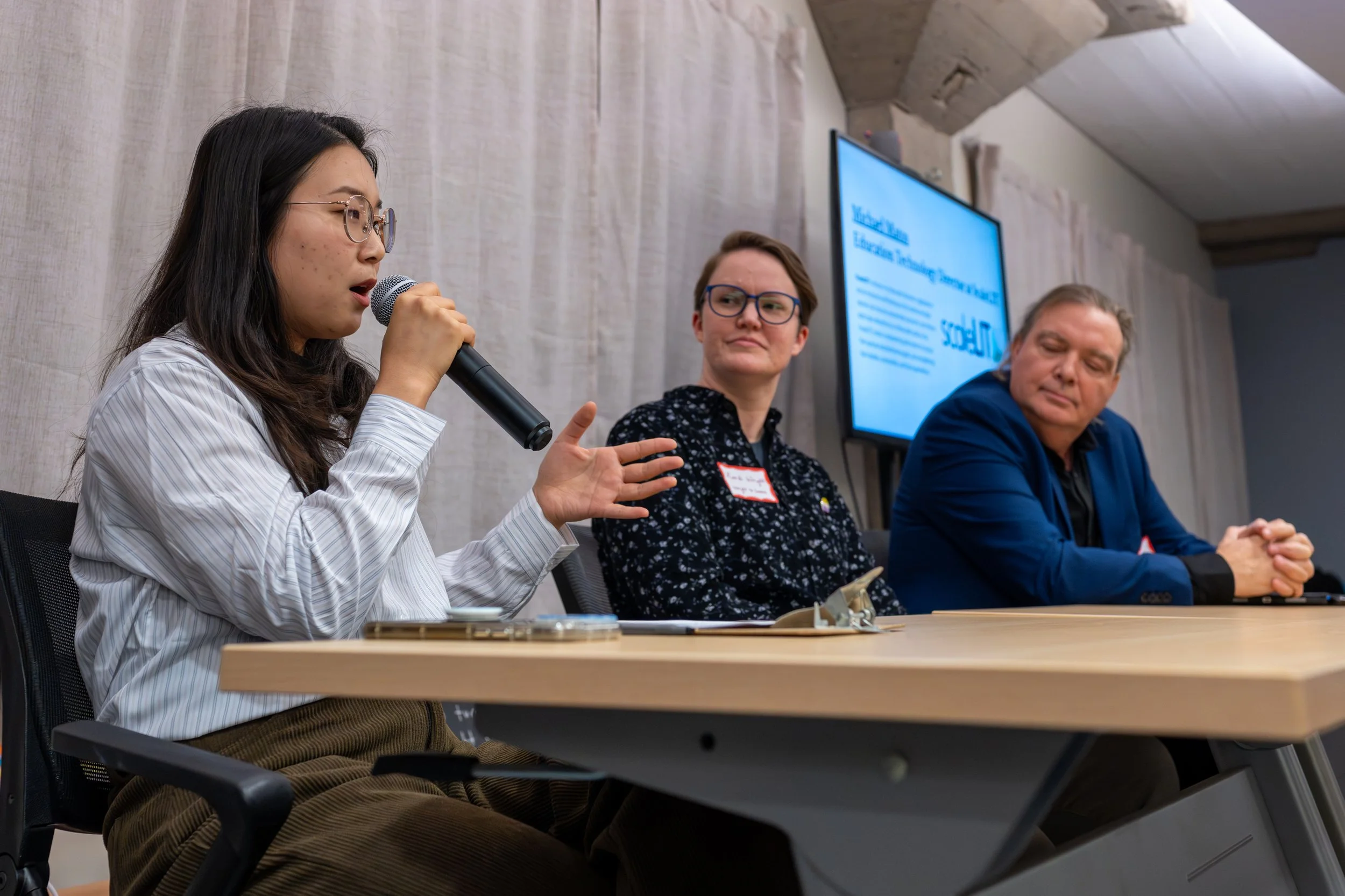
Melody Kim, civic engagement team lead for HANA Center, (left) discusses digital equity as a panelist along with Xandi Wright (center) and Michael Matos at City Bureau’s Public Newsroom event in its Bronzeville office in Chicago, Dec. 10, 2025. (Dylan Connell/City Bureau)
For young students, the ability to start off with access to computers fosters a more intuitive relationship with digital services down the line, said Xandi Wright, founder of the digital literacy consultancy Wright to Learn.
“Students who grow up with a computer at home that they can just play on and experiment with in their free time … have a fundamentally different relationship to that technology versus students who only have access to a computer during school hours,” Wright said.
As part of its work with City Bureau, Wright to Learn developed a six-week digital resilience cohort program primarily serving older adults in Forest Park. Participants who came to five out of the six sessions got to keep laptops provided for the course.
A lack of education on digital services deeply impacts older generations, and organizations committed to improving adult education have taken note.
“We’re that front line of bringing that educated, digitally literate individual into the workforce,” said Michael Matos, education technology director of scaleLIT. “It all goes back to literacy. Building those literacy levels builds confidence, because you’re secure online, and then it also builds resilience.”
Matos’ digital equity work at scaleLIT focused on providing free, weekly digital literacy sessions connecting adult education, workforce development resources and digital confidence in programming.
The Trump administration briefly withheld funding for adult education in July 2025, endangering programs that get a share of $716 million. Federal officials later released that money. Despite these uncertain times, Matos said he remains positive the work his organization is doing will prevail.
In addition to digital equity programs, December’s Public Newsroom created a space for community members to start the dialogue and think beyond the general understanding of digital intelligence.
“Managing the IMPACT Program has shaped how I think about informed, connected communities,” Bosnic said. “Are our institutions accessible online? Do people have the confidence to use the Internet to find resources for their family? I’m so excited to grow our ecosystem and convene more stakeholders to highlight the everyday role digital equity plays in our lives.”
Abena Bediako is a 2024 Civic Reporting Fellowship alumna and covered creative ways recently arrived migrants earned a living in Chicago. Bediako has a master’s degree in journalism from DePaul University and was most recently a McCarter Fellow at WTTW. She is currently a reporter for Journal & Topics in the northwest suburbs.
Support City Bureau’s work to reimagine digital equity by becoming a recurring donor today.