
Underrepresented in the niche puppet scene, a community of Latino artists including Changosnakedog are leaning on one another for mentorship, and striving to make their performances accessible across generations, languages and music genres.
By Zulema Luz Herrera
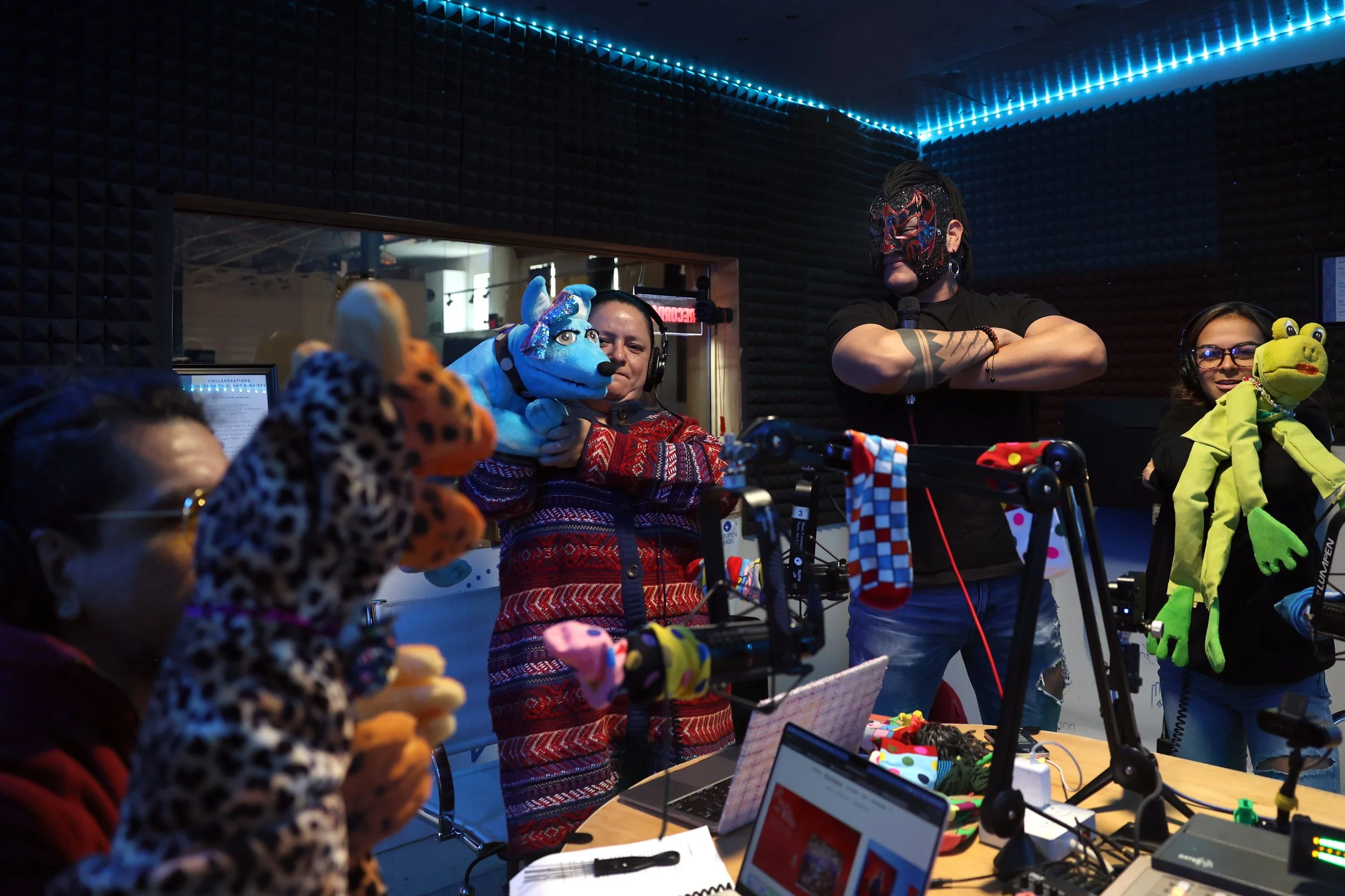
(L-R) Otto Anzures Dadda, Carolina Gomez and Melannie Gonzalez (far right) form the bilingual puppeteering trio, Changosnakedog. Here, they interview special guest luchador Mr. Fragmento (second from right) during their show on Sunday, Nov. 2, 2025, at Lumpen Radio station in Bridgeport. (Anastasia Busby/for City Bureau)
When Melannie Gonzalez thinks of bilingual kids programs, “Dora the Explorer” immediately comes to mind. For 25 years, the Nickelodeon TV series and spinoffs about a 7-year-old Latina adventurer have interactively taught viewers Spanish as they solve problems and puzzles together.
But Gonzalez didn’t see many bilingual children’s theater shows growing up in Chicago. Now, as a member of the bilingual, three-person puppet band Changosnakedog, she has become the representation she never experienced.
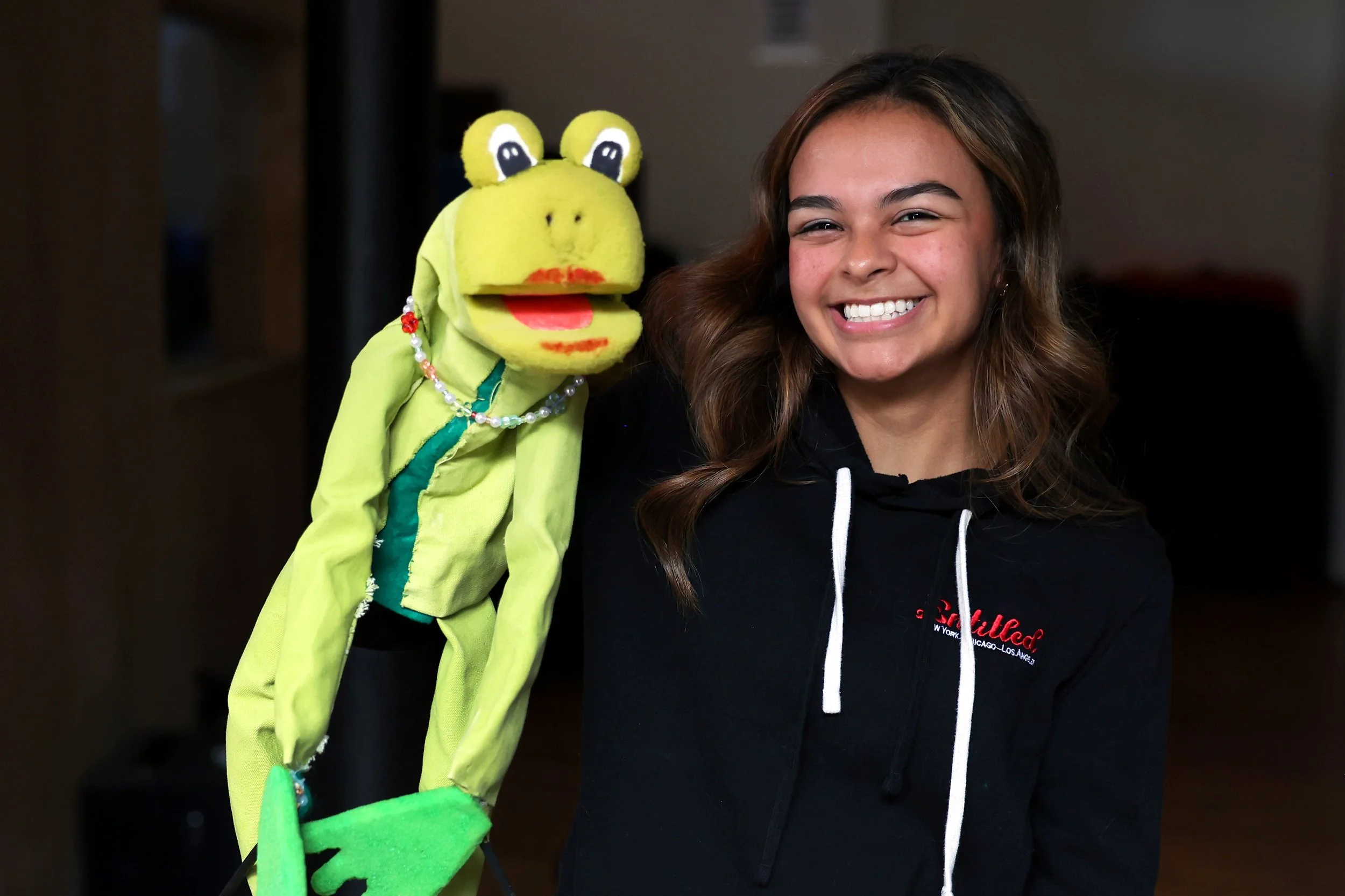
Mexican-American artist Melannie Gonzales holds her puppet, Zana la Rana, on Sunday, Nov. 2, 2025, at Lumpen Radio station in Bridgeport. (Anastasia Busby/for City Bureau)
“It’s really hard to find something that’s actually in person that you can go watch and be able to understand [as a kid], whether you speak English or Spanish,” Gonzalez said.
The cast includes: Otto Anzures Dadda, 49, voicing Balam, a jaguar; Carolina Gomez, 35, on vocals for the puppy Changosnakedog; and Gonzalez, 19, who plays Zana La Rana, a frog.
Anzures Dadda, the only one with previous professional puppeteering experience, founded the group in 2023.
“The music brought us together. I feel like it's the perfect combination of personalities,” Gomez said. “Otto is a dreamer. He dreams everything, and that's amazing. Melannie is the most curious person I've ever met in my life. She plays the drums and she plays the piano, she loves art, and she's very curious about art that she's just everywhere. I am a very academic person. I'm the nerd of all of them and I feel like I round those two aspects of them.”
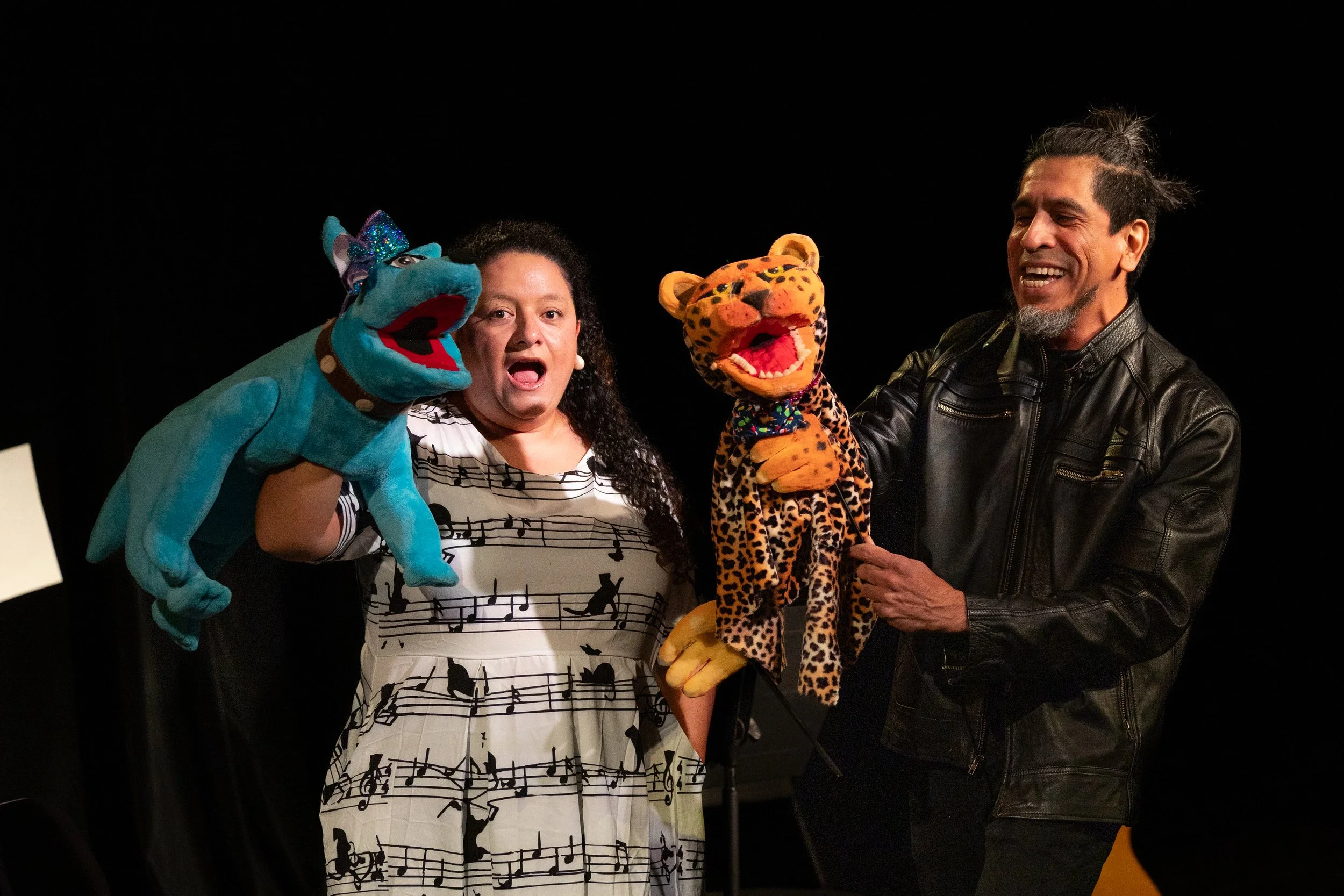
Carolina Gomez, left, and Otto Anzures Dadda of Changosnakedog perform during “Ratas en Fuego” at Urban Theatre Company in Chicago’s Humboldt Park neighborhood on Saturday, Nov. 22, 2025. (Heidi Zeiger for City Bureau)
While the bilingual puppet trio is intergenerational by happenstance, they are intentionally targeting an audience of adults and children alike alongside other local Latino puppeteers and performers working to bring multilingual, family-friendly content to the Chicago-area arts scene. Those include Mexican-American puppeteer Rocio “Chio” Cabrera and disabled Mexican-Yoremi/Mayo Artist Osiris “Pinky” Cuen Gabriel Mundo, both of whom have worked with Anzures Dadda.
Changosnakedog’s performances are for all ages, with the content suited for infants to kids up to young children, while their musicality opens it up for older audiences to join in on cumbia dancing or jam out to rock songs.
“The adults like it; they would listen to the songs by themselves, but they also listen with their children because it enriches them,” Anzures Dadda said. “We definitely need more family-friendly stuff. I want to teach habits that are healthy and spread good advice that the children need. We have to support our community and cultivate education.”
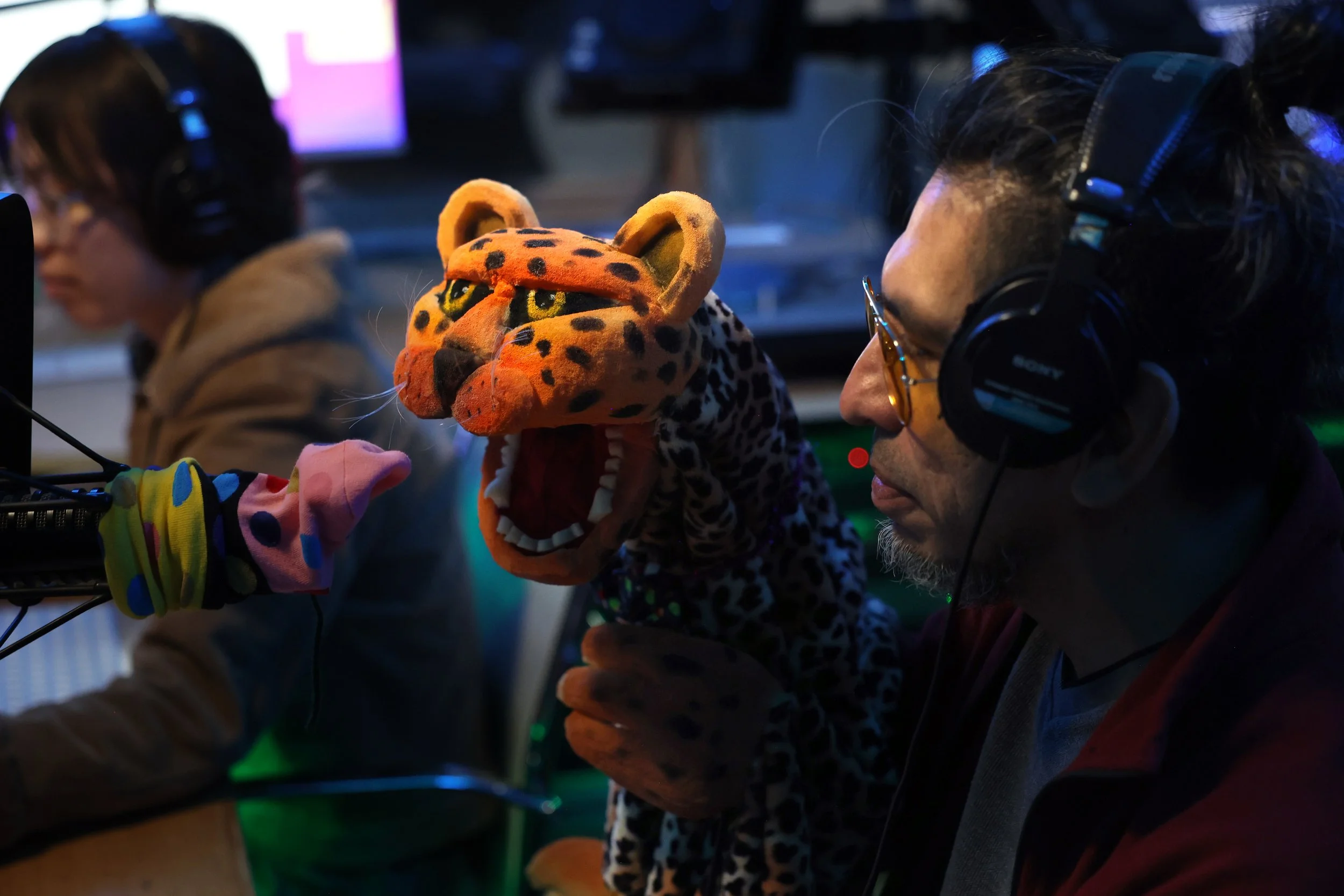
Otto Anzures Dadda plays the character Balam the jaguar during the show on Sunday, Nov. 2, 2025, at Lumpen Radio station in Bridgeport. (Anastasia Busby/for City Bureau)
A star is born
When it comes to the puppets’ lore, Balam is a jaguar from Chiapas, Mexico, a traveler without an ID, not constrained by borders. Uncertain about his future, he saw a shooting star that inspired him to follow his dreams and travel to Chicago. This is where he met Changosnakedog, a dog from outer space — who is also (spoiler alert) the shooting star Balam followed to the Windy City.
Chicago is also where he met Zana La Rana, the “cool girl” who goes to school in the city. She was forced to leave her Indiana home after a shampoo factory was built on the pond where she lived.
All the characters coming from different places is part of Changosnakedog’s message to normalize migration as natural — but not always a choice — and that no one’s existence is illegal.
Members of Changosnakedog record a show at Lumpen Radio in Chicago’s Bridgeport neighborhood in November 2025. (Anastasia Busby/for City Bureau)
For Anzures Dadda, the group is an outlet to share his Mexican and indigenous Xochimilca-Otomí heritage and broad musical background.
Growing up in southern Mexico, Anzures Dadda remembers dancing on tables to family records and credits his grandfather for exposing him to his first instruments, guitar and mandolin. He was a part of a Mayan rock band Sak Tzevul that sang in Tzotzil, which is common in Chiapas, and started a jazz club called Dadda with his brother. He also played a frog in his first puppet band, Los Fabulosos Batracios. Changosnakedog became a natural melding of these experiences, he said.
In 2013, Anzures Dadda met his now-wife Marie Silver, a lawyer living and working on human rights issues in Chiapas at the time. Silver moved back to her hometown of Chicago, and Anzures Dadda followed in 2020.
With his suitcase of puppets, all he was missing was like-minded puppeteering peers to bring these stories to life. In 2023, he posted an open call on Facebook, looking for a bilingual singer who works with kids.
That is how he connected with Gomez, a Colombian musician with a background in early childhood education. She moved to Chicago in 2015 and teaches Spanish immersion for Chicago Public Schools as well as Little Piano Explorers music classes at the Old Town School of Music, working with kids as young as 3.
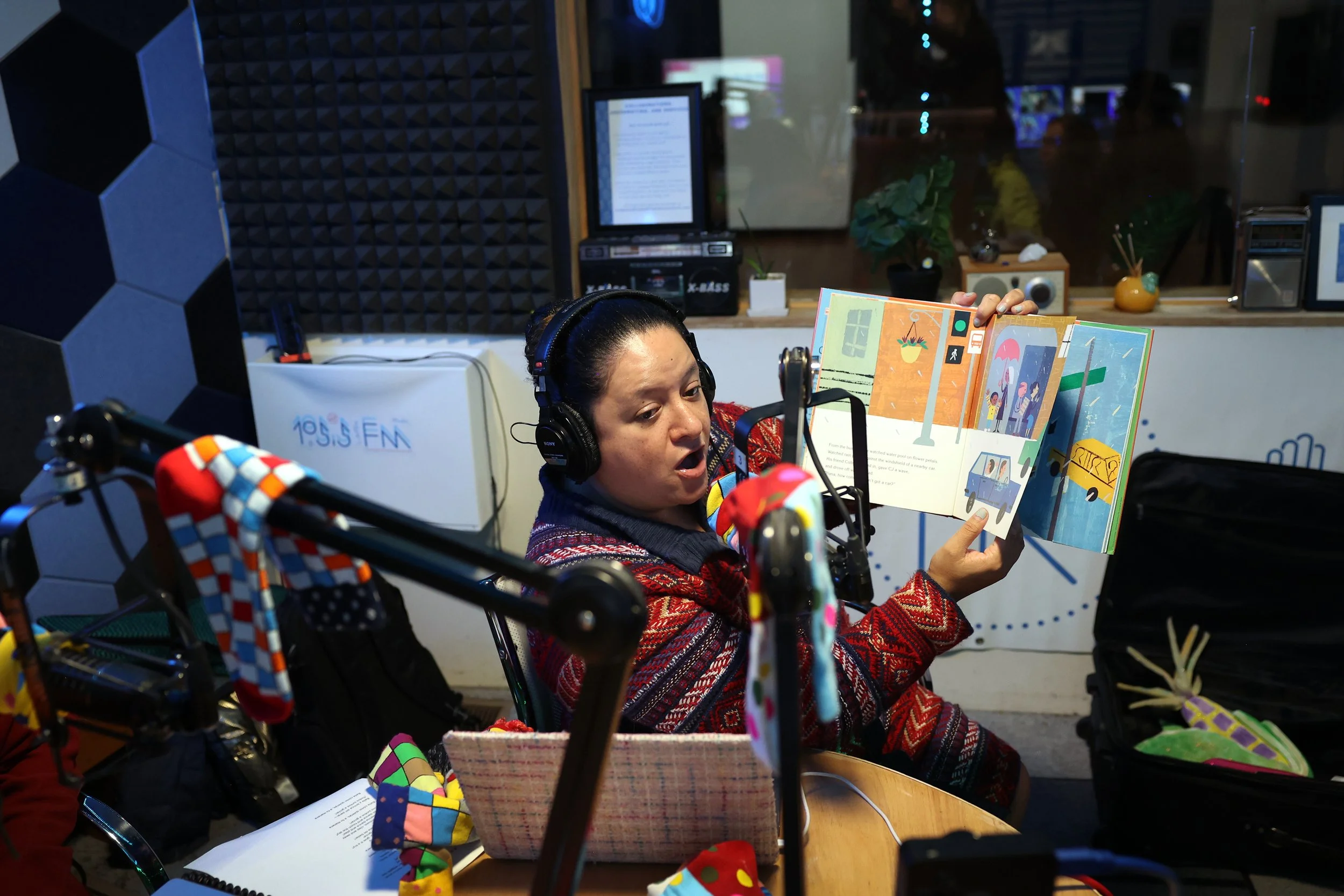
Carolina Gomez reads a book as herself during the show on Sunday, Nov. 2, 2025, at Lumpen Radio station in Bridgeport. Gomez is also an elementary school music teacher. (Anastasia Busby/for City Bureau).
Singing since she was little, Gomez was set on a career in music, joining the Colombian National Choir and starting a rock band. Though some research recommends children can start learning to play music when they are 6, Gomez feels it can begin even earlier.
“When Changosnakedog came along, it was kind of like that cherry that the cake needed. I feel like you need to nurture all the education and all the concepts, but also add that social awareness of your environment,” Gomez said. “Why do I want to learn the 1-2-3s and the ABCs when I'm not kind? When I don't understand my peer that has another color of skin or has an accent, or my friend that does not speak my language?”
Gomez puppeteers Changosnakedog, inspired by Anzures Dadda’s dog he adopted when he arrived in Chicago. The German Shepherd-Blue Heeler mix had the otherworldly behavior of grasping things with her paws like a monkey (chango in Spanish) and slithering around furniture like a snake. Whenever she behaved this way, Anzures Dadda and his wife Silver would chant “changosnakedog” in a sing-songy fashion.
Gomez adds her own personality and interpretation of the extraterrestrial pup.
“Changosnakedog is a kid. It's a little puppy. A puppy is energetic, a puppy is reckless, a puppy is fearless,” Gomez said. “She always wants to make new friends. She's very hopeful. She loves her new planet, because everything is new for her.”
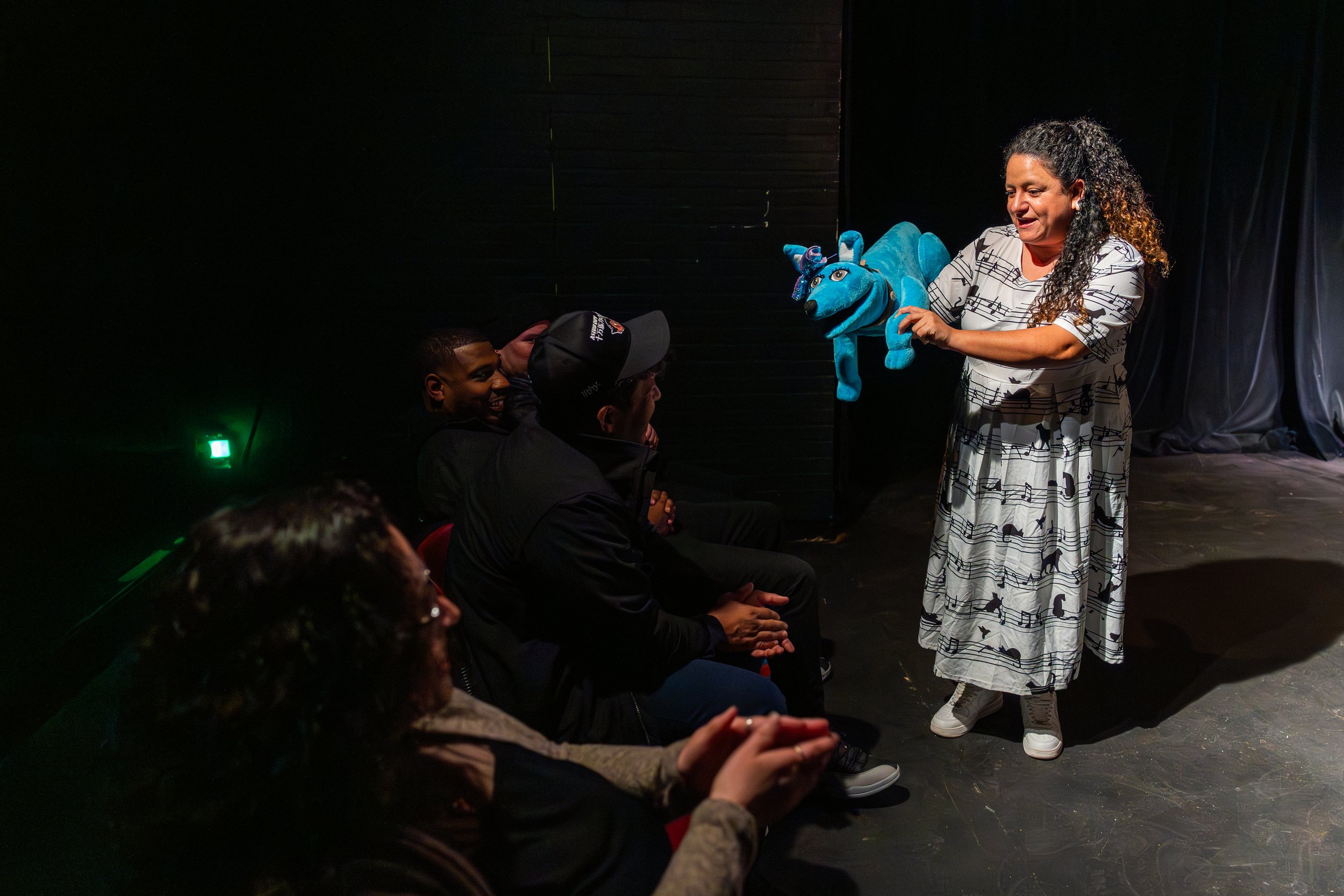
Carolina Gomez performs during “Ratas en Fuego” at Urban Theatre Company in Chicago’s Humboldt Park neighborhood on Saturday, Nov. 22, 2025. (Heidi Zeiger for City Bureau)
Anzures Dadda then met Gonzalez through her parents, who work in the music industry through their bilingual arts group Chess Live.
Being exposed to the music industry so young, it was natural for Gonzalez to be on stage singing. Around 7 or 8, she joined a rock band with 40- and 50-year-olds. In addition to singing, Gonzalez plays piano, ukulele, bass, accordion and the guitar. Anzures Dadda was impressed after seeing one of Gonzalez’s performances, and asked her to join Changosnakedog. At that point her only other exposure with puppeteering was in high school through a workshop run by Rocio “Chio” Cabrera.
“Being in the music industry isn't something I say that's really easy,” Gonzalez said. “It forces you to grow up faster and live life quicker, but it really makes you center your ideas and center where you want to go.”
Like Zana La Rana, she attends school, balancing her time between Changosnakedog, being a full-time student at Loyola University, and performing with a Natalia LaFourcade tribute band called Dirección Contraria. Her character’s name refers to a popular Mexican healing rhyme that Gonzalez used in her childhood.
“It's really common that in Mexico, when you get hurt, they sing you this song: ‘Sana sana colita de rana sino sanas hoy sañaras mañana,’” Gonzalez said. “Which translates to, ‘If you're not OK right now, and it doesn't heal by today, it'll heal by tomorrow, and you'll be OK.’ And I think it really connects to younger kids because of that.”
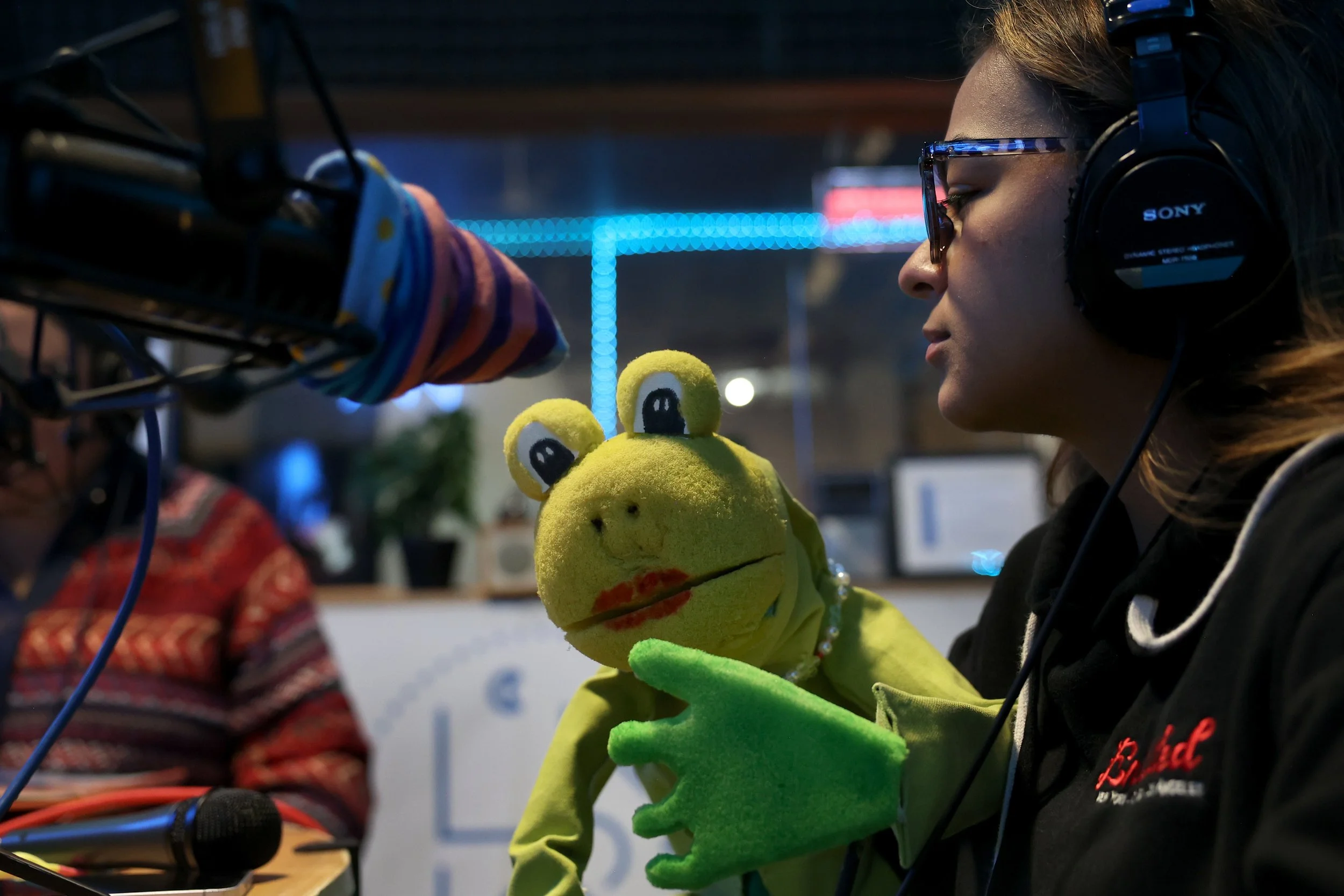
Melannie Gonzalez with Zana la Rana during their show on Sunday, Nov. 2, 2025, at Lumpen Radio station in Bridgeport. (Anastasia Busby/for City Bureau)
‘How to crack that code’
On a brisk Sunday morning in early November, DJs and staff at the Lumpen Radio station in Bridgeport prepare the studio for a second recording session of Changosnakedog’s new radio puppet show.
The puppeteers each have two mics, one for themselves and one for their puppets. The studio is alive with chatter as they go through a rundown of the show, tuning their instruments and passing around multicolored sock puppets, which will later morph into a cumbia-singing duo.
The cast supports each other, feeding off their collective energy. In the cumbia performance, Gonzalez plays the ukulele, Anzures Dadda provides the vocals for the sock puppets while playing the notched, gourdlike güiro, and Gomez does the sock puppeteering.
During the episode’s storytime, Gomez also plays herself, reading a book to Balam and Zana La Rana, who chime in with their reactions, and sharing advice on healthy eating habits, switching between Spanish and English throughout.
The radio show is part of the group’s effort to extend its reach.
The trio previously has done music songs on Spotify and music videos on YouTube, but radio is a powerful tool in Latino communities, reaching about 94% of Hispanic adults in the U.S., according to a Nielsen report.
The format allows them to do more and travel with their storytelling, relax their hands through co-puppeteering, and take turns playing instruments and singing, Anzures Dadda said.
“We're trying to figure it out — how to cra ck that code for our Latino community, to start believing a little more in art as a form of education,” Gomez said.
Growing up in Colombia, Gomez listened to Colorín ColorRadio, one of the only radio stations dedicated to kids in the country from 1992 until, in a controversial move, it was replaced with a Christian radio station in 2006. The station hosted live events and featured music, anime, storytelling, and original characters such as Perroberto the Dog or Pillo the Intergalactic Doll. Creating a Chicago version of Colorín ColorRadio through the Changosnakedog universe is a dream come true for Gomez, she said.
The Shrek effect
Other multilingual Latino puppeteers in Chicago also draw from their backgrounds to create inclusive spaces across ages and languages.
Based in Humboldt Park, Chio got into puppetry as a young schoolgirl, creating little worlds inside her desk. The pencils were people with faces she would carefully draw on their eraser-heads. On cut-out index cards, she drew buildings and a Ferris wheel that made up a miniature Chicago.
As an anxious kid with a stutter, Chio found improv classes helped her build confidence. The COVID-19 pandemic ignited a sense of urgency within her to pursue the arts more seriously and treat it as a “life blood,” she said.
She created her own puppet play, “Juana and the Missing Mayan Book,” through a residency with the Chicago International Puppet Theater Festival and helped Anzures Dadda conceptualize the stories behind the cast of Changosnakedog. She also worked on the bilingual puppet show “El Barzón,” which tells stories of farm workers and laborers, inspired by the Mexican revolutionary song of the same name.
“My parents are immigrants, and so I've always felt like I didn't know enough about my history being born here. For me, I use puppetry as a way to explore what would have happened if I hadn't come over,” Chio said. “Or better yet, what happened because I did come over.”
Creating content that entertains the whole family is something Chio has started referring to as the “Shrek effect,” a nod to how the smash film franchise appealed to both adults and kids.
“My own family doesn't go [to] see theater. It's not in the culture of a typical Mexican immigrant, at least not in my family,” Chio said. “ So I'm trying to make the theater that my mom goes to see.”
She does community outreach and hosts puppet-building workshops for kids and parents through Chicago International Puppet Theater Festival as well as Opera-Matic, a Chicago-based public art organization that creates participatory art spaces.
Chio has seen the positive impacts of this work through Gonzalez, who attended one of her workshops and is now continuing puppetry with Changosnakedog. She hopes that with each workshop or project, another person is inspired to join the next generation of Latino puppeteers. Her puppetry has recently been showcased in the Ballard Institute and Museum of Puppetry’s “Somos Uno”: Mexican and Mexican-American Puppetry exhibition.
Mundo, a queer artist from Arizona also thinks of family when envisioning performances.
With the help of Anzures Dadda, Mundo was able to develop the character Cuentinflas, a combination of the Spanish word for story (cuento) and the stage name of the late famous Mexican comedian Cantinflas. In “Hora de Cuentinflas,” a bilingual singing and storytelling act, Mundo shares Mexican songs and stories at Chicago parks and on social media.
Mundo also has collaborated with Anzures Dadda and Chio Cabrera in puppetry performances, including “Lizard Y El Sol”, a bilingual children’s play with the Goodman Theatre in 2025, and El Barzón. As Cuentinflas, Mundo co-led a puppet-making workshop with Changosnakedog.
Mundo grew up between the U.S. and Mexico, visiting family in coastal Sinaloa. With a single mom who worked a lot, Mundo spent a lot of time watching programs such as “Barney & Friends” and “Sesame Street,” which helped Mundo learn English but fell short of creating in-person connections. As a performer, Mundo wants to cultivate that relationship between caregiver and child and help build an understanding of youth as empowered individuals with complex emotions.
“I invite both the youth and the families to play together and to imagine together because I feel like we lose touch with play when we’re older,” Mundo said.
To some Mexican families, art isn’t seen as valuable as more “successful” jobs like being a lawyer or doctor, Mundo and Chio said.
But art’s vital role in building community makes it important for Latino adults to appreciate its value, said Ana Días Barriga, a Mexican puppeteer and Northwestern University researcher studying puppetry.
“If the adults already understand the value of art, then the adults can start to make the change and clear the path, so that when the kids grow up, the path is ready for them,” Díaz Barriga said.
These are the pathways that artists like Mundo, Chio and the members of Changosnakedog are attempting to create in their craft, they said. It isn’t easy to pursue as many of them juggle multiple jobs on top of their artistic projects.
But they’re determined to keep trying — one kid, one parent, one puppet show at a time.
“Not a lot of [Latino] people know about theater or know about puppeteering, and I think it is something you have to go out and look for,” Gonzalez said. “But it's a really good community. It's a really good world, and it takes you to a whole different level of how you see certain things.”
Zulema Luz Herrera is a Chicana journalist and musician from Chicago. A third-generation Mexican American, Herrera has journalism degrees from the University of Illinois Urbana-Champaign and the University of Arizona, where she produced a documentary on food insecurity in Tucson and created visual media for a local immigrant services organization. She is part of City Bureau’s fall 2025 Civic Reporting Fellowship cohort.
Support City Bureau’s Civic Reporting fellowship by becoming a recurring donor.