
Welcome to Newswire — your weekly guide to Chicago government, civic action and what action we can take to make our city great, featuring public meeting coverage by City Bureau’s Documenters.
Quote/Term of the Week
Railroad-owned easement / noun
An easement is the legal right to use another person or entity’s property for a specific use. A railroad-owned easement means that a rail company has the legal right-of-way to lay tracks and have trains pass through.
Ex: An Amtrak spokesperson told Block Club Chicago that a “railroad-owned easement” would allow the company to build on the Illinois Sports Facilities Authority property.
This is our playoffs [Alt headline: “No, I’m drunk”]
The White Sox have been in the headlines in more ways than one recently. While we’d love to talk about the team’s deeply unfiltered and unhinged interviews, we’re instead diving into one of Chicago’s latest development controversies: Amtrak’s plans for a $900 million Midwest Maintenance Facility — next to Rate Field.
Amtrak plans to build a 24-hour maintenance facility at the Canal Street Yard, directly west of the stadium, stretching from Cermak Road to Pershing Road and west to Canal Street. The proposed plans would also take over parts of the White Sox parking Lots C and G.
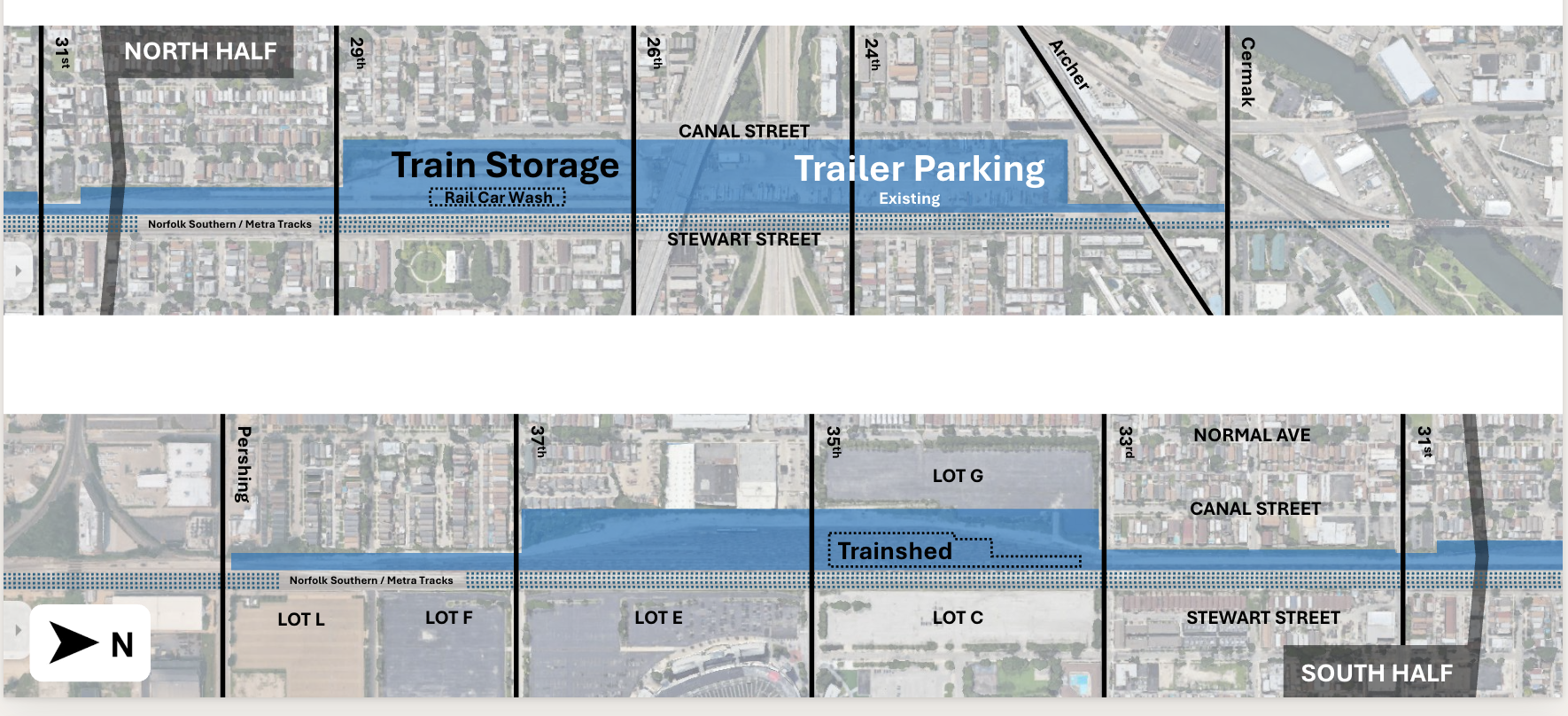
From the Midwest Maintenance Facility plan presented by Amtrak.
The stadium and surrounding parking lots are owned by the Illinois Sports Facility Authority.
PAUSE: Why would Amtrak be allowed to build this development on property the company doesn’t own?
In a response to questions from Block Club, a spokesperson said Amtrak can do this thanks to a “railroad-owned easement” to a ramp in Lot G. The spokesperson said that Amtrak will publicize the specific parking and traffic plans after coordinating with ISFA and the White Sox.
Amtrak leaders said they chose the Canal Street site because it has already been used for rail operation, and has necessary connections to Union Station. The current maintenance site at 14th Street in the South Loop is too small and requires too much maintenance work to happen outdoors, according to Amtrak officials.
PLAY: What does this mean for surrounding communities?
Bridgeport and Chinatown neighbors have largely rejected the maintenance facility plans, packing the community meeting hosted by Amtrak last month. Residents said they were worried about how the 24-hour facility would impact noise, air quality and access to public spaces. They’ve posted flyers around the neighborhood and used social media to keep the rest of Bridgeport in the loop.
Leslie Darling, head of the ISFA, said she and board members were blindsided by Amtrak’s plans to build the new facility on Sox Park territory.
Local officials including Ald. Nicole Lee (11th Ward) also have opposed the plans and criticized Amtrak for not heeding the community’s feedback around the project. City Council passed a resolution demanding a pause to the project until developers can release environmental studies to the public and appear at a hearing before alders.
This morning, the City Council Committee on Transportation and Public Way is holding a subject matter hearing on the development. Local community organizations will be present, and plan to give public comment, calling on alders to fight back against Amtrak’s plans.
But technically, it is not up to the City Council to approve or block the project.
Another wrinkle to this: White Sox minority owner Justin Ishbia is closely involved in the Amtrak project as part of an effort to potentially to move the ballpark to the South Loop.
PAUSE: Wait, what?
Ishbia’s company, Canal Edge, unveiled plans last month for a new riverfront Sox stadium — right where Amtrak’s current maintenance yard is. The stadium is part of a broader megadevelopment proposal called The Railyards that could also include housing and health care facilities.
Canal Edge is partnering with Amtrak in its plans to move the maintenance facility to Bridgeport. Ishbia’s company is committing $125 million toward that $900 million project and leading the development.
So the railyard would move to Bridgeport, the Sox would move to the South Loop.
PLAY: Ishbia is lined up to buy a controlling stake in the White Sox in 2029, when the team’s lease at Rate Field expires. He has publicly called for a new stadium if he takes over.
Current Chairman Jerry Reinsdorf is still running the show and also has lobbied for a new stadium at The 78 megadevelopment on the other side of the river, but that hasn’t gotten much traction.
Lee and Cook County Commissioner John P. Daley said the proposal to move the Sox to South Loop is “nothing less than a betrayal” to Bridgeport.
Despite the opposition, the new railyard project just got a huge boost of $$$.
In August, Amtrak landed a $659 million federal grant to support moving the railyard from 14th Street to the Canal Street Yard next to Sox Park, plus some other infrastructure improvements.
What you can do:
Follow the movement: A collective of community members from Bridgeport, Chinatown and Armour Square have created Stop Amtrak Bridgeport. follow along for updates and calls to action.
Contact Amtrak: Have feelings about this development? Send an email to info@mwmaintenancefacility.com to let Amtrak know how you feel.
Contact your alderperson: Want your alderperson to take a public stance on this development? Click here to find your alderperson and let them know.
Will your gas rates go up?
On Monday, an administrative judge was set to weigh in on whether Peoples Gas can institute a $144 million rate hike. If allowed, the hike could add $7 or $8 to most Chicagoans’ monthly gas bills.
Once this judge makes a decision, they will share their opinions with the Illinois Commerce Commission (remember them?) and THAT is who will make the final call about this rate hike by the end of year.
This really could be your time to contact the ICC. Here’s how you do it:
File comment on the ICC website. Go here to make a comment on the Peoples Gas proposal
Call the ICC at 1-800-524-0795.
Speak at an open ICC meeting.
The ICC’s next open meeting is scheduled for Thursday, Oct. 8.
For more information on how to make a public comment, check out this past edition of Newswire.
What you can do:
Follow the Citizens Utility Board: The Citizens Utility Board (CUB) is advocating for lower utility bills, cleaner energy and consumer protections. Check out CUB’s website here and learn more about how you can take action.
A version of this story was first published in the October 7, 2026 issue of the Newswire, an email newsletter that is your weekly guide to Chicago government, civic action and what we can do to make our city great. You can sign up for the weekly newsletter here.
Have thoughts on what you'd like to see in this feature? Email Civic Editor Dawn Rhodes at dawn@citybureau.org.