
Chicago used federal money to launch two pandemic-era programs to help renters with cash and legal assistance to keep them housed. But it failed to keep them funded.
By Carolina Baldin and Alana Warren
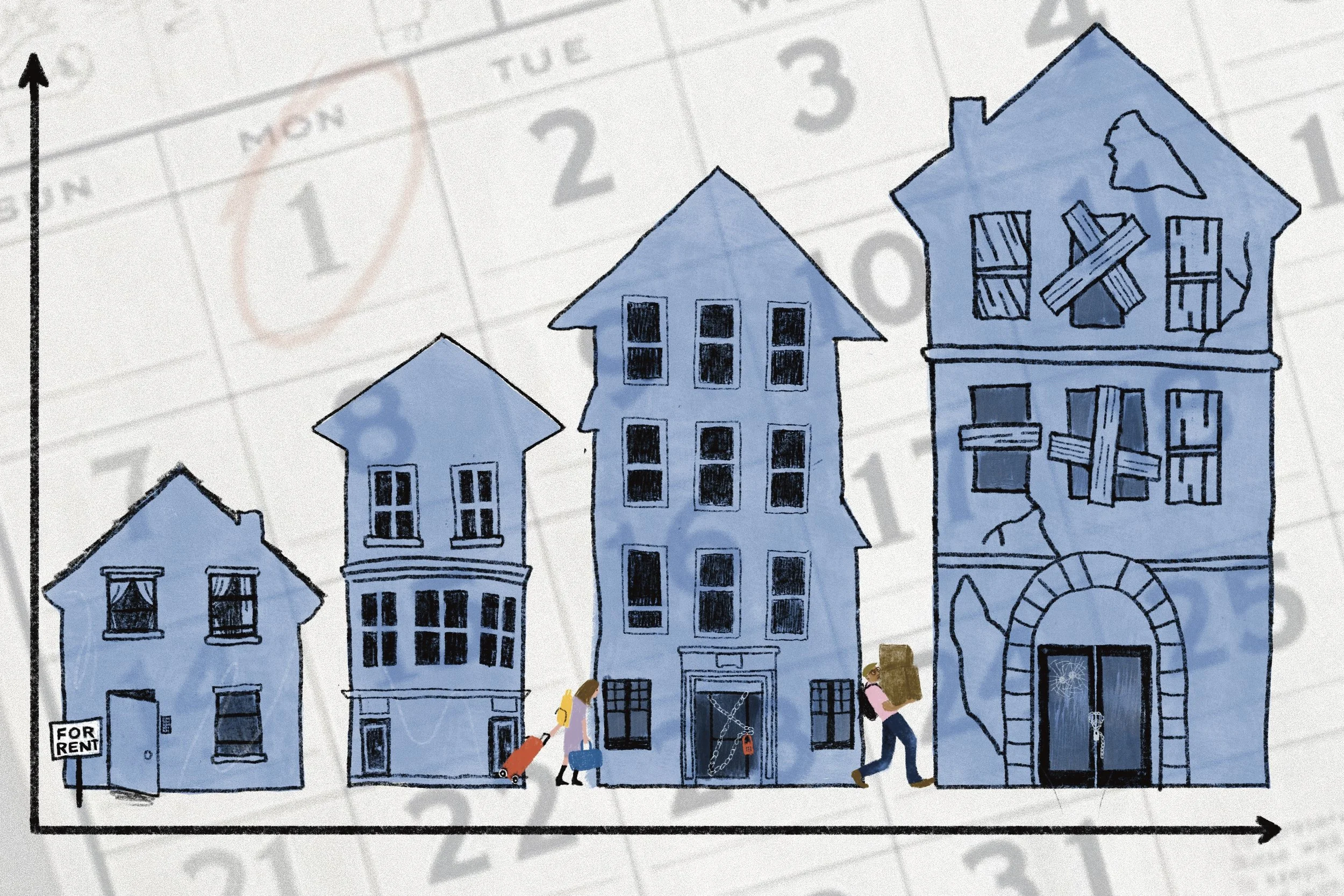
Renting in Chicago is becoming increasingly difficult as prices spike more than most other cities, and low supply in high-demand areas has applicants outbidding one another on how much they’ll pay in rent. (Gaby FeBland/City Bureau)
“Perfect Storm” is a series produced by City Bureau in partnership with Documenters Network sites focused on how federal funding instability is affecting local communities. It looks at how communities across the United States — big and small, rural and urban — are reckoning with slashes to federal budgets, the sunsetting of COVID-era grants, and turbulent legal challenges leaving funding in limbo.
Chicago Documenters assignments from Holland Harmon, Gillian Waldo and Tema Zeldes-Roth were used to inform this reporting. Find more meeting coverage at Documenters.org.
Lashondra Graves, 49, doesn’t know how many unread messages she has on her phone — the red-circled “99+” above her app icon represents dozens of Chicagoans asking for her help.
Graves started matching renters with places to live in 2014, a free service that grew into an unofficial capacity as The Apartment Lady.
The messages range from tactical — “I need help with security deposit” — to heart-wrenching: “Me and my baby’s father just found out that we got scammed out of the house. We have nowhere to go. I was told to contact you … Please help.”
She responds to them all; she knows many of the people seeking her help feel they have nowhere else to turn. After all, she has dealt with housing insecurity for most of her life.
Renting in Chicago is becoming increasingly difficult as prices spike more than most other cities, and low supply in high-demand areas has applicants outbidding one another on how much they’ll pay in rent. Closures of single-room occupancy buildings and unhoused encampments further frustrate efforts to get more people into stable housing.
But as Mayor Brandon Johnson and a defiant City Council are battling over competing renter protection ordinances, they’ve let pandemic-era funding for the Emergency Rental Assistance Program expire without plans to replace it.
While ERAP and its counterpart, the Right to Counsel program, were a response to an unprecedented global emergency, housing advocates say the eviction prevention initiatives are two of the best ways to curb homelessness.
“The impact that a couple thousand [dollars] has is [determining] whether or not someone has housing tomorrow or next month,” said Jim Garfield, an attorney with the Uptown People's Law Center who focuses on tenants’ rights. “The impact for the tenant is huge.”
Where funding lapsed
As the federal government flooded state and city budgets with cash infusions to meet emergent needs in the first year of the COVID-19 pandemic, Chicago used an $8 million federal grant to establish its Emergency Rental Assistance Program in 2021.
Tenants who suddenly found themselves out of work or otherwise unable to pay rent due to pandemic restrictions could get up to 15 months of missed rent and utility payments covered, and up to three months of future costs. The money was often paid directly to the landlord, and could not exceed $2,500 per month.

“These are not programs where only the tenant benefits,” notes Michelle Gilbert, director of legal and policy at the Law Center for Better Housing. Evictions, after all, lead to empty apartments, she said. “So rental assistance keeps a tenant — who can now pay — in the property, and gets [the landlord] a check.”
As Chicago received additional federal money, it expanded ERAP to include the Right to Counsel pilot program, offering free legal aid to renters fighting eviction cases in court.
Ultimately, Chicago provided $134.6 million in direct rent assistance to help over 17,400 residents, according to the city’s website.
But now the ERAP coffers have run dry, with nothing budgeted for this year.
The city did allocate $3.7 million, including $2.3 million in federal money and the remainder in state and local funds, for a separate Rental Assistance Program under the Department of Family and Support Services for 2026 — a fraction of what got spent in years prior through ERAP.
But as of Sept. 4, the DFSS Rental Assistance Program is not accepting new applications due to high volume, according to its website.
Still, the need remains: More than 40,000 eviction cases have been filed in Cook County since they resumed in early 2022, according to a Block Club report that also detailed the circuit court’s poor record-keeping methods. And while online court records do not provide reasons why landlords file for evictions, the Law Center for Better Housing notes that from 2010-2017, more than 80% of cases included landlords seeking back rent. Most were for less than $2,500.
Housing-related calls to 211 Metro Chicago — a social services helpline run jointly by the city, Cook County, and United Way of Metro Chicago — more than doubled since its launch in 2023, according to county data. Of the more than 23,400 calls so far this year, two-thirds were seeking help with eviction and homelessness prevention or diversion.
And in 2024, the most recent year with available data, more than 58,000 people in Chicago experienced homelessness, according to the Chicago Coalition to end Homelessness. That includes more than 19,300 living on the streets or in shelters, and twice as many temporarily “doubling up” with family or friends. Black and Latine residents were the most affected.
Local efforts thwarted
But it didn’t have to be like this, advocates say. Four years ago could have marked a turning point for Chicago’s efforts to keep people housed.
As pandemic-era grants wound down, funding for rental assistance and homelessness prevention faced setbacks, sparking a debate around who should cover costs in the years following.
In fall 2022, housing organizers launched the Bring Chicago Home campaign, hoping to fund homelessness prevention with a proposed real estate tax on the sale of property worth $1 million or more. They aimed to get it on the ballot in early 2023, but the initiative floundered after pushback from then-Mayor Lori Lightfoot and her allies.
Johnson took office in May 2023 and, that September, proposed an ordinance that would make the Right to Counsel pilot program permanent. City Council never moved forward with it.
That same year, Johnson’s administration revised the Bring Chicago Home proposal and, this time, City Council placed it on the 2024 ballot. But 53% of voters rejected it.
By the start of 2025, $6.9 million remained in the pool of money used for emergency rental assistance and legal assistance for eviction cases, according to this year’s budget documents. The city used some of the money for Right to Counsel, and redistributed the rest to the DFSS Rental Assistance Program, Cox said.
Ultimately, the Emergency Rental Assistance Program money ran out, bringing an end to a program advocates said made a major impact for not a lot of money.
Now, Johnson is pointing the finger at the federal government.
The city’s pandemic-designed ERAP was “never a sustainable operation,” Johnson said during a March 5 town hall meeting in Lincoln Park. The federal cuts to housing and support programs further exacerbate the problem of paying for such initiatives, he said.
“The thing that I believe is the greatest challenge for [the city] right now is the lack of sustainable revenue to fund these programs,” Johnson said in response to a question about rent assistance. “I can’t emphasize this enough: There are very few levers that I have as mayor of the city of Chicago to generate revenue.”
What help is available
Some rent relief and legal assistance still exists in the city and state — but with fewer and less-reliable dollars.
With $4 million annually split between federal Community Development Block Grant money and leftover ARPA money, Chicago is still offering the Right to Counsel program through 2027 for residents who have received an eviction notice, a court summons, or a threat of eviction; and have a household income at or below 80% of the Area Median Income, which is $97,200 for a family of four, and $68,050 for a single person.
Cook County’s free legal aid for residents facing eviction is available regardless of income level.
While Chicago’s Department of Housing does not have plans to revamp ERAP, delegate agencies provide direct rental support to tenants with their own federal funding, as well as help with outreach and application support, Cox said.
State help has fluctuated as federal pandemic funds wound down. The Illinois Court-Based Assistance Rental Program, launched with federal COVID money for renters with active eviction cases, has hit pause on applications at least twice in recent years when funds ran out. It re-opened in July 2025 after being closed for months.
Illinois’ Homeless Prevention Program continues to fund rental and mortgage assistance channeled through about 70 provider organizations across the state, including more than a dozen who work in Cook County.
Despite the demand for housing assistance continuing to grow, many Chicagoans are not able to easily find resources to support their needs, advocates say.
Nonprofit organizations like the Uptown People’s Law Center or ONE Northside do their best to advocate for tenants rights issues and assemble community members together to lobby for better housing efforts, but it’s still not enough to meet the growing housing demand, they say.
“We’re closing affordable housing each year. We’re not building new affordable housing,” said Heather Aubry, 28, an organizer and paralegal at UPLC who helps relocate tenants from single-room occupancy buildings. “Basically, programs like ERAP are supposed to be this safety net for that.”
Housing struggles continue
Even as someone who spends her time helping people find housing as The Apartment Lady, Graves herself still fell through the cracks of Chicago’s housing network.
“Think about it: I have been doing eviction prevention since 2014. I’m fighting [other people’s] eviction cases while I’m homeless,” she said. “I know the system, and I still fell through the cracks.”
After experiencing homelessness for most of her life, Graves wanted to help others in need, so she taps into her network of landlords and housing organizations, finding affordable apartments all over the country and sending links to people who need help.
She recognizes how hard it can be to find somewhere to live, especially for those who have evictions on their records.
“Once you get the eviction, or once you get even the court filing, it’s a wrap,” Graves said. “How can you move if no one’s going to rent to you?”
Over the last couple of months, in addition to couch surfing, Graves also had to jump around to different homeless shelters and crisis centers. It's an experience she said has brought its own safety problems, indignities, and a lack of guidance on how to access additional resources that could secure stable housing.
To Graves, while there might be a funding issue, she said the resource providers could also do a better job of working together so that people aren't trapped in patterns like shelter hopping.
“Once you’re in that pattern, it’s trauma-filled,” she said.
Graves currently sleeps on a friend’s couch in South Shore. She teared up when she heard Chicago cut back on direct rental assistance.
For her, it strikes a tragic chord.
In 1994, she recounted, her 16-year-old brother Jeffrey died looking for a place to sleep. Graves’ 3-year-old daughter was sleeping in his usual bed at their grandmother’s house. He left to find shelter elsewhere, and was killed that night.
Graves shared his story at a Chicago Continuum of Care breakfast in February, where legislators gathered to discuss the city’s homelessness response system.
Graves has been trying to innovate her work as The Apartment Lady so she can better help those who reach out to her. She started experimenting with training an AI tool she calls Tenant Alexa to give an initial response to the dozens of people seeking her help.
Her hope is it can help with the overwhelming volume of messages she is likely to continue receiving until a better solution can be found.
Jerrel Floyd contributed to this story.
Alana Warren is a St. Louis native who has spent the past eight years building her career and home in Chicago. Her work ranges from research analyzing state and local budgets for the Civic Federation to project management and consulting.
Carolina Baldin was born in São Paulo, Brazil, and studied law there before moving to Chicago in 2020 and gaining a master’s degree in journalism from Northwestern University in 2023. She is a freelance reporter.
Reporting for this article included the use of artificial intelligence to research housing advocacy efforts in Chicago. All information included in this article was independently analyzed and verified by the reporters.