Chicago Documenters interview former students, parents and teachers to see what priorities are shaping the upcoming election.
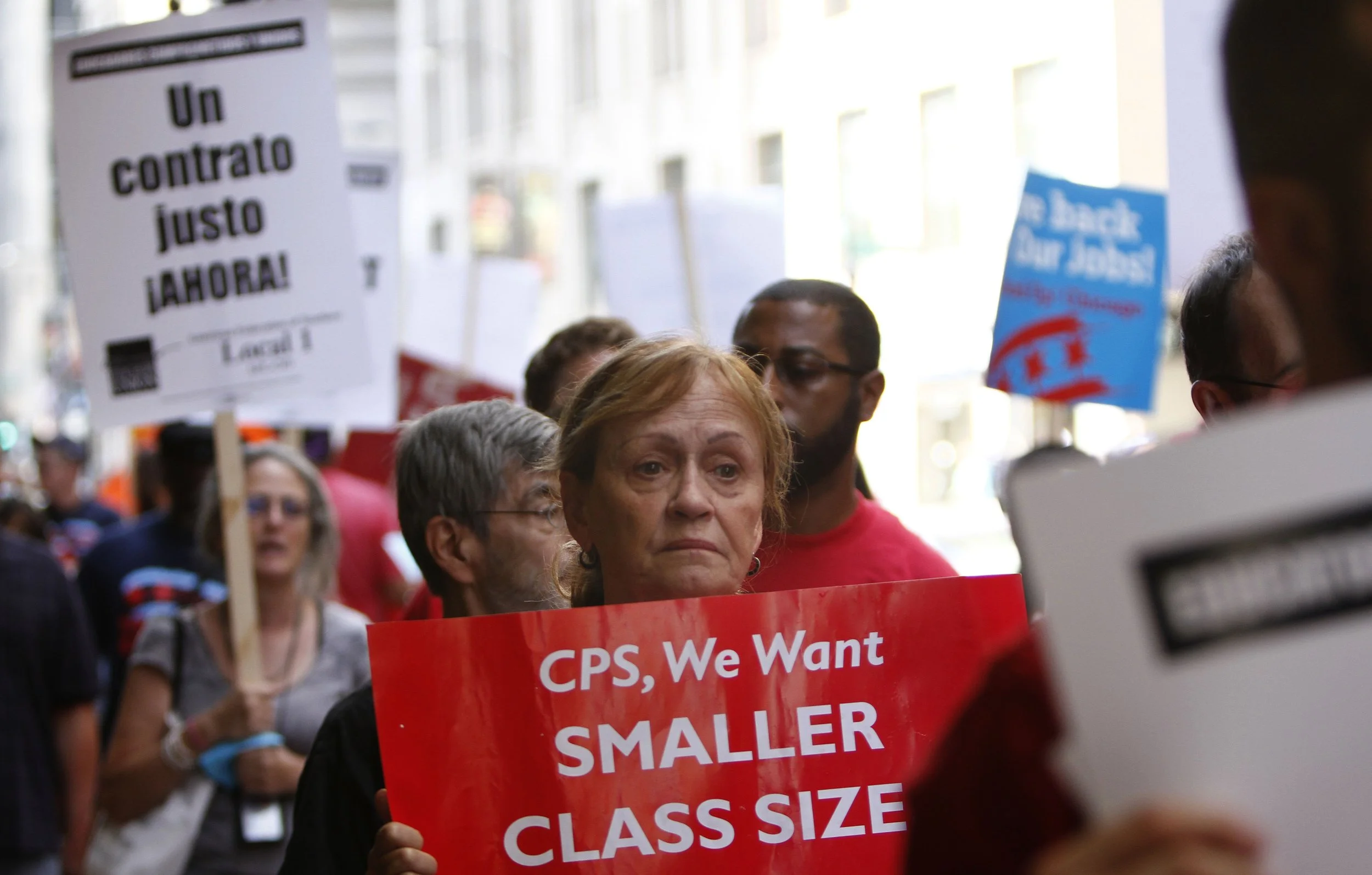
Chicago Teachers Union members picket prior to a Chicago Board of Education meeting on Wednesday, Aug. 22, 2012, in Chicago. The union called for fair contracts with higher pay for its teachers. (AP Photo/Sitthixay Ditthavong)
By Grace Del Vecchio, Kenji Granberry, Kat de Jesus Chua, Meghan Lee, Ayanna Israel, Olivia Loftis
As Chicago moves toward the city’s first fully elected Board of Education, City Bureau got on-the-ground takes on what that future could look like.
We began by surveying Chicago Documenters about their own connections to Chicago Public Schools. Then, through conversations with CPS parents, former students, educators and community members, Documenters sought to illuminate how Chicagoans are thinking about this transition.
Electing School Board representatives (instead of the mayor appointing them) gives Chicagoans more input into how CPS is governed, and a greater role in shaping the future of public education, advocates say.
The ballot will include one at-large board president and 20 board members (one representative for each of the 20 school board districts). Chicago voters can cast two votes: one for their district’s board member and one for the president. Their terms begin in January.
VOTER GUIDE: Early voting began Oct. 1, with polls open through Election Day on Nov. 3. Check out this guide from Chalkbeat & WBEZ.
We spoke to 28 people living in 15 of the 20 School Board districts, who were between 19 and 85 years old. They shared their hopes, concerns and questions as the city makes this historic transition.
Here are excerpts from those interviews. –Grace Del Vecchio, Chicago Documenters editorial manager
Interviews have been edited and condensed.
How interested are you in the School Board elections?
Tequila Harvey, 45, is a training and support specialist team lead for CPS. She began her career with the city working as a bus driver for the CTA. When she got injured on the job and was unable to return to that position, she began working for CPS. Harvey has been both a parent and full-time CPS employee.
My interest is very high right now, not just because I’m a CPS employee. Even though my son has graduated, I still have nieces and nephews who are going to CPS schools. But my concern is for all children. We have a need for accountability and oversight, and I’m wondering what this School Board election will bring. I don’t feel like we're getting that in the School Board that we currently have.
It feels like a power grab right now. I haven’t seen where it has made a difference in the lives of the children that we serve. What does this mean to you as a candidate, and why do you want to be on the board? Are you truly coming to make a difference, or do you just want the seat? Because they’re two very different things.
What would you expect from a functioning School Board?
Savannah Payne, 26, is a first-year teacher at a South Loop elementary school, where she is employed through the CPS Teacher Residency program. Raised in Miami by a family of public school educators, Payne spent much of her childhood in school buildings. After studying computer science in college, Payne worked at an ed-tech startup, then at the Chicago Public Education Fund, supporting CPS principals through the 2024 School Board elections, when Chicago shifted from a mayor-appointed board to a 21-person hybrid board. After finishing her master’s degree and residency, Payne plans to teach middle school math.
If the School Board was functioning properly, I think it would always be super student-centered. I think the fear that I have is with actual PACs coming in and playing a role in this race — like we’ve already seen crazy amounts of money being put into these campaigns. It makes me nervous about whose interests are going to be served. I think a well-functioning School Board would be able to focus completely on the students.
I think it should be, given the historic — and excruciating — debt that CPS is in that persists from year to year. I think a School Board should be thinking really proactively — and not just when the annual budget needs to be approved — about smart ways to generate revenue on a district level. What can we do at a district level to improve equity? And not from a deficit standpoint, even though that’s where we’re operating. How do we actually close the deficit? Be proactive instead of just kicking the can down the road constantly.
The School Board should be functioning as an advocate, as a liaison between the school district itself and the state. So how does the School Board actually advocate for getting everything we need for our students, and actually demanding that in the state? Like, I don’t know how many years it’s been, or if ever, that CPS has been adequately funded by the state of Illinois. And so I think it should be holding legislators’ feet to the fire that exists in the form of a $500 million deficit [which increased to $732 million in 2026].
What qualities are important to you when voting for a member of the Chicago School Board?
Whitney Jean Alim, 31, recently left CPS after working there for roughly a decade as an instructor in social studies and language arts, and as a curriculum builder in the Central Office. Alim lives in Avalon Park and is a long-time community organizer with Black Youth Project 100, which promotes racial justice and equity.
First and foremost, I am looking at who they are taking money from. A lot of money has been put into the School Board election, and I think following the money is important, because you want to know what special interest groups are trying to control our educational system. The other things I look for: Are you actually a staple in your community? Would you be a good representative for your area and the needs of it? What are your experiences? Not everybody is going to have been a Chicago Public Schools student. Not everybody is going to have been a teacher. But what is your relation to this district? Are you a parent? Are you a grandparent? What is your investment?
I say this because, a lot of times, people think you have to have kids in school or been to the school or be a teacher to care about our public education system. I don’t necessarily think that is a fair ask. I think that everybody should be invested in our public education system, because it affects us all. Whether you have a child or whether you don’t, whether you’re employed by CPS or you’re not, I think everyone should be invested in our children.
Chicago Public Schools employs the second-most number of people in our city. That is a huge population. So when you think of it that way, who should have control over this workforce? I think that’s very important too. And a lot of the teachers or staff in CPS also have students who go to CPS schools. It’s all related.
What changes would you like to see in the CPS system?
Diego Barrios, 24, is a fulltime substitute teacher at CPS, with hopes to become a high school music teacher. Barrios cares deeply about the power an arts education can have for students. As a substitute teacher, Barrios said he’s seen a wide gap in the quality of facilities and resources at different schools. In the future, he would like to see a more equitable distribution of resources in the district. These issues will inform how he votes in the election for the Chicago Board of Education.
I would love to see a way for a bit more of a fair distribution of money and budgeting. I have been to many schools — when I was first substituting, I went to schools all over the North Side, and I’ve done job interviews on the South Side. It is quite honestly almost disturbing how big of a difference there can be in schools with what they have in terms of facilities, equipment and the overall environment.
I’m gonna name schools: Lane Tech is very talked about as being one of the best schools in CPS, but you have to test into it. I saw the amount of [science] labs they had in there. My curious mind was looking at the school map to see where the band room was — they have three separate rooms: one for choir, one for band, and one for strings.
I’ve been to schools where their band room is the theater, or whatever space they have, and that’s all they're given. I'd like to see students have a fair chance of pursuing something and have the best quality of it.
This is funny for me to say as a teacher, but, I don’t think your GPA and how well you are at testing determines how good of a student you can be. It only determines how well you were set up to pass.
What issues do you care the most about when voting for a member of the school board?
Marvin Salinas, 19, graduated in 2025 from Prosser Career Academy, a CPS vocational school in Belmont Cragin. He now studies music at DePaul University. He is the son of Salvadorean immigrants and his mother works in CPS as a special education classroom assistant.
Holistic support for students. I think an issue, especially with my community, is students getting lost [in the system]. I hate to say it, but some students don’t really appreciate the value of school, or they don’t know how important it is to their life, and they fall under bad influences and stuff like that.
What I’m trying to get at is: Students need more access to better counselors and have people who genuinely show that they care for them, because in some households, that’s not a thing. They’re misguided, and they do not-good things, and some schools would just rather punish them for the bad thing that they do. But they need to understand where this is coming from, why is this happening. There needs to be a way they can get to the root problem and try to just show the students there’s better stuff for them.
Support City Bureau’s work to reimagine local news by becoming a recurring donor today.