New work requirements for SNAP kicked in Feb. 1, endangering benefits for nearly 400,000 Illinoisans. Safety net community groups are expecting a tough year as more families look for support and organizers strain to meet the increasing needs.
By Jerrel Floyd
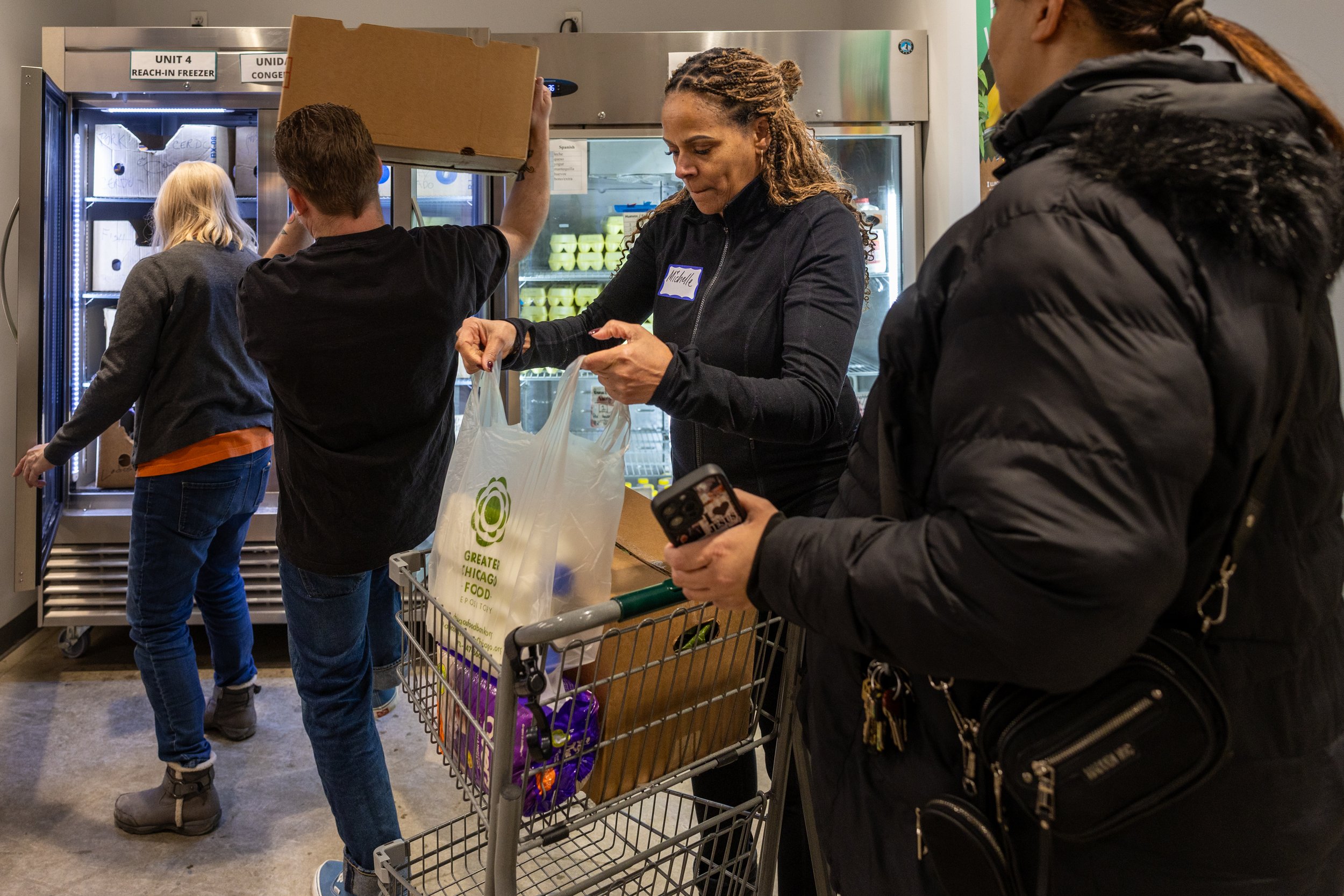
Michelle Herndon (center), director of culture and community at Boka Restaurant Group, volunteers at the El Mercadito food pantry in the Humboldt Park neighborhood on Feb. 2, 2026. (Heidi Zeiger / City Bureau)
If you or someone you know needs food, visit the Greater Chicago Food Depository website, Feeding Illinois or the Find Food IL interactive map to locate assistance near you. You can also find support through the Chicago Area Mutual Aid Map and Directory.
New requirements for federal benefits are increasing the burden on struggling families — and on Chicago’s community resource providers who are trying to help.
Starting Feb. 1, the Supplemental Nutrition Assistance Program, or SNAP, expanded work requirements by removing exemptions for vulnerable community members. Now, families with older children, people navigating homelessness, veterans, people up to age 64 and youth who aged out of foster care must log at least 80 hours of work, job training, or volunteering or community service each month to qualify for support. Around 360,000 Illinoisans risk losing SNAP support because of the changes.
Other programs and funding for families and children have also been under threat. The Trump administration froze billions of dollars in grants to Democrat-led states, including Illinois, targeting Temporary Assistance for Needy Families, the Child Care and Development Fund and the Social Services Block Grant Program. A federal judge has blocked the freeze while the case continues.
All this is playing out amid a worsening affordable living crisis and growing food insecurity in Chicago.
Now more than ever, organizers say everyone needs to do their part to invest in resources that support their communities. Nonprofits such as Safe Families for Children, La Casa Norte and Families Helping Families Chicagoland are recruiting volunteers, pushing awareness and calling for more financial investment to support their missions.
“No organization works in a vacuum,” said José M. Muñoz, executive director of La Casa Norte, which provides housing and resources for youth navigating homelessness. “If another organization is not able to provide [community members] with something, then that just strains the safety net system.”
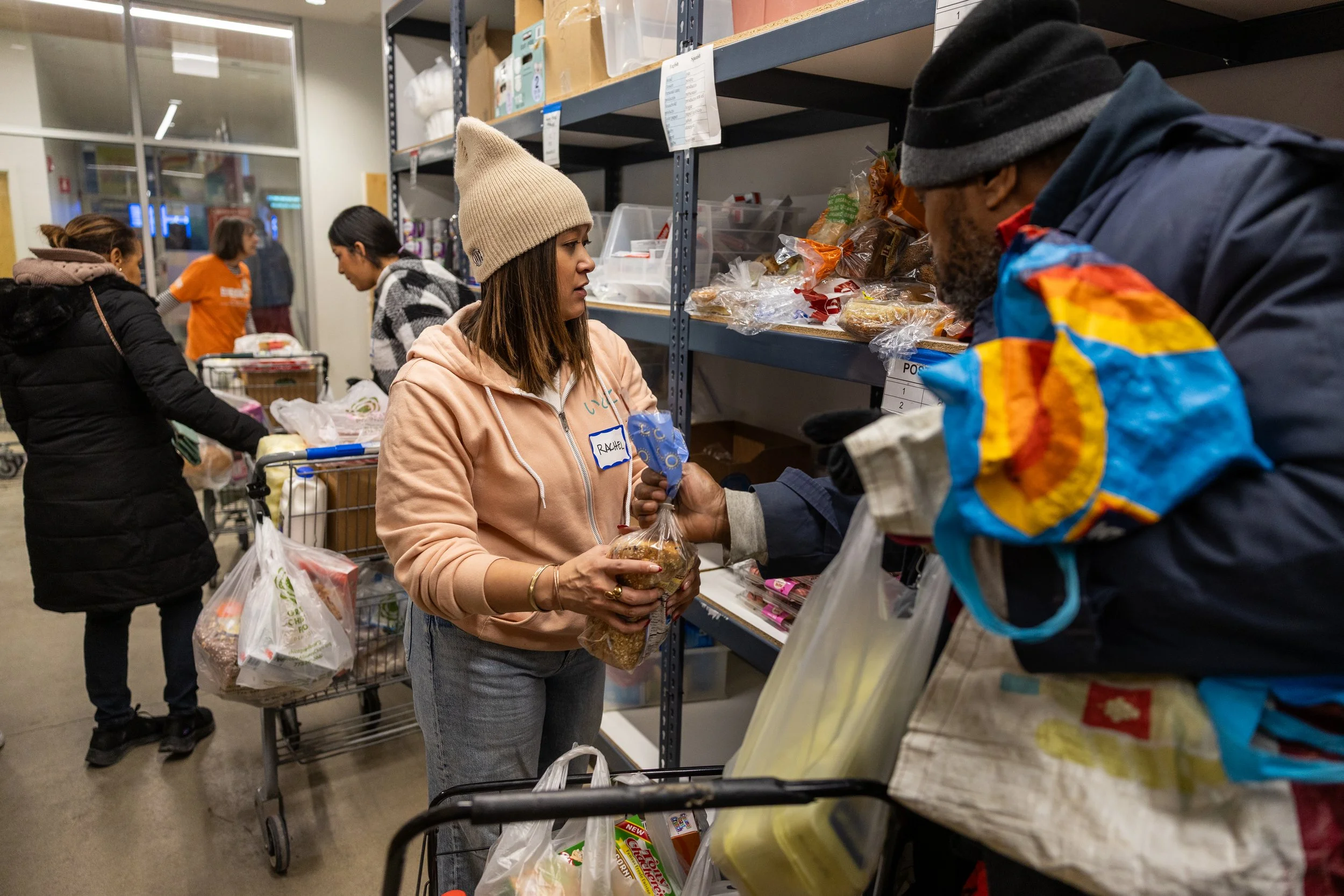
Volunteer Rachel Evaristo of Lakeview hands bread to a client at the El Mercadito food pantry in the Humboldt Park neighborhood on Feb. 2, 2026. (Heidi Zeiger / City Bureau)
‘Not Enough Resources’
In addition to housing support, the Humboldt Park-based La Casa Norte has a food pantry, job training services and a health clinic.
Like for many nonprofits, the need for help exploded in the early part of the pandemic and hasn’t let up. Between 2020 and 2025, the organization went from supporting 5,000 community members to 24,000 across all programs, Muñoz said.
The SNAP work requirement changes add another thing families have to worry about to survive, Muñoz said.
“We know firsthand that hunger is not a motivator; it’s a barrier,” he said.
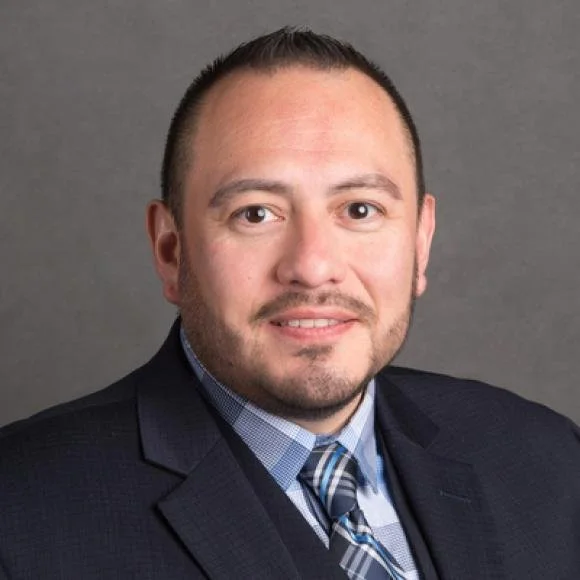
José M. Muñoz, executive director of La Casa Norte.
La Casa Norte collaborates with Nourishing Hope to operate El Mercadito, a social services hub in Humboldt Park. It offers monthly access to groceries, as well as referrals to social service programs within the two organizations. The food pantry serves 150 households daily, part of a Nourishing Hope network that serves 4.5 million each year, according to its website.
But community-based hunger relief programs are meant to supplement SNAP, not replace it, advocates say. The cuts to SNAP spike demand for help and make it more costly to keep people fed. For every meal a food bank provides under the national nonprofit Feeding America, SNAP supports nine meals.
SNAP recipients can use a job training program to meet the new work requirements, which is something La Casa Norte offers. But that work bumps up against the challenge of dwindling employment opportunities that would help stabilize families over the long-term. It’s difficult to find job training programs for tech-related jobs, for example, which require more specialized training, Muñoz said.
“The bottom line: There [are] not enough resources,” he said.
La Casa Norte is asking for additional donations and volunteers as it is set to open a non-congregate housing space in Humboldt Park for the young population that it serves. The new space offers a newer model of shelter services, where young people who live in the building will each have their own rooms, Muñoz said.
This means a higher number of beds to manage, but leaders hope it will improve the shelter experience and make it easier for young people to get support, he said.
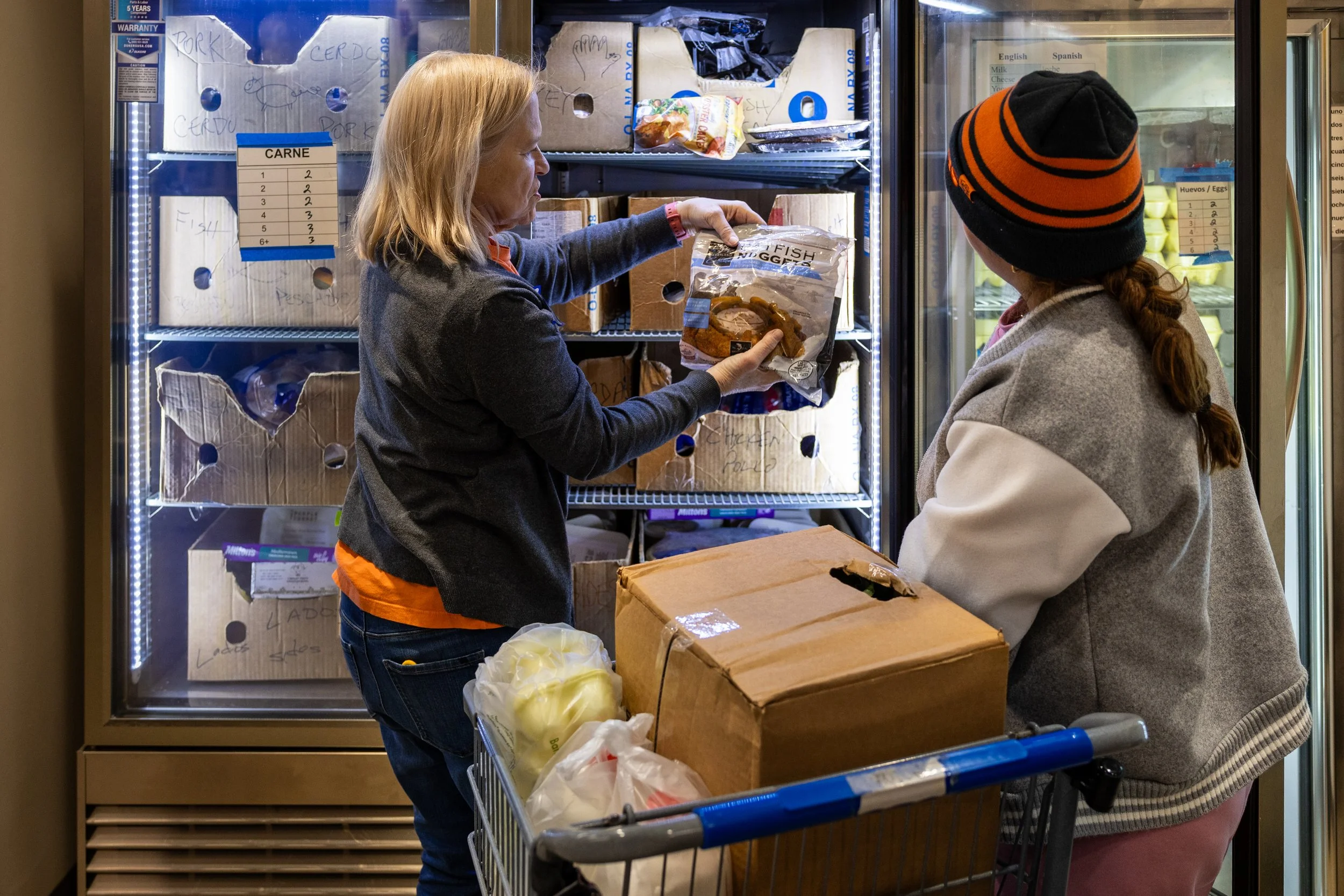
Volunteer Sharon O’Donnell helps a client pick out some frozen fish at the El Mercadito food pantry in the Humboldt Park neighborhood on Feb. 2, 2026. O’Donnell began volunteering at El Mercadito three years ago through her Rotary Club (Heidi Zeiger / City Bureau)
As parents with children 14 and older reckon with the new work requirements, providers are anticipating an increased need for help with things like school pick-ups or help around the house.
“We’re already feeling the pinch,” said Courtney Rose, the Cook County director of Safe Families for Children.
At Safe Families, parents are paired with vetted and trained volunteer caretakers, known as Host Families. More than 1,200 host families throughout the Chicago area help look after a client’s children while the parent in need navigates a difficult situation — a substitute for those who might not have a grandparent or family friend who can lend a hand.
A Family Coach also is part of the care team, monitoring a child’s safety with a Host Family, providing resources to parents, supporting volunteers and improving the relationship between the family and volunteers.
Monica Turner, a single mom of three, first connected with Safe Families when her then-7-year-old son started having seizures and she needed support with her two daughters, 9 and 12.
Turner’s first volunteer caretaker routinely FaceTimed her so she could talk to her daughters, and brought the girls to see her at the hospital where she worked. The volunteer also brought Turner food during her shift, bought groceries and ate dinner with the family, Turner said. When she had mental health struggles or her daughter needed more help managing an autoimmune disease, Turner looked to Safe Families for support. This experience not only made her comfortable using it as a resource but also gave her the capacity to volunteer as a Host Family down the road, she said.
It was scary at first to trust a volunteer with her children, “but I think I got the feel of it and the vibe of the lady and said, ‘Oh yeah, you know what, I’m confident that they will be alright,’” Turner said.
how to help
La Casa Norte accepts one-time and recurring donations as well as pledges. They also organize volunteer days throughout the year.
Nourishing Hope accepts volunteers of all ages as well as one-time and monthly donations.
Safe Families for Children is accepting applications for volunteer Host Families, Family Friends, Family Coaches and Resource Friends. Find out more and apply here.
Greater Chicago Food Depository also accepts volunteers for packing, pop-up distributions, delivery drivers and more. You can check out opportunities to sign up here. They also accept donations.
Bracing for the increased need, organizers are rolling out a volunteer recruitment campaign. One goal is to expand how many volunteers work with each family, instead of limiting to one helper, Rose said.
“We simply will not be able to support them in a way that families deserve to be supported unless we get a massive influx of more volunteers,” Rose said. “It’s really up to you, the volunteer. What are you willing to invest?”
Becoming a Host Family includes half-day trainings, home assessments, interviews and background checks for anyone living in the host home over 18 years old. Staff estimate it takes around six weeks to be approved.
Safe Families also offers options to become a Resource Friend who donates useful goods and professional services to families, or a Family Friend who can befriend a parent in need and help with some child care.
Coaches have frequent check-ins with volunteers, and share tips and tricks for caring for children with a variety of health conditions, said Melanie Thill. She became a Safe Families host through Oasis Church Chicago in Tri-Taylor and now co-leads the church’s Safe Families ministry.
Turner and Rose said they want more people of color to consider stepping up as host families. Safe Families has a large demographic of Black and Brown children who come through their program, and organizers want those children to engage with families who look like them, Turner said.
Though it’s becoming increasingly challenging to find available resources, the goal is to stop social isolation and create a network of support, Rose said.
“We’re all struggling together,” Thill said.
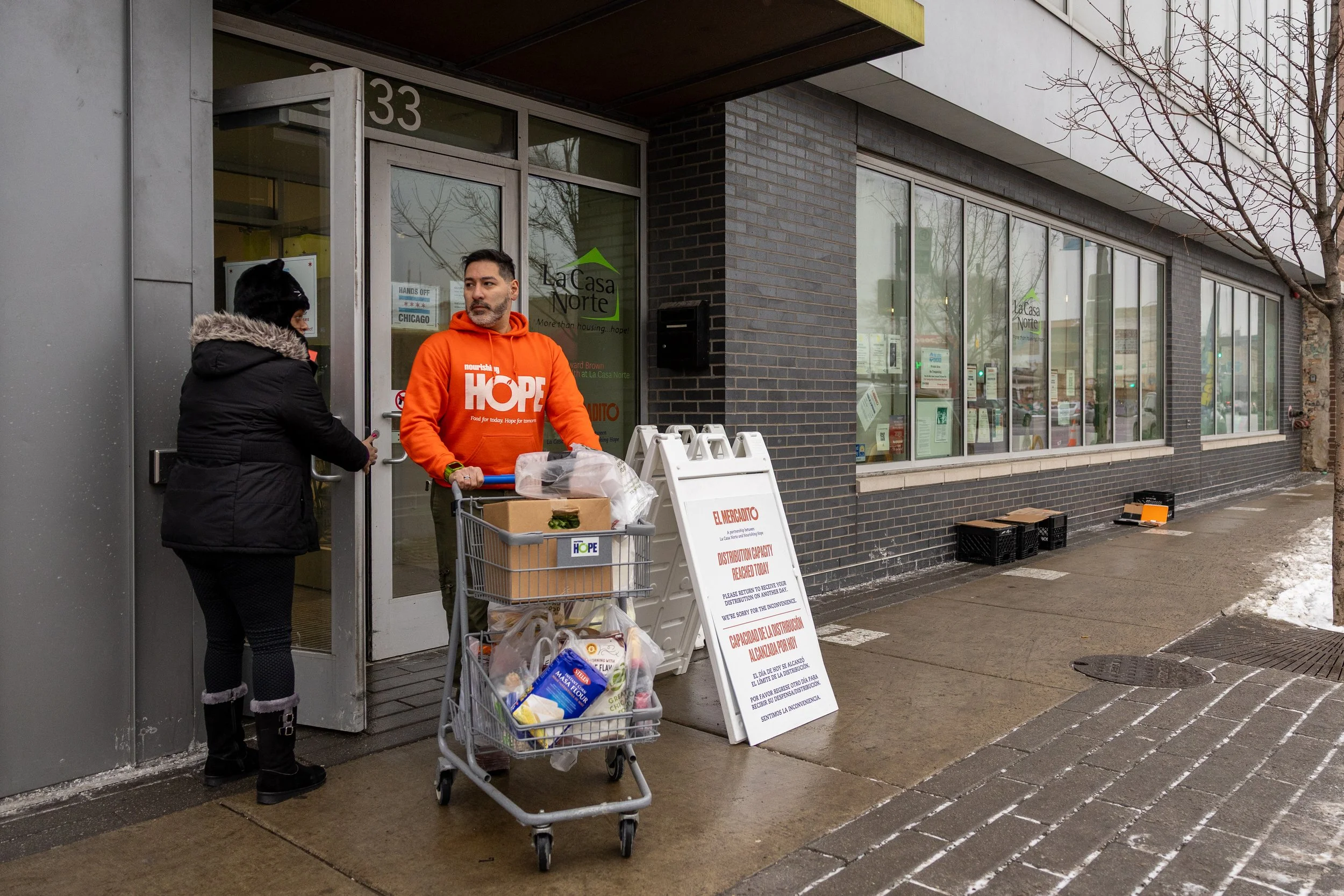
Omar Roman Cristiano, staff member with Nourishing Hope, assists a client with her groceries outside the El Mercadito food pantry in the Humboldt Park neighborhood on Feb. 2, 2026. (Heidi Zeiger / City Bureau)
Amy Newman, a teacher and founder of Families Helping Families Chicagoland, also is expecting bracing to get more requests for emergency help.
The group supports foster kids and families with children in crisis by donating money to pay bills, delivering gifts for kids, and promoting individual fundraisers. Families in need could be dealing with a fire, food or death in the family, or SNAP benefits getting cut off. The help the group provides often depends on the money it can raise, be it hundreds or thousands of dollars, she said.
“Something happens that has [families] go, ‘Oh my gosh, I need help right now,’ and we’re sort of the Band-Aid,” Newman said.
With the changes to SNAP, Newman predicts families who lose those benefits will simply move their money away from other things they need, like using utility bill money to buy groceries or vice versa, she said.
“So for us, it’s figuring out, how are we going to fill in for them?” she said. “We’re just a stopgap; we’re not something that’s going to keep them going.”
Newman wants to raise more money to boost direct support for families. She also wants to connect with other small organizations so they can point people in the right direction to get the correct resources. This involves getting the word out about what they do and encouraging community members to lend a helping hand.
But ultimately, Newman agrees that the available support can’t meet spiking demand.
“In the world, there just needs to be more resources to help people to self-sustain,” Newman said.
Jerrel Floyd has been City Bureau’s engagement reporter since 2022, covering housing, food insecurity and mental health while leading cohorts of Civic Reporting fellows. Previously, he was a ProPublica Illinois fellow and a local government reporter with The Post and Courier in Charleston, South Carolina. He has covered a wide range of topics from youth development to education and health.
Support City Bureau’s work by becoming a recurring donor.