
With thousands at risk of eviction, homelessness advocates and survivors are navigating federal funding instability and lacking local funding in the city's budget.
by Jerrel Floyd

Thomas Wilkins on Friday, Aug. 21, 2026, outside of his apartment in Logan Square. (Photo: Anastasia Busby; illustrations: David Alvarado)
“Perfect Storm” is a series focused on how federal funding instability is affecting local communities, produced by City Bureau in partnership with local organizations in the Documenters Network. It looks at how communities across the United States — big and small, rural and urban — are reckoning with slashes to federal budgets, the sunsetting of COVID-era grants, and turbulent legal challenges leaving funding in limbo. Find the full series here.
Chicago Documenters assignments from Ava Grubb, Holland Harmon and Tema Zeldes-Roth were used to help this reporting. Find more meeting coverage at Documenters.org.
Thomas Wilkins remembers wasting away.
A homeless man in his late 30s, Wilkins was managing a chronic illness and a drug addiction, while unable to access his necessary HIV medication. He said he eventually got diagnosed with wasting syndrome. He would get some help here and there — $80 a month from a health and housing program was a vital asset. But it wasn’t enough to alter his situation, he said.
“I was living in the park, didn’t have [anywhere] to take my meds, couldn’t feed myself,” he said.

That changed when he was accepted into a permanent supportive housing program through AIDS Foundation Chicago.
For the last 21 years, Wilkins, now 63, has maintained stable housing in Logan Square, where he lives with his wife and three chihuahuas. He runs a maintenance business for surrounding buildings.
Without the baseline security of a place to live, it never would have happened, he said.
“This program truly saved my life,” he said.
But as the Trump administration fights to cut funding — despite continuing blocks by federal judges — for the sort of evidence-based, housing-first programs that gave Wilkins that stability, he and thousands like him risk facing evictions and housing insecurity once more.
Combined with Chicago’s lack of a permanent pot of money for such programs, the proposed federal cuts are not only manifesting a perfect storm of funding instability, advocates say, but also threatening to put more Chicagoans on the streets as the federal government pulls back from the housing-first model, which many experts say is a solution to the recent rise in homelessness.
“It really puts immediate housing within reach of people that would traditionally have a lot of barriers,” said Brandi Calvert, the vice president of housing at AIDS Foundation of Chicago.
Credible threats
These permanent supportive housing programs, also known as a housing-first model, are built around the research-based concept that for someone navigating persistent homelessness, the most vital thing to secure for them — before finding a job or other support — is a stable place to live. After that, needs related to chronic health conditions and finances can be addressed.
“It has been the gold standard for housing for the past 30 or so years,” said Calvert, whose organization, AIDS Foundation of Chicago, offers its housing-first program across the city.
Calvert describes it as housing without preconditions. It also involves heavy case management and supportive services, with the main requirements being that a person has experienced chronic homelessness and is also managing a disability, mental health condition, addiction or chronic illness, she said.
The model is also better for communities as a whole, research says. Housed people are less likely to need emergency services such as hospitals, temporary shelters, or jail, which ultimately costs less for taxpayers, according to the National Alliance to End Homelessness. Housing-first programs decrease homelessness by nearly 90% and improve housing stability by around 40%, according to a 2021 review in the Journal of Public Health Management and Practice.
Since 2009, the U.S. Department of Housing and Urban Development’s largest funding channel for homeless services and resources has been the Continuum of Care Program. Through CoC, regional coordinators bring together local resource providers, social service workers and advocates to administer the programs using the federal money.
For 2026-27, HUD was set to award $3.9 billion, approximately 88% of which was spent on permanent housing in the past, according to the National Alliance to End Homelessness.
But in November, the Trump administration tried to impose a 30% cap on CoC money used for permanent housing programs. It argued that housing-first programs “deprioritize accountability” and enable dependency.
A similar argument was seen with recent changes to SNAP benefits.
The administration also wants to require program coordinators to incentivize the criminalization of people without homes living in public spaces, prioritize temporary transitional housing programs, and disqualify housing projects that highlight racial preferences, use harm reduction tactics or acknowledge gender identities outside of cisgender men and women.
While federal lawsuits have delayed the changes and allowed funding to be disbursed without the cap, Chicago stands to lose almost $67 million if the cuts are enacted, amounting to a projected loss of 5,892 beds out of its more than 9,000 permanent supportive housing beds, according to the National Alliance to End Homelessness. Illinois would lose $106 million and 9,362 beds out of 21,400 total.
“There’s a credible threat to the funding that states and cities have relied on for decades,” said Doug Schenkelberg, executive director of the Chicago Coalition to End Homelessness. “That funding has never been adequate. It’s never been enough to meet demand, but it has been reliable.”
And Chicago needs those dollars to meet a steadily high number of people without reliable housing.
The coalition estimates more than 58,000 community members experienced homelessness in 2024, living on the streets, in shelters, or temporarily in someone else’s home. This is more than triple the federal estimate, which doesn’t include people staying with others or living in an overcrowded home without contributing to housing costs, known as doubling up.
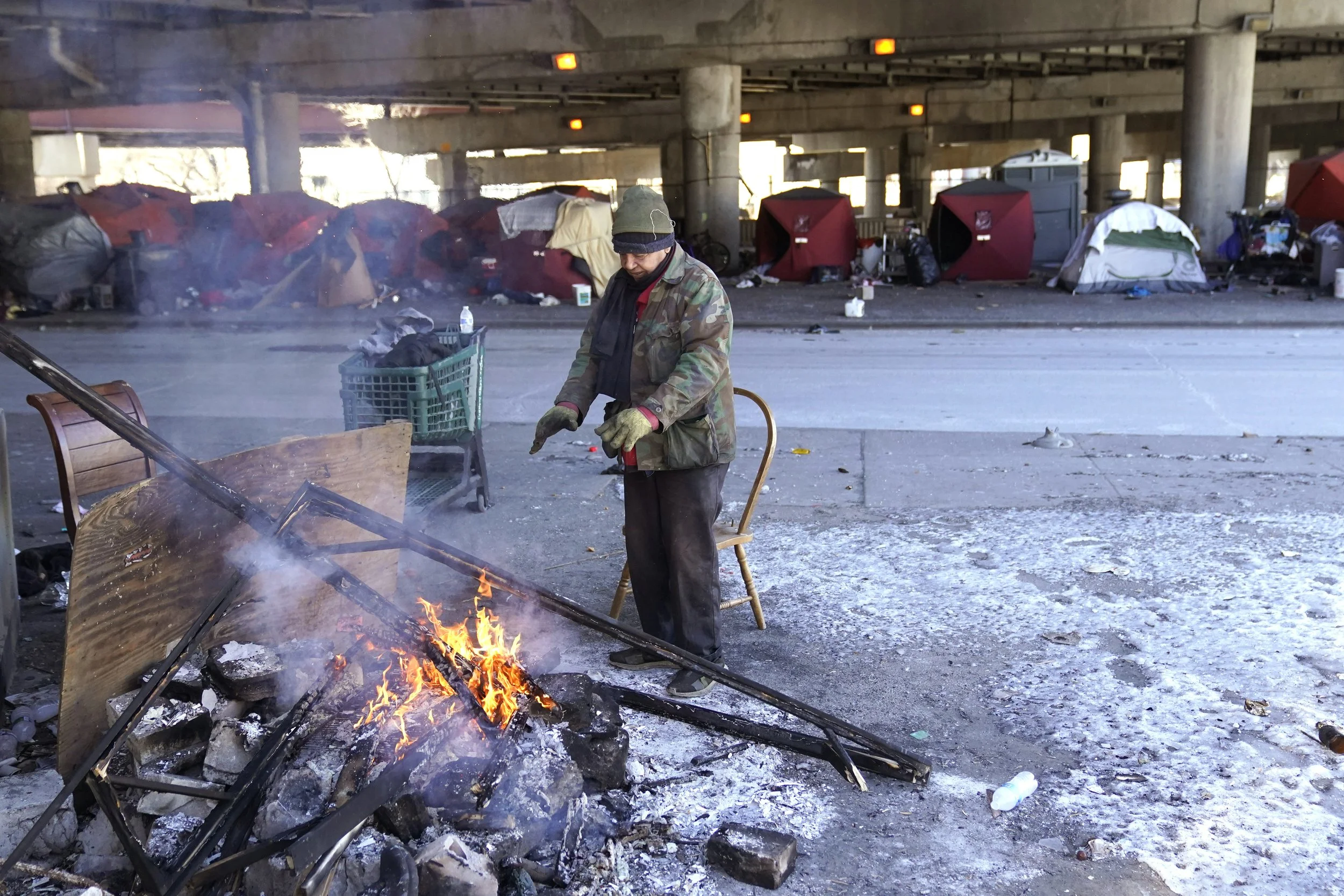
A man warms his hands by the fire he created across the street from a homeless encampment under a major interstate freeway Tuesday, Jan. 16, 2024, in Chicago. (AP Photo/Charles Rex Arbogast)
It can take months to find a place in some Chicago shelters, according to a December report by Borderless magazine. And for every person who gets help with housing insecurity from Chicago’s Continuum of Care provider, All Chicago Making Homelessness History, 10 more are in need, the organization said.
With the goal of making homelessness in Chicago “rare, brief, and nonrecurring,” Mayor Brandon Johnson appointed the city’s first chief homelessness officer in 2024. Together, they created a five-year plan, released in April, to better the city’s response to housing insecurity.
But the money required to enact the plan relies on federal dollars as the heaviest funding source. Federal COVID-19 relief money has to be spent by the end of 2026, and there are no plans to replace it through other sources. The Department of Family and Support Services, whose $66 million in homelessness services represents the largest bucket of such spending in the city, received a nearly $300 million budget cut this year.
COVID-19 relief funds were introduced in 2022 through the American Rescue Plan Act of 2021, and the department coordinated more than $900 million until 2025. More than 20% of the money was from ARPA. The department's current budget, around $650 million, now sits below its 2020 budget by about $35 million.
“The fact that our homeless response system in Chicago is so reliant on federal funding just means that we are more likely to be destabilized when there are sweeping changes at the federal level, like there are happening now,” said Nicole Bahena, senior vice president of community engagement for All Chicago Making Homelessness History.
Creating instability
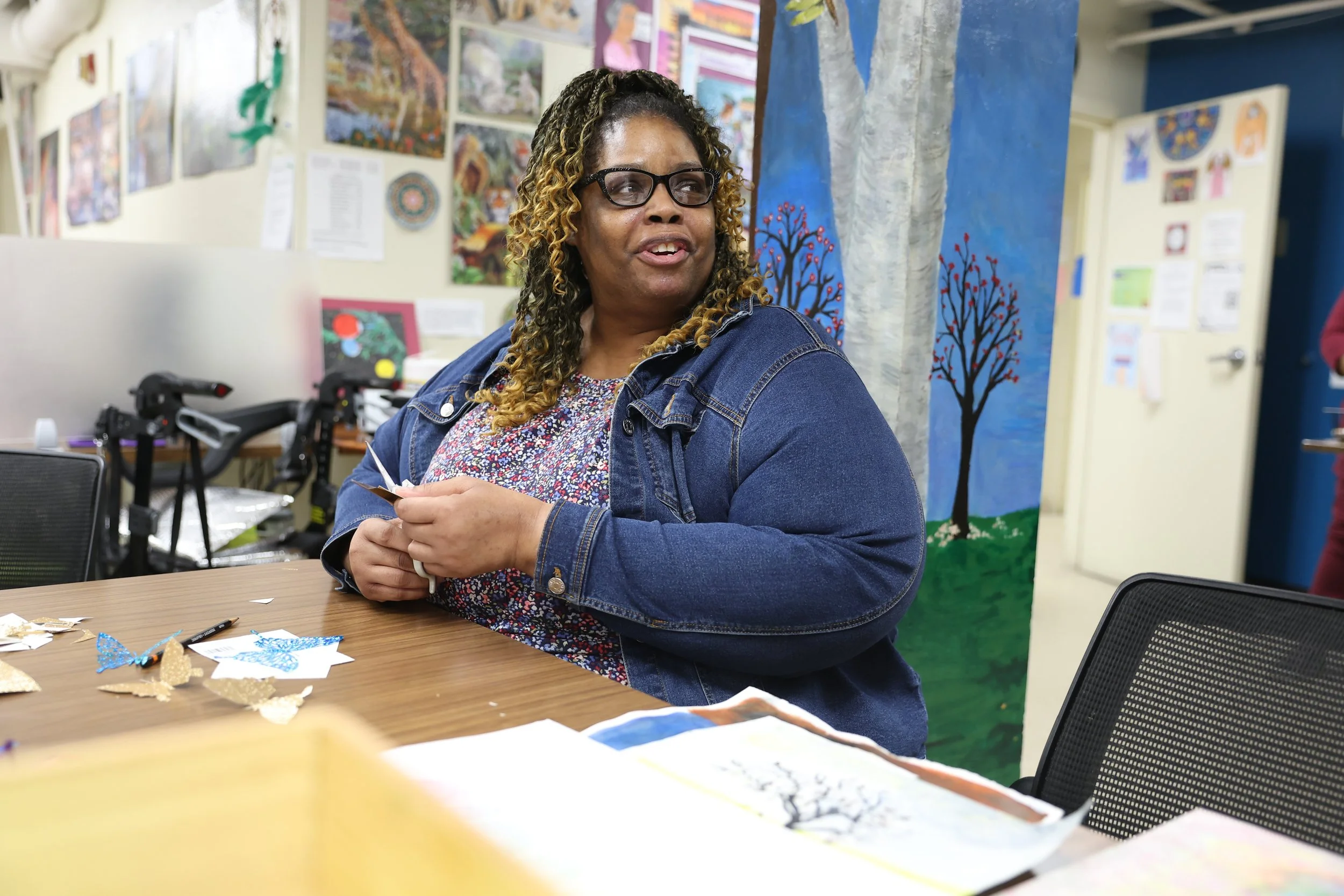
Mildred Jenkins cuts up paper butterflies at Deborah's Place in Chicago’s Old Town neighborhood on Thursday, April 16, 2026. (Talia Sprague/for City Bureau)
After three years of short-term shelter hopping, in early 2020, 54-year-old Mildred Jenkins found a place that allowed her to stay longer than a couple of months. Even better — the computers there actually worked.
It was through this East Garfield Park shelter, Breakthrough Women’s Center, that she could follow up on different applications to help her secure housing through providers like the Chicago Housing Authority. It’s where she first learned about Deborah’s Place, the East Garfield Park nonprofit housing organization that operates her current apartment building.
She said she was surprised to learn that when she moved into her apartment with Deborah’s Place, she wouldn’t even need furniture. She had assumed she would be sleeping on the floor.
“I was grateful,” she said.
Over its 40 years in operation, Deborah’s Place has become the largest provider of permanent supportive housing for unaccompanied women in Chicago. Every year, the organization supports nearly 700 women, mostly through the permanent supportive housing program.
But the demand for housing and shelter beds is outpacing what the city has available, said CEO Kathy Booton Wilson. The threats of federal funding cuts combined with the growing need are creating instability in how they are able to provide care and delaying placement for people newly without homes, she said.
“If you think of this huge influx of people going back out onto the streets, that’s people who are going to be using much more expensive resources,” Wilson said. “The hospital emergency rooms are already full of people who are homeless, who are just going there because they have nowhere else to go.”
The proposed federal cap on permanent housing would throw several wrenches in the operations of housing organizations, said Perry Vietti, president of the Interfaith Housing Development Corporation, a nonprofit developer that builds long-term affordable housing in Chicago.
Switching projects from permanent housing to a transitional model, where residents could only stay for around two years, would mean restructuring state and city funding and difficult adjustments to contracts and agreements, he said.
“It's not simple to make those changes,” he said. “You can’t just change midstream without radical alterations having to be approved.”
The federal cap would threaten residents in two of the buildings in the Deborah’s Place portfolio, which have long-term agreements to remain permanent supportive housing. Loans with the city and state would be violated, forcing evictions, Wilson said.
Among them are The Conservatory Apartments in West Humboldt Park, which house 34 women in studio apartments built in partnership with Interfaith Housing in 2024.
“That would be really horrible if the people who finally just got into housing there had to leave, and that building had to close,” Wilson said.
Other clients of Deborah’s Place receive permanent supportive housing funds that cover rent for around 200 apartments not owned by the nonprofit. Wilson said those landlords would lose their tenants and that dependable rental income.
“It would be really disastrous,” she said.
The Trump administration’s efforts to criminalize homeless camping and other demands are further complicating matters for service providers, advocates said. Calvert said many organizations and providers who are part of the Chicago Continuum of Care are trying to find a balance of complying — in order to avoid losing funding altogether — and holding their values up.
“We’re trying to figure out how we bend but still hold true to what we’ve been doing all these years,” she said.
People who get evicted from permanent supportive housing can’t automatically move to a transitional housing program, because they wouldn’t be considered chronically homeless, according to providers.
“Everybody else who’s in permanent supporting housing right now, who is formerly homeless, who managed to get into housing and is fighting to pull their lives back together, those people are going to have to leave their housing,” Wilson said. “So those people will be back on the streets.”
Perpetuating homelessness
That tenuous living situation is something Jenkins remembers all too well. During her years of shelter hopping, she would call 311 or visit a police station or hospital for help finding a day or night shelter with a place for her.
“But not anywhere where they can actually help you [long-term],” she said. “It’s just giving you a place to sleep and maybe food the next morning.”
Jenkins said she remembers police setting her up with a short-term stay at a women’s shelter through Olive Branch Mission, a nonprofit that offers homeless services. One night, she said, while she was using the bathroom, a woman came up to her and tried to assault her. They ended up fighting.
“I never had a fight in my life until I was an adult,” she said.
As a result of the altercation, Jenkins was kicked out, and she was back looking for another shelter. It all represents a pattern Jenkins doesn’t want to experience again.
“I was like, OK, I need a breakthrough,” she said.
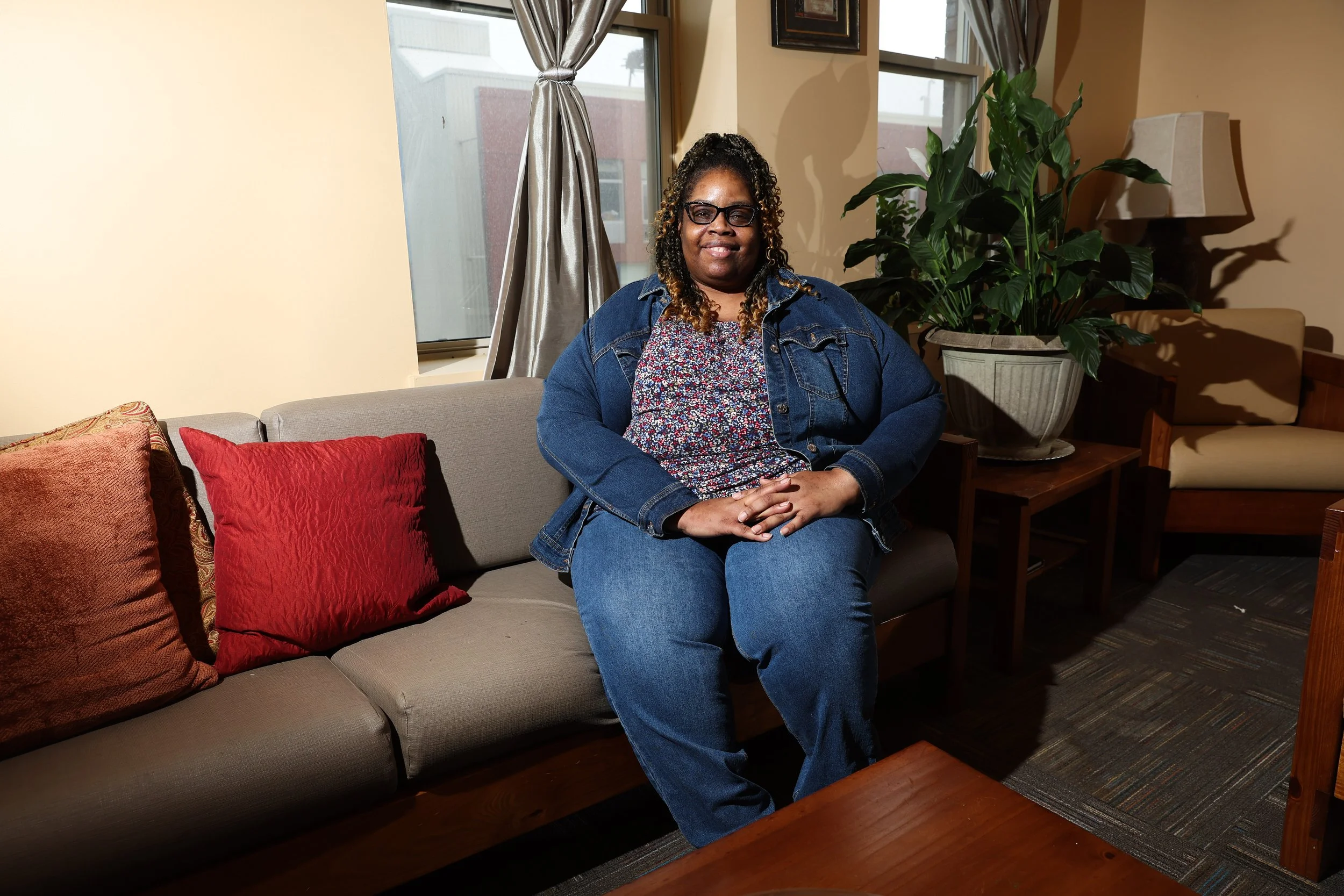
Mildred Jenkins poses for a portrait at Deborah's Place in Chicago’s Old Town neighborhood on Thursday, April 16, 2026. (Talia Sprague/for City Bureau)
While program managers stress about how they’ll navigate funding cuts, for their clients like Jenkins, the threat means revisiting a reality they’d hoped they had escaped for good.
Kellia Phillips, now 46, grew up living with her grandmother and mother. As a teenager, she doubled up with her aunt, paying rent and watching her little cousin, Phillips said.
She left that home and went to stay with a friend’s mother for around three years. She didn’t realize she had experienced homelessness until she was old enough to process her past.
“That’s not your home,” she said of her tenuous living situations. “It didn’t click when I was 16.”
As she grappled with an abusive relationship later in life, she began shelter hopping, looking for space for her and her children. It meant long days and missed dinners because of the long commute from work and picking her children up from school, she said.
Finally, she found a permanent living space through a housing-first program at a Catholic Charities family shelter called Madonna House.
Now she advocates for others facing housing insecurity as a member of the Chicago Coalition to End Homelessness’ Speakers Bureau, asking Chicagoans to show more compassion for their unhoused neighbors.
“It’s not that they don't want to do better; it’s just that at that moment of time, they can’t,” she said.
There are hurdles that come with the instability of homelessness. Wilkins became homeless after his aunt kicked him and his siblings out of her home after his mother passed.
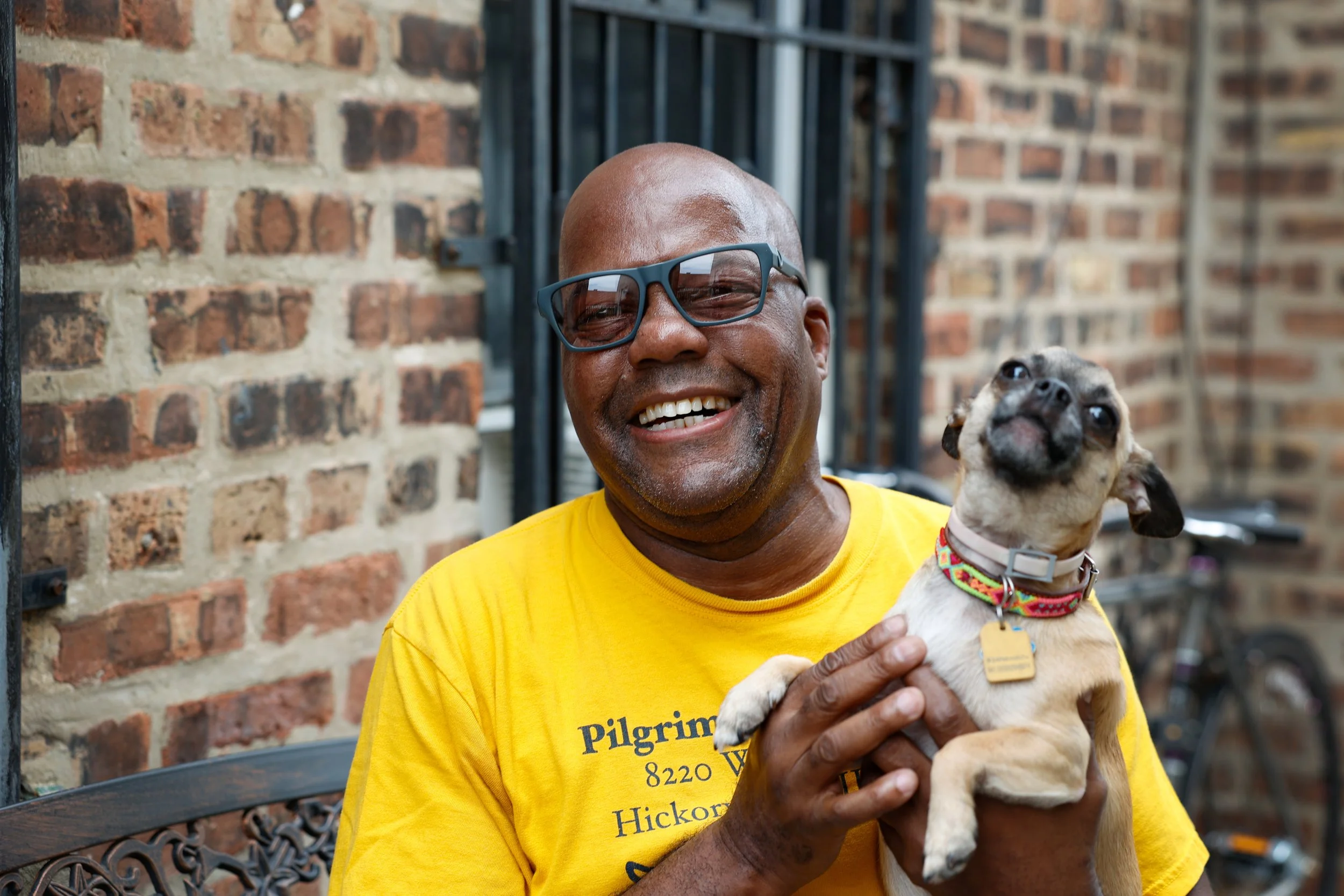
Thomas Wilkins holds one of his pet chihuahuas on Friday, Aug. 21, 2026, at his apartment in Logan Square. Wilkins has been in Logan Square for over 21 years. (Anastasia Busby/City Bureau)
He spent years navigating public parks, shelters and couch surfing. Eventually, he said, he lost track of his siblings.
Because Wilkins didn’t have an address and was constantly moving from place to place, consistently getting medication to manage his HIV was challenging. Temporary shelters weren’t an option to store medication either.
That lack of access was in part why his health was failing so much.
“So it was a vital point that I fought, fought and fought to secure housing,” he said.
Jenkins recalled being booted from shelters after her time was up, once returning from the laundromat to find her belongings removed from her locker and waiting for her up front.
Without warning, she was abruptly back on the streets of Chicago.
“When you’re homeless, people treat you different,” she said.
After finding another shelter, she got sick and went to the hospital. They dismissed her cough as nothing serious and told her to leave. But when her cough persisted, shelter staff said it caused a disturbance and she couldn’t stay until she figured out what was wrong.
They sent her to another hospital, where she was diagnosed with pneumonia. She was separated from others at the shelter, and figured she caught it from sleeping outside.
It was impossible to secure a job while navigating so much uncertainty, she said.
“No one asks to be homeless, no one wants to be homeless,” she said.
Finding solutions
The federal government’s historic stability, sweeping funding resources and national scope make it best equipped to handle issues such as homelessness across states and communities, providers said.
“If the feds can’t do this, who can?” said Lynda Schueler, CEO of Housing Forward, a west suburban-based organization with a variety of homelessness services. States and local governments can’t replicate the level of resources the federal government is currently committed to, she said.
“It’s the federal government’s responsibility, really, at the end of the day,” she said. “They are the best positioned to be able to solve this, and solve this in a way that focuses on housing and not work requirements and imposing unnecessary, undue harm on such vulnerable people.”
But with federal funding at risk, some local advocates are looking at other states and municipalities for alternative funding strategies that would stabilize financial support for services in Chicago.
Through her work with All Chicago Making Homelessness History, Bahena learned that Minnesota has a state tax that is directly funneled into county-level homeless services, she said.
Because of the funding source’s flexibility, Hennepin County was able to shift money toward crisis support services when federal immigration enforcement action targeted Minneapolis in December, she said.
New York City, meanwhile, is “just a different beast,” with more local and state funds going into their homeless services, she said. Less than 25% of its housing-first money comes from HUD’s Continuum of Care, according to the National Alliance to End Homelessness — a far cry from Chicago’s 60%.
Chicago’s attempts to create permanent local funding have failed. Mayor Brandon Johnson and housing advocates backed the Bring Chicago Home referendum to create a revenue stream for homeless prevention in the city. The move would have increased the one-time real estate transfer fee on property sales over $1 million, while simultaneously lowering the fee for less expensive homes and buildings. It was estimated to bring in around $100 million per year.
But voters rejected the measure in March 2024.
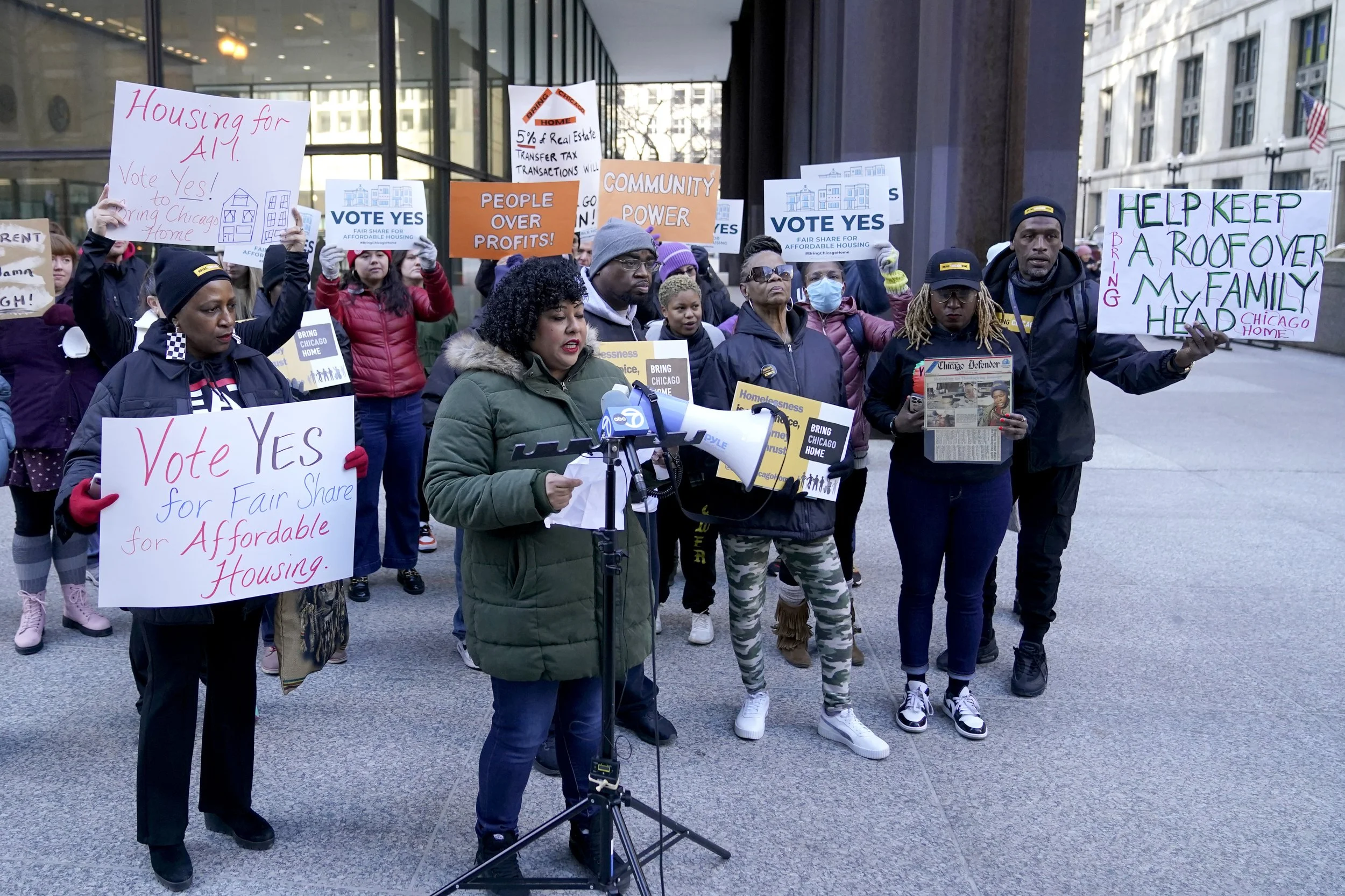
Supporters of the “Bring Chicago Home” ballot measure that raises a one-time tax on luxury properties to fund services for homeless people rally prior to a court hearing, Feb. 14, 2024, in Chicago. (AP Photo/Charles Rex Arbogast, File)
Schenkelberg, executive director of the coalition that supported the measure, said they’re still committed to creating a dedicated funding stream in the city for housing and services.
“What are the different avenues to do that, what makes the most sense in the long-term, what's politically viable?” he said. “We're figuring it out, and we're working on it.”
From advocates and providers to developers and those with lived experience with homelessness, most agree community members will play the most significant part in addressing the problem.
Organizers are pushing residents to reach out to their local alder and say that they support investment in homelessness prevention, with the hope that a revenue source like Bring Chicago Home will garner more support in the future.
But people like Phillips and Jenkins also just want community members to speak to their neighbors more, regardless of housing status. Hearing their stories and building empathy, they say, is vital to addressing the homelessness crisis.
“In 2.5 seconds, you could be homeless,” Phillips said. "But you’re never thinking like that because you’re throwing so much hatred, so much pain, or whatever you’re dealing with, onto the person that’s experiencing homelessness."
Today, after spending years visiting her complex’s learning lab and serving on the board of directors at Deborah’s Place, Jenkins said she feels empowered. As she takes those early steps of finding a job and managing her depression in order to transition to a space of her own, she said she’s ready to pay it forward and share her and others’ stories.
But to fully understand Jenkins’ story, it’s important to know how she found herself experiencing homelessness in the first place.
Over a decade ago, the South Side native moved to Madison, Wisconsin, to help her mother with a colon cancer diagnosis. The strain of caring full-time for her mother, who died in 2014, led to Jenkins developing a hernia wrapped around her own colon.
After emergency surgery, she recuperated at her brother’s three-bedroom home as one of nine adult residents, plus three children.
When she healed and eventually left, she said she couldn't find enough resources for single women without children while in Madison. After landing at a Salvation Army shelter, she experienced one of her first physical assaults.
Jenkins said a group of women were after a pair of new black FILAs that her brother had bought for her job as a cook at the University of Wisconsin. After the attack, all of the women involved, including Jenkins, were asked to leave.
Sleeping outside in the streets of Madison, she said she decided to return to Chicago, hoping for more resources and a path to stability. She said she hitchhiked to a Greyhound station and found a nice young man who bought her a bus ticket.
“I had no money, but I just said, ‘If I can get back to Chicago, I think I can make it,’” she said.
And after years of struggle, she’s starting to feel like she has.
Editor’s note: The story has been updated with the correct spelling of Kellia Phillips’ name. City Bureau regrets the error.
Jerrel Floyd has been City Bureau’s engagement reporter since 2022, covering housing, food insecurity and mental health while leading cohorts of Civic Reporting fellows. Previously, he was a ProPublica Illinois fellow and a local government reporter with The Post and Courier in Charleston, South Carolina. He has covered a wide range of topics, from youth development to education and health.
Support City Bureau’s work by becoming a recurring donor.