New Jersey was the first state to treat civic information as a public good. This summer's budget process will decide if that experiment will survive.
By Sonam Vashi
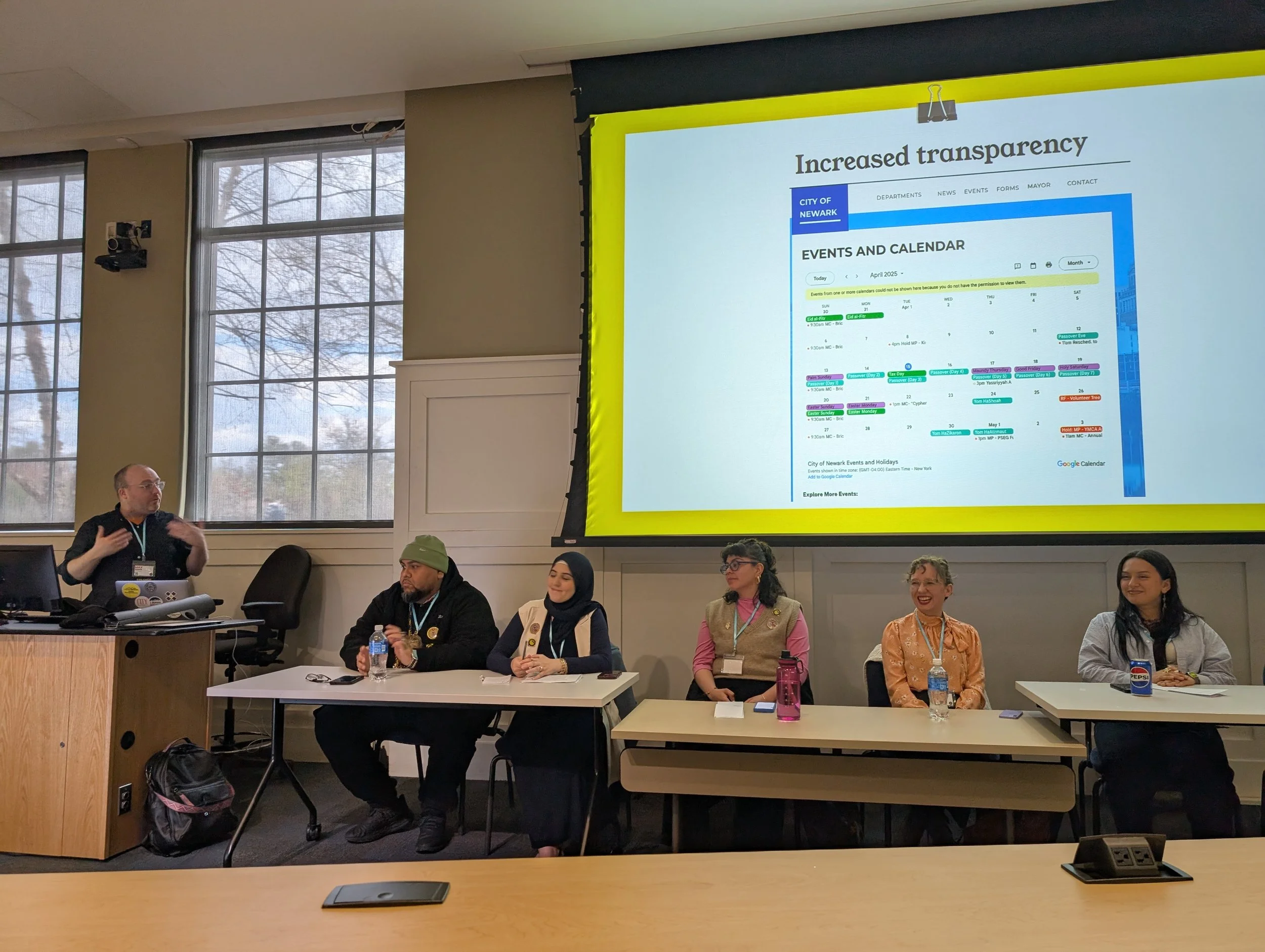
From left: Max Resnik (City Bureau’s Director of Documenters Growth); Victor Enok Gavilanes (Newark Documenter); Hayat Abdelal and Viri Martinez (New Jersey Alliance for Immigrant Justice); and Victoria Masteller and Yeimy Castillo (CoLAB Arts) discuss the impact of Documenters in New Jersey on a panel. Credit: Anastazia Vanisko/City Bureau.
Civic life is blooming in New Jersey. In Newark, the New Jersey Alliance for Immigrant Justice has trained and paid everyday community members as Documenters to inform their neighbors about their local government and make it more transparent, including by pressuring the city’s public safety committee to put its meeting notices on their website. Elsewhere in New Jersey, coLAB Arts has trained and paid community members to make public meeting reports more accessible by translating them into Spanish, tracking transparency violations, and hosting events to inform people about local school board elections.
Community members—not just professional journalists—are leading this work, and the impact is more powerful as a result: In one instance, a school board candidate told the coLAB team that they attended the event only because it was organized and attended by Documenters.
“‘I joined this program because I’m deeply committed to justice and I believe that access to information is a fundamental part of empowering communities,’ said Newark Documenter Nicole Herrera, who’s covered zoning boards and sewer commissions in the city.”
This structural pathway for participation could be happening in every community in New Jersey and beyond—and if we want a thriving democracy, we need that kind of civic infrastructure. A recent national survey from the National Civic League and ActiVote found that 65% of respondents felt civic decisions are dominated by 'the usual suspects'—and that nearly half would be more likely to get involved if leaders and residents could work together more directly.
This and many other reports show that the solution isn’t more information: It’s more pathways for action. At City Bureau, our Documenters program is exactly that: a structured, paid, accessible civic action opportunity that builds the trust, agency, and belonging people are hungry for.
A proven model
In New Jersey, this work is possible because of the New Jersey Civic Information Consortium (NJCIC), a first-of-its-kind public funding model that uses government dollars to fund local community-driven news.
This moment requires experimenting and evaluating different pathways for supporting civic life, including public funding. This idea isn’t radical: historically, our country has agreed that the government has a role in sustaining the community infrastructure that people need to participate, learn, and thrive.
Addressing the collapse of commercial media and social infrastructure will require more sustained investment than philanthropy alone. Private foundations often have geographic limitations, shifting priorities, and blind spots toward smaller or marginalized communities that don’t match the pace or scale of our society’s needs. So, like libraries, public broadcasting, and emergency information systems, NJCIC treats civic information as a public good. This is what makes NJCIC such a critical experiment for the country.
Since it was created in 2018, NJCIC has invested more than $12 million in news and civic information across New Jersey, reaching more than 90% of counties in the state. NJCIC provides essential connective tissue for news and civic organizations, partnering with national organizations and universities across the state to offer central training and services. (State law protects editorial independence for grantees.)
City Bureau’s partnership with NJCIC has trained hundreds of community members, documented more than 150 public meetings, and paid more than $15,000 directly to people—compensating them for their time and making civic participation an accessible act.

Newark Documenters celebrate the launch of their guides to local public agencies. Credit: Max Resnik/City Bureau.
These effects have rippled outward to the larger community, too: A local community college has started incorporating Documenters training into their community journalism certificate courses, enabling students to take Documenters assignments.
NJCIC’s support has created structural pathways that directly connect community members to the decisions shaping their lives: whether your rent goes up, whether your school stays open, whether your neighborhood has a plan for floods. Most of those decisions happen in rooms where—aside from officials and lobbyists—nobody else is watching. Now they are. With continued—and ideally expanded—state support, the model New Jersey has built in Newark and New Brunswick can continue to be a national leader in community-powered information infrastructure that reaches every county, trains thousands of residents, and treats public meetings as the civic commons they were always meant to be.
“As Victor Enok Gavilanes, longtime Newark resident and Documenter, said: ‘Change takes knowledge … I think that’s what Documenters gives you—an opportunity to be a change agent.’”
Now, that model is at risk
However, this work is under attack: In order to close a budget deficit, New Jersey Governor Mikie Sherrill has removed state aid to NJCIC entirely in the proposed state budget, set to be finalized at the end of this month. (NJCIC received $2.5 million from the state in 2025 after initially being zeroed out in a proposed budget.) The proposed funding cut comes at a moment when New Jersey already has far too few reporters covering local government, school boards, housing authorities, utilities, courts, public agencies, and the State House itself: New Jersey already ranks near the bottom nationally for local journalists per capita.
What comes next
What happens in New Jersey's budget process this summer matters beyond New Jersey. Cutting NJCIC’s support would dismantle some of the most promising civic infrastructure in the country and close the door on thousands of New Jerseyans who have only recently experienced that they have a seat at the table.
New Jersey has a chance to keep proving that civic information—like roads and libraries—is worth public investment. We hope they take it.
Learn more and support the New Jersey Civic Information Consortium
Learn more about the Documenters Network: documenters.org