
The Inner-City Muslim Action Network’s Green ReEntry program has been helping men rejoin their communities after incarceration for over 15 years. Rebuilding homes is a way to mend across generations.
By Marium Asif
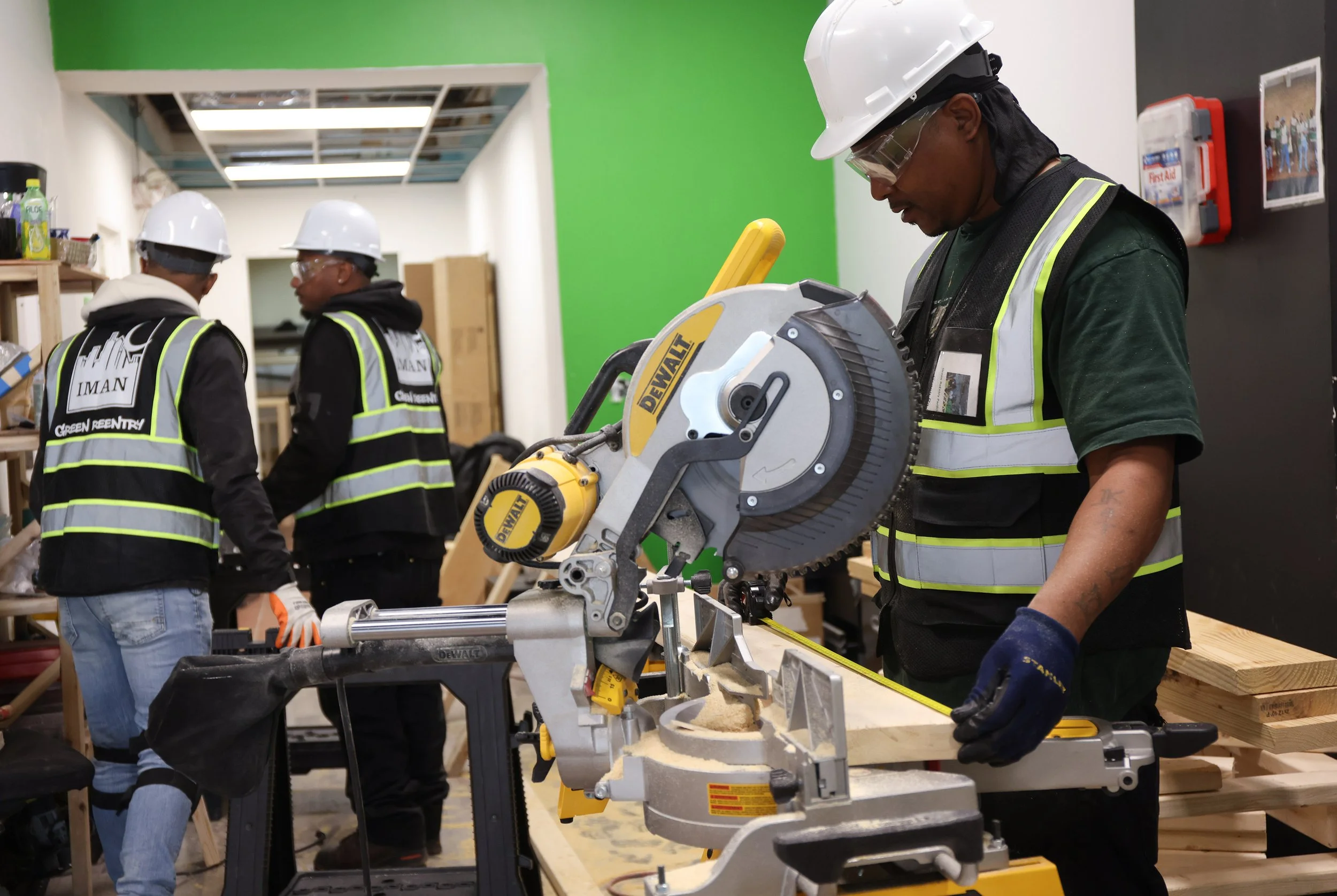
Dujon Dukes, right, Jovarnis Baugh, center, and Kevin Henderson work on an outdoor bench at Inner City Muslim Action Network (IMAN), Monday Nov. 17, 2025. (Abel Uribe/for City Bureau)
The day begins in a circle.
It’s 8 a.m. inside Inner-City Muslim Action Network (IMAN) Health Center. Chairs are drawn together, and the 23 men in the Green ReEntry program start their 15-minute morning ritual with a pledge, repeating a few short lines until their voices blend.
“I am a man.
“I pledge as a man to be responsible to myself, my family, and my community….
“I pledge to give as much as I receive.
“I pledge to respect both peers and staff.
“We are a team, one unit, and one chain. We are only as strong as our weakest link.”
After the last echo, the group starts the PIES daily check-in — how each person is doing Physically, Intellectually, Emotionally and Spiritually.
“It’s like a group strength builder,” said Dujon Dukes, 43, a member of the most recent re-entry cohort. “You get to see how a person is feeling in the morning. He might not be feeling like a 10, he might be feeling like a six, and you want to know what’s going on with them.”
IMAN, a faith-based community organization in West Englewood, combines spiritual grounding with social services such as health care, housing, and a grocery store. Green ReEntry launched in 2010 to support formerly incarcerated men and at-risk youth through therapy, case management, mentorship, and paid job training.
Thousands of people are released from Illinois prisons each year, according to the Illinois Department of Corrections. Reentry services and programs are critical to prevent recidivism, but challenges such as finding stable housing continue to make that process difficult for many. What’s more, federal funding for violence intervention and reentry programs has been slashed. Amid rising cost of living and reduced monetary support, many community-based organizations are being asked to serve more people with fewer resources. Against this backdrop, IMAN focuses on long-term relational support rather than short-term services.
Working collectively is key to everyone’s success, IMAN’s leaders say. Green ReEntry participants stay together from morning pledge to afternoon cleanup. Besides learning trades, the men are learning how to trust again, to listen and to pass on the advice they wish they’d received earlier.
Men in their 20s commune with those in their 50s and 70s. The program becomes the bridge between the past and present, between men who once shared parallel lives in cellblocks and those trying not to end up there. In the rhythm of labor and support, Green ReEntry builds and heals among generations.
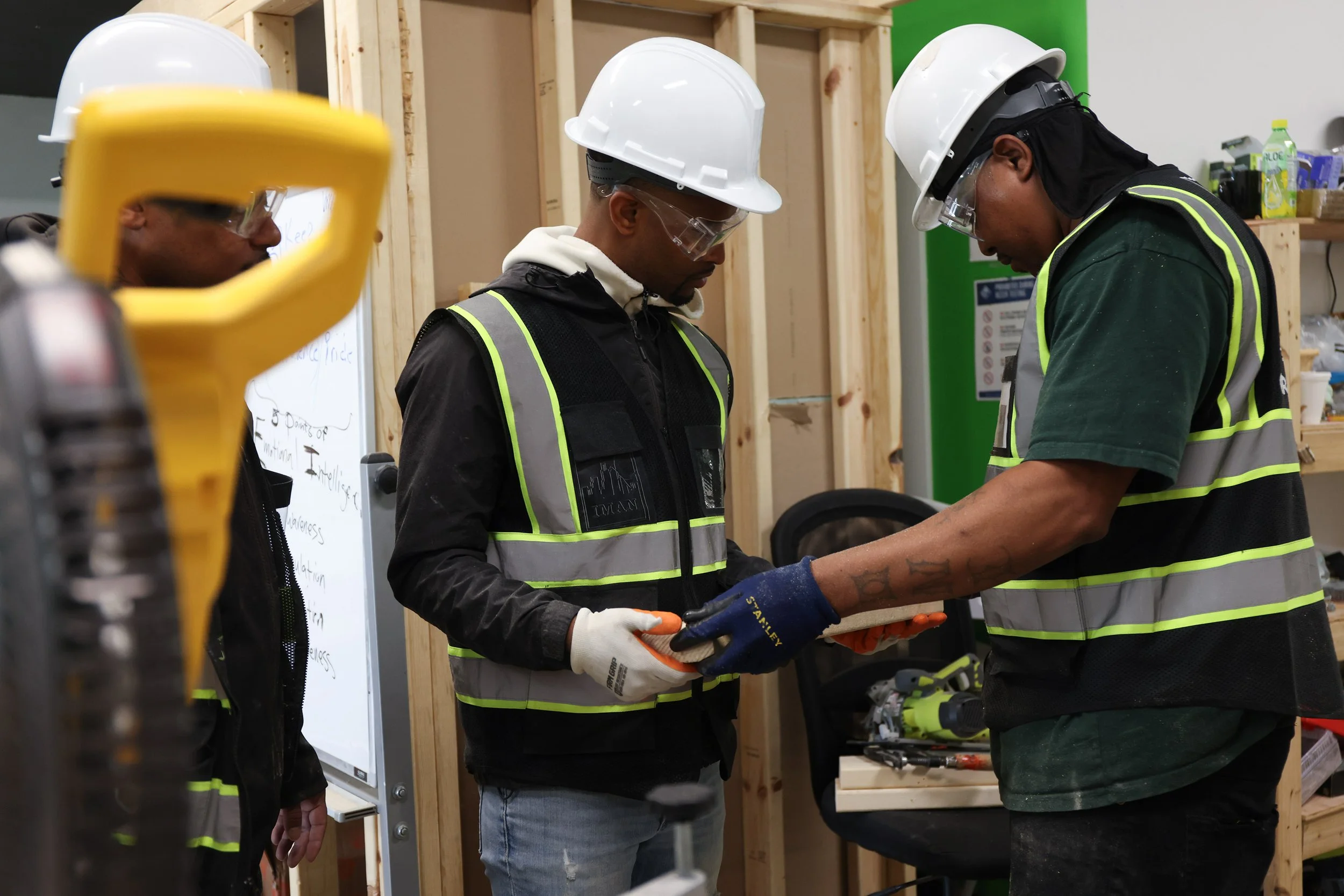
Jovarnis Baugh, left, Kevin Henderson, center, and Dujon Dukes, work on an outdoor bench at Inner City Muslim Action Network (IMAN). (Abel Uribe/for City Bureau)
Alia Bilal, IMAN’s co-executive director, said leaders structure the program this way because incarceration fractures connections across age lines: fathers lose decades with their children, and young men grow up without elders to steady them. Bringing these generations into the same room restores something the system took.
“One of the really beautiful things that we see when we have those two populations together is that the pioneers in that space, the elders in that space, end up filling some real [needs] that the young men […] have needed filled, and vice versa,” Bilal said.
The Way Back
For most men in the program, the hardest part of returning home isn’t the paperwork, the job search or even the parole check-ins, they said. It's learning how to be around people again, how to sit in a circle, make eye contact and talk about how you feel.
For men who spent years behind walls, silence became a form of survival. That rhythm of showing up, checking in, sharing and listening turns these strangers into a community.
Sheikh Yusuf Madyun spent over a half-century behind bars before he was released in 2021 and joined Green ReEntry.
At 23, then known as Joseph Hurst, he was sentenced to death for killing Chicago Police officer Herman Stallworth and wounding officer Eugene Ervin in a 1967 traffic stop. He was resentenced when the United States Supreme Court briefly placed a moratorium on capital punishment in the 1970s, and paroled in 2021 after then-Cook County State’s Attorney Kim Foxx did not oppose his bid for freedom. He spent nearly 54 years in prison, converting to Islam while inside. He also has spoken out about poor health care inside prisons.
Leaving prison at age 77, he found the world unrecognizable. Even simple things — the sound of traffic, the speed of phones, the absence of faces he once knew — were disorienting. Coming home was “bittersweet … a lot of sweetness, but there’s also bitterness, a lot of letdown,” he said.
IMAN was where he could have a daily routine of showing up, working together, sitting with others. Learning with the cohort became a bridge back into community life. After years of watching society “from ringside,” he found in IMAN a space where “the pieces of the puzzle just fell into place.”
“Just getting on the bus, coming … meeting with the people, getting the feel of society again,” he said.
Despite having aged out of the program’s construction work, it mattered to him that he could be part of the group and contribute his wisdom. One of his roles was to remind fellow members about their responsibilities outside of the eight hours of structured work.
“Most crimes don’t happen when you’re at work … so what are you going to do with those other days that you’re not at work? How are you going to conduct yourself those days, those times?” he said.
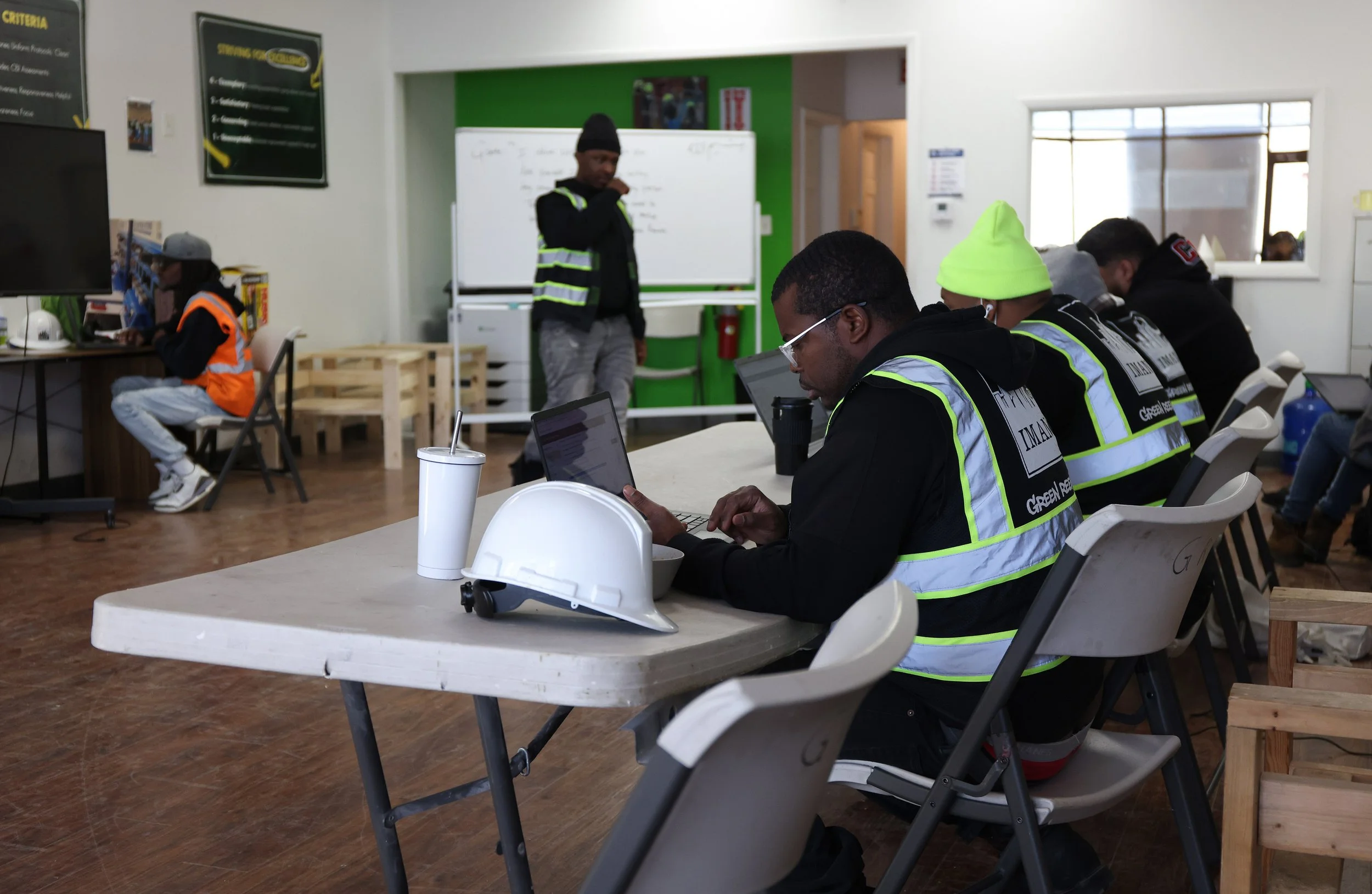
Participants learn the basics of woodworking and carpentry using laptops before being allow to use woodworking tools. (Abel Uribe/for City Bureau)
Ramon Lee was incarcerated for 18 months for driving under the influence. After he was released, Lee, then 29, found Green ReEntry after fruitless job hunting.
"[T]o be quite frank, they were literally the only program in the city giving me a chance at that moment in my life," said Lee, now 36.
The first weeks were awkward — all those strangers in a circle, everyone watching, no one talking much — but eventually the dynamic started to shift.
“This [routine] that they do every morning, I noticed that it made some of us feel more welcome, more acceptable to talk in circles for ones who never did. For people who are really nonchalant and not really good in crowds, they broke that ice right through the door, and they created a brotherhood, a bond that no one saw coming before,” Lee said.
IMAN’s structure aims to dismantle the routine of incarceration and replace it with rituals that encourage trust and grounding.
“We’ve got to trust each other,” Dukes said . “When one person discloses something traumatic in his life, it doesn’t leave the facility. We all got each other’s numbers. We can email each other. Some of us stay around each other. We talk. That’s our biggest support right now.”
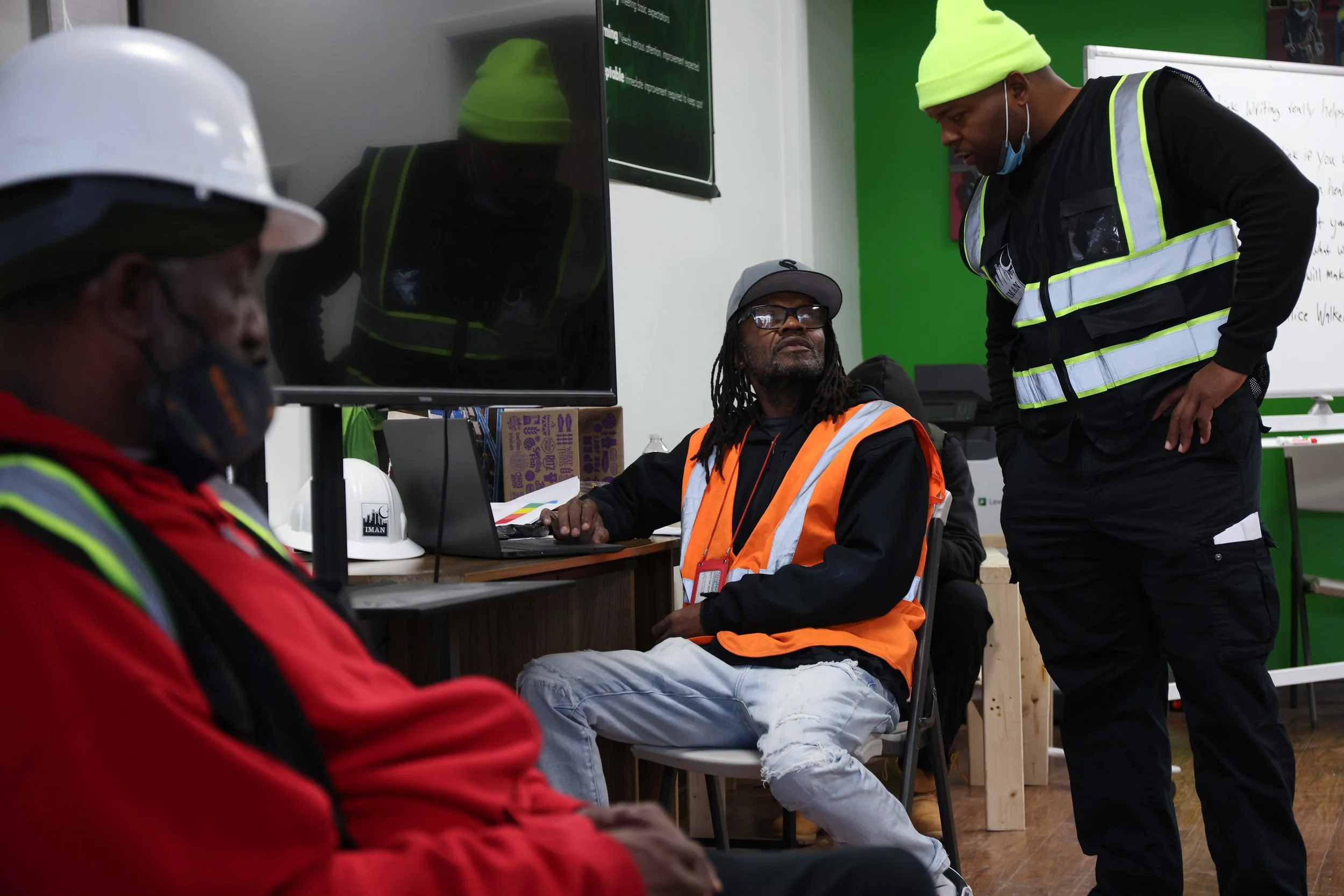
Carpentry instructor Hakim Kellum, center, gives an assignment to a participant during carpentry class. (Abel Uribe/for City Bureau)
The circle is where men begin to relearn community, but the work stretches far beyond that space. For many, reentry is a constant push and pull between who they were and what their environment allows them to be. Kevin Henderson felt that tension immediately.
Henderson, 31, was 15 when he was tried as an adult and convicted of armed robbery. As it happens, he was arrested at a gas station a few blocks away from where IMAN’s headquarters sit. Sentenced to 25 years, he served 11 before he was released in August 2021.
In his first months out, he was pulled toward the same corners and the same habits. He caught “a few more other cases” after he was released, fighting past patterns as much as temptation.
Henderson had known IMAN as a building in the neighborhood before he was incarcerated. When he was released, he noticed men in work vests outside. He learned about the trade program after talking to them, and that’s when he began trying to get into Green ReEntry.
“I was back doing the exact same stuff, and I said to myself, man, I need to do something different,” he said. “I tried to get in [IMAN] for two years straight. I’d drive past every day and be like, man, today they’re gonna see my name today.”
When he was finally accepted, it became a second home.
“It changed me mentally a lot, in a positive way,” he said. In daily sessions, the cohort practices slowing down and grounding themselves before reacting.
“I wish [the program] were Monday through Sunday. That’s how much I like coming here, he said. “It keeps me from being out ripping around the streets right now.”
Henderson wasn’t the only one trying to reroute his life’s trajectory.
Many of the younger men arrived at IMAN carrying the same mix of hope and volatility. What steadied them was the presence of older men who had already lived through the worst of those cycles — men who understood the system was inherently broken and the road back was long and full of hurdles. Inside IMAN, those generations meet in the same room, in the same circle, trying to push themselves in the same direction.
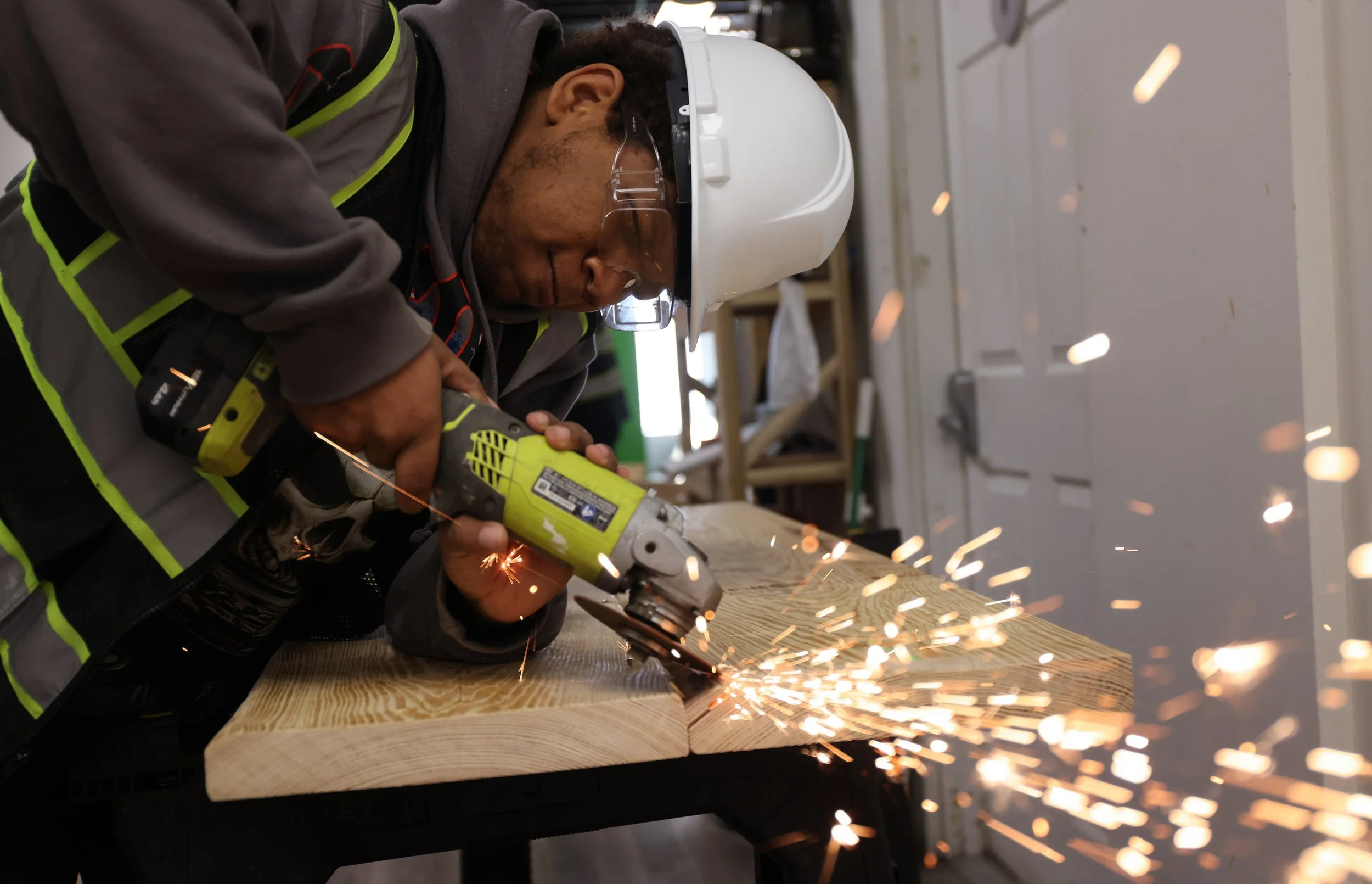
Danthony Smith uses a grinder to cut screws from his table top during carpentry class. (Abel Uribe/for City Bureau)
‘Once we believe in these guys, they start believing in themselves’
The age gap can span a half-century. One man lived in an era before cellphones; another grew up with one in his pocket. Yet every morning, they sit side by side, bound by a shared understanding of what it means to lose time and what it takes to reclaim it.
Mujahid Hamilton has seen this dynamic both as a participant and a mentor.
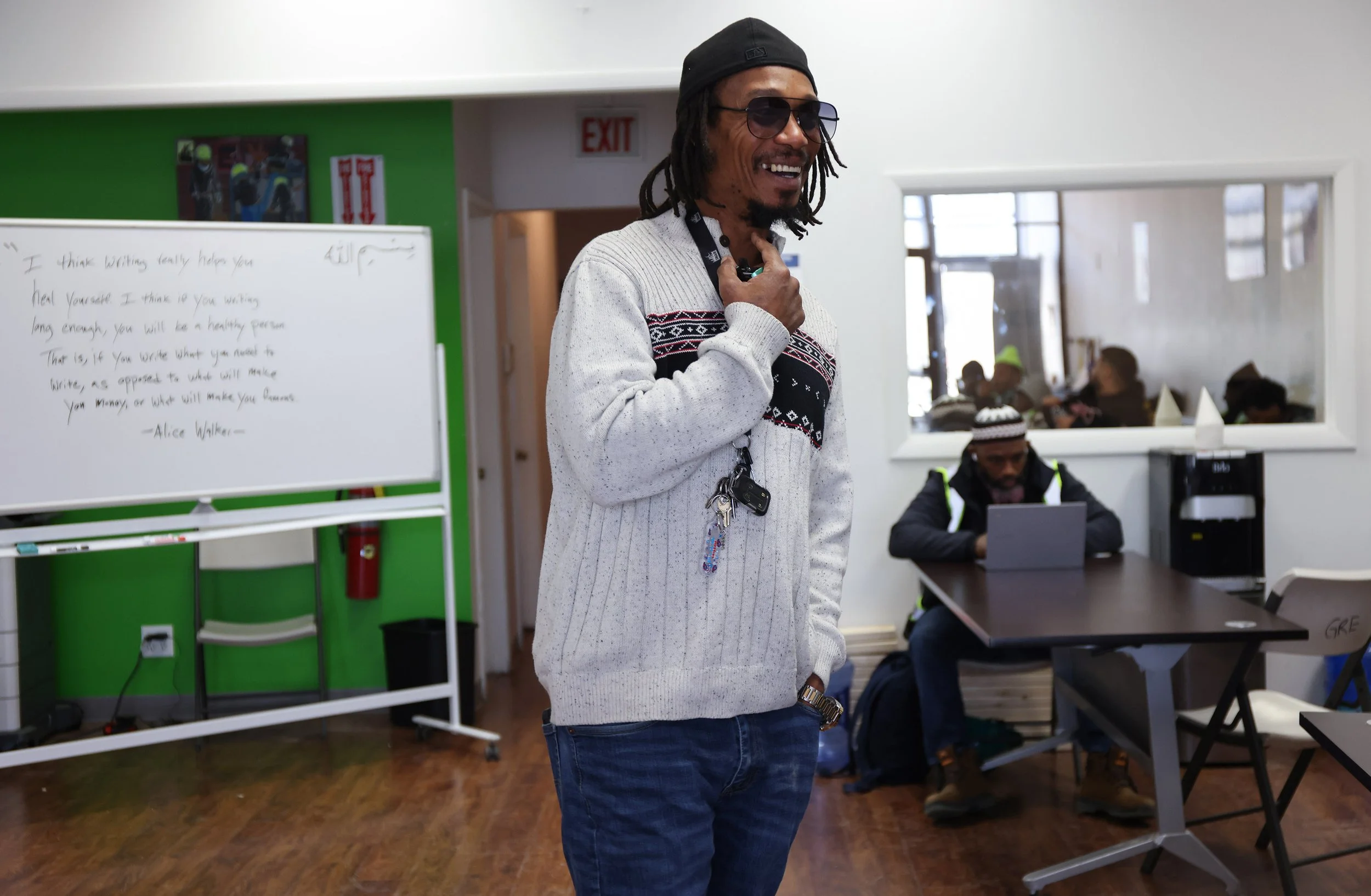
Mujahid Hamilton, curriculum coordinator for the Green Re-Entry Program, talks to participants at carpentry class. Hamilton is an alum of the program. (Abel Uribe/for City Bureau)
He joined IMAN in 2016 after he served 22 years for first-degree murder. Now the curriculum coordinator, he has been coaching participants since 2017.
“This is where the magic happens,” he said. Once we believe in these guys, they start believing in themselves, and we’re giving them a different option. Being genuine makes all the difference in the world.”
The exchange of guidance works both ways. Many younger participants grew up without steady male figures, and the presence of older men shifts the dynamic of the room, Bilal said.
“The older gentlemen are able to give wisdom and comfort. They provide the kind of manhood, that place of a man in their life, that many of them didn’t have growing up,” she said. “They can say, ‘I went through that. You don’t want to go through that, take another route.’”
Madyun often speaks to the younger men about purpose and continuity.
“When you look at a tree in springtime, the leaves come back. For what reason? To make a contribution to the betterment of that tree,” Madyun said. “It’s the same with us, our being connected to the tree of humanity. We come into existence to make an intelligent contribution to the betterment of that which brought us into existence.”
When the morning session ends, most of the men head out to the workshop. Facilitators run through their work and give them time to catch up on their assignments, checking in with each of them individually. The synchronous hum of the rooms gives way to the cacophony of chairs and feet as everyone moves around, and then back to a slow din as people start to filter out.
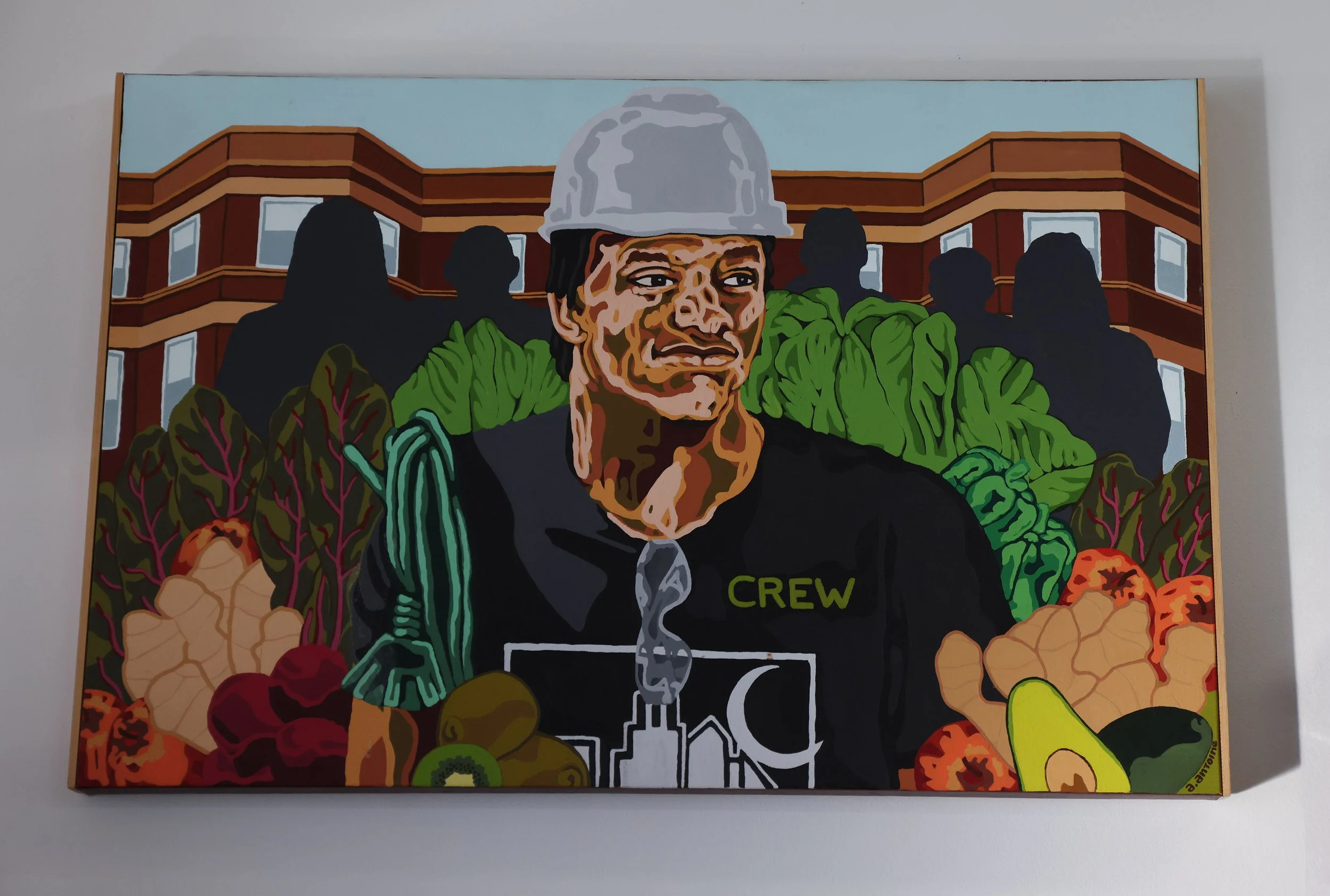
A painting of Steven Ward hangs in the carpentry classroom wall. Ward was a dedicated participant who was killed in 2017 before finishing the course. (Abel Uribe/for City Bureau)
The Weight of What’s Built
A few blocks from IMAN’s health center at 62nd Street and Talman Avenue is a tribute to a Green ReEntry participant who has been a guiding light for future cohorts.
Steven Ward, a 23-year-old West Sider, came into the program fighting for his life. He had been shot the day his group began in 2017.
“He left the hospital, climbed up a million flights of stairs on crutches, thinking he was gonna lose his spot, so he went up there, and he got in the program,” Hamilton said.
Ward stood out for how seriously he took the program. He talked about wanting to be “a father to his children,” and “a good man to his fiancée,” Hamilton said. When Ward’s parole officer saw a video of him around guns online, he was sent back to prison for a few weeks. He returned to Green ReEntry and “still passed every test” and “outperformed the guys who had been there the whole time he was gone,” Hamilton said.
Ward was killed in December 2017, the night of IMAN’s 20-year anniversary celebration, program leaders said . Ward was waiting at an intersection in suburban River Forest when at least one person opened fire into his car, according to news reports at the time.
IMAN had only been running the intergenerational model of Green ReEntry for a few months at that point. Ward was one of the first younger participants to embody what staff hoped that intergenerational structure could nurture: someone who showed up fully, learned from the elders and gave his all to reform. His commitment became part of the story staff told about what it takes to succeed.
Ward and his cohort were working on the reconstruction of the Talman Avenue house when he was killed. The staff and participants agreed to name the building the Steven Ward Residential Center and cut the ribbon in 2018. The center is part of the group’s work to provide transitional housing “to escape the cycles of violence, positively transform their lives and develop themselves as leaders.” A ceramic memorial on the front of the house includes the handprints of Ward’s fellow members and IMAN staff members. Ward’s two young daughters also added their handprints.
For Ramon Lee, who trained in HVAC, drywall, and studio maintenance through Green ReEntry,,and went through the program with Ward the building is a permanent, tangible symbol of the change they’re capable of.
“It’s something I can take my son to see,” he said. “Our names are there, and it’s not going anywhere.”
The men working at the Steven Ward building now might not have known its namesake Ward, but they learn his story from the pieces he left behind: the tribute on the wall, the small footprints, the way staff and still-connected alumni invoke his name.
In a program built on second chances and long sentences, the house stands as a reminder that not everyone gets the time they were hoping to reclaim. It also holds the proof that a few months in community, a handful of shared mornings and long workdays, can leave a mark strong enough to outlast you.
Marium Asif is a creative writer, poet and journalist from Karachi, Pakistan. A graduate of Habib University in her hometown, she moved to the United States in 2023 to pursue a master’s degree in creative writing from the School of the Art Institute of Chicago. She is working on a novel based on Pakistani folklore and Abrahamic mythology. Asif was part of the Fall 2025 cohort of the Civic Reporting Fellowship.
Support City Bureau’s Civic Reporting fellowship by becoming a recurring donor.