
Knowing how Chicago creates a city budget can be tricky — tracking the next steps is even harder. Justin Marlowe, a University of Chicago expert on municipal finance, breaks down what we do with this huge plan.
By Zainab Qureshi
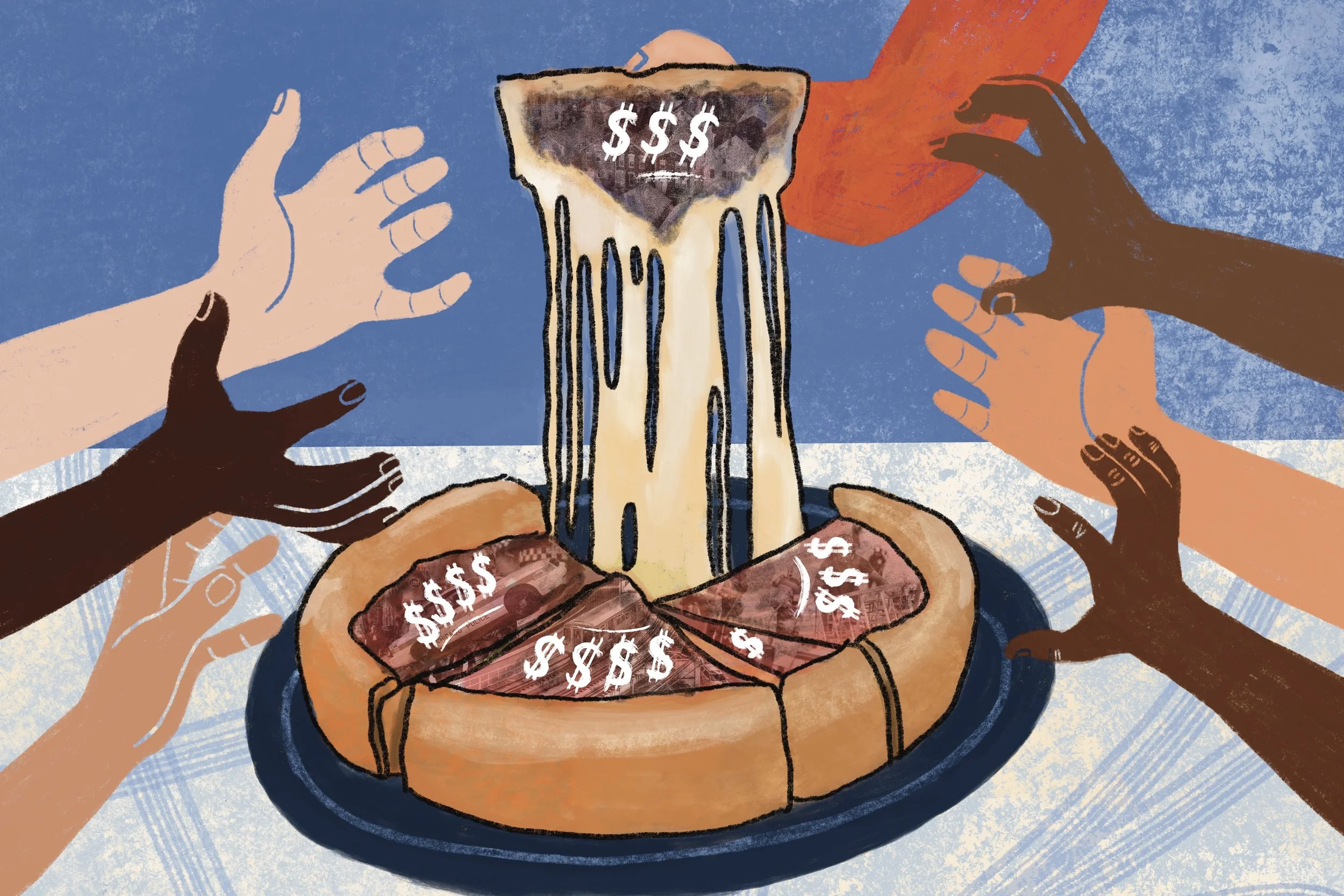
When it comes to the budget, our mayor and City Council must divvy up the money to all departments, agencies and programs. With growing financial challenges, there’s only so much to go around while local leaders battle for the biggest possible slice. (Illustration by Gaby FeBland/for City Bureau).
Editor’s note: Our Civic Reporting Fellowship reporting series, Decoding the City Budget, relied on extensive Documenters notes covering City Council budget hearings last fall. Find more public meeting coverage at Documenters.org
Chicago’s budget lives within hundreds of pages of documents. But how can taxpayers follow along as it works throughout the year?
For many residents, it remains unclear how local leaders make decisions related to the budget, how money moves through city agencies, or who is responsible when things go wrong. That lack of clarity raises a bigger question: Is the budget hard to understand because it’s complex or because it’s built to be hard to understand?
City Bureau spoke with Justin Marlowe, director of the Center for Municipal Finance at University of Chicago, to understand how the city’s budget process plays out throughout the year.
Marlowe breaks down why city budgets are so tough to follow, how officials make decisions behind the scenes, and what Chicagoans should know about where their tax dollars go.
Now is a great time to learn more and start weighing in, whether you want to track how the city is faring with our current budget and/or you’re ready to look ahead to next year. The Mayor’s Office is hosting community roundtables throughout June about the 2027 budget plans. You can find out more and sign up here.
This interview has been condensed and edited for clarity.
What happens after the budget passes?
It's up to the mayor to do anything that the budget calls for. If it calls for setting up a new program, then the mayor goes out to all of the relevant city agencies that might have some role in standing up that program. Presumably the City Council will follow up throughout the rest of the year and in the following years to make sure that that program is doing what it was intended to do.
Who collects the money and makes sure it goes where it's supposed to?
The comptroller [within the city’s Department of Finance] is mainly the one who's responsible for receiving revenues. You can think of the comptroller as the city's banker. The city has commercial banking relationships with banks all over the place where they actually park their money, the same way you or I might have a checking or a savings account. But the decisions about where the dollars go [are] made largely within the comptroller's office.
How does the city track spending?
The comptroller's office has an internal system that everybody follows. There's actually multiple overlapping systems, which is a huge part of the complicating factor here. The systems often don't talk to one another, which is a huge concern. One of the reasons why we don't see more reporting on outcomes and effectiveness is because there's no single way to get that. Other big cities have all that information in one place.
Chicago City Hall. (City Bureau file photo)
What happens if a department overspends?
This is a huge point of contention.
It goes back to the allotment process, where the comptroller is doling out an agency or department or program’s budget in small chunks throughout the year. If you overspend in a given quarter, you're given less in the next quarter as a way to rein in that spending and end the year without massive overspending.
Part of the problem is there are a variety of what [we] might call overrides. If the police department is able to demonstrate that something happened that could not reasonably have been expected to be in its budget, then it can essentially go and get an override of those budget controls, and that shows up as overtime or some other unexpected costs.
At the end of the fiscal year, you have to either find those dollars someplace else within the budget so that you end the year with a budget balance, or revenues have to come in unexpectedly, or you have to amortize [write off] those costs into future budget years.
Could Chicago's budget be easier to understand?
Chicago's budget process does not have the same level of sophistication around measuring actual outcomes and results compared to a lot of other big cities. The question then becomes, what does it mean to translate that into actual measurable improvements in performance [and] on the quality of life for people? It's not to say that the data don't exist, but what would better transparency and accountability mean for a lot of people? The answer to that question is actually linking the budget to outcomes of performance in a way that it does not necessarily right now.
For taxpayers who want to learn more about how the city spends its money, where would you start?
I think the city budget office does a reasonably good job with making explainers. And the introduction to the budget document itself is reasonably well done. You have to know a little bit of the terminology, but I think they do make a point of it to try to make that as accessible as possible if you want to get a high-level overview.
Editor’s note: Marlow also mentioned Civic Federation as a non-government source of information about the budget. The research organization frequently analyzes local governmental processes, including the city and state budget negotiations. The Office of the Inspector General in Chicago also manages dashboards of city finances the public can use to learn more about the budget.
How else can taxpayers hold local leaders accountable for city budgeting?
All the traditional systems still apply. I encourage people to ask questions [to their alderpeople], because at the end of the day, it's their job to do that oversight and to be able to answer those types of questions.
Find out who your alderperson is and how to contact them.
There's very few ways for citizens to show up in a systematic way to talk about specific programs or departments or projects and their budgets. A lot of that is still done through the very traditional aldermanic budget hearing. There's public comment at the beginning of the budget hearing, [and] as you have to show up on a specific day, at a specific time to talk about a specific proposed budget. Very few people you know can actually do that, and that's one thing that Chicago, for the most part, has not done: invest in new ways for people to engage that a lot of other cities now have.
Editor’s note: Here’s a look at how the budget process unfolds throughout the year. Find a community forum near you and sign up here. You can also submit a public comment and fill out a survey.
In past years, University of Illinois Chicago produced a report detailing the feedback residents provided, which the Mayor’s Office says they use to inform the budget the mayor presents to City Council in early fall.
are there parts of the budget you’d still like to know more about?
Something else that I've never fully understood is to what extent do alders actively avoid playing a role in the budget process? If they can claim that their fingerprints are not on these very important policy decisions, then somebody else can take the political blame for it.
When I talk to my students, they care very deeply about these things. If their alderperson were to say, “Well, that wasn't really my decision; I didn't have anything to do with that,” they don't see that as an acceptable answer. At what point do we see that tide shift and we get a critical mass of voters who say: “Yeah, that's not going to cut it. We're going to find someone else to do that job.”
Zainab Qureshi is a Pakistani-American journalist and storyteller from west suburban Aurora. She firmly believes that people should be able to share their stories with the world, and she hopes those narratives deter oppressive stereotypes of communities of color. She was part of the Winter 2026 Civic Reporting Fellow team reporting on the city budget.
Support our Civic Reporting Fellowship and Documenters programs by becoming a recurring donor.