
What our first AI-driven feature for Documenters.org taught us about keeping people at the center.
By Eve Lacivita
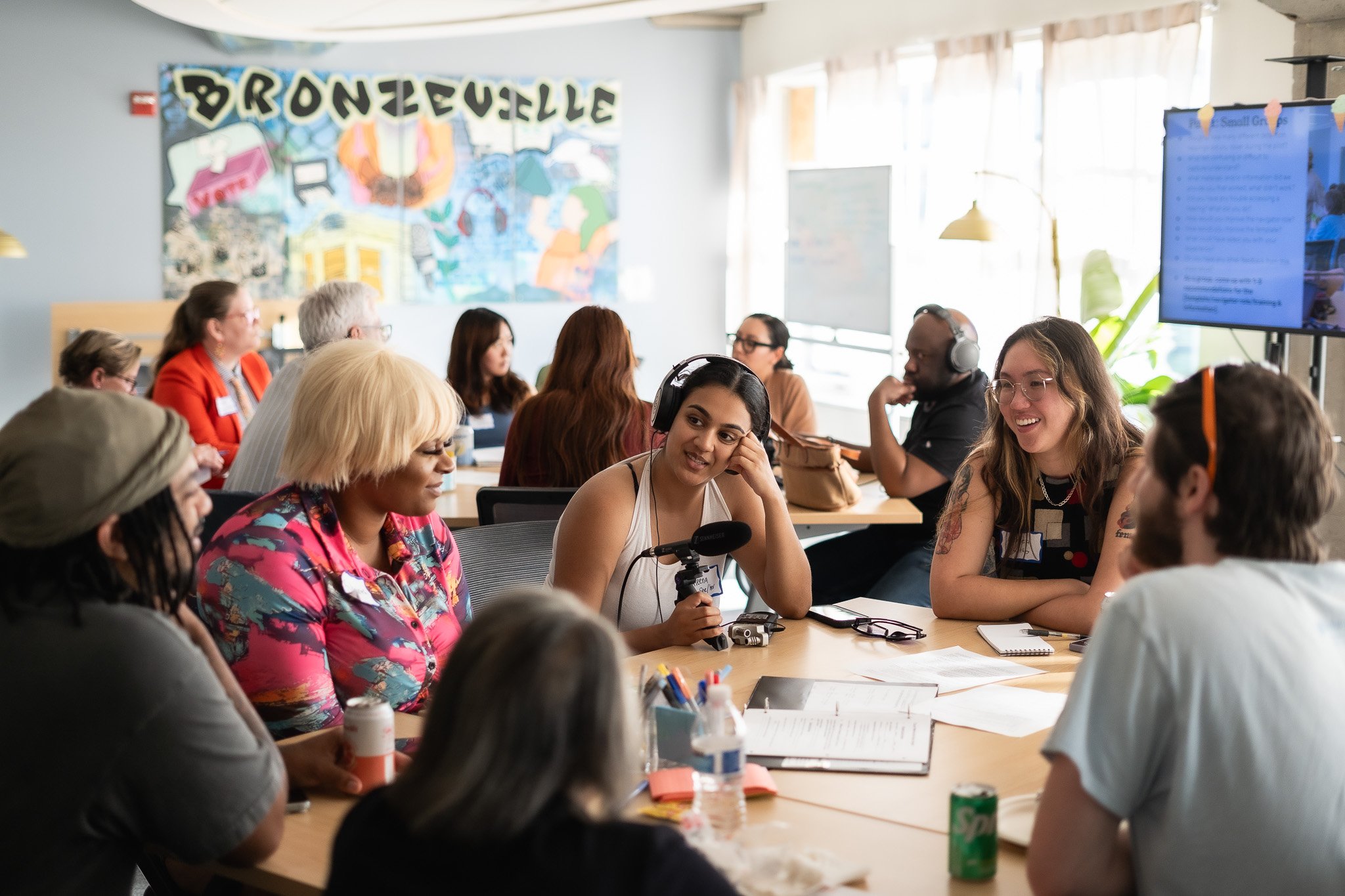
Chicago Documenters participate in Documenter Debrief: Court Watching Edition at City Bureau’s office in May 2026. Photo: Jordan Esparza-Kelley/City Bureau
Imagine it’s your first time showing up to a public meeting you’ve never covered before–city council, a water reclamation board, a zoning committee–and people are speaking quickly, throwing around unfamiliar acronyms, and jumping into conversations without setting the stage. You’re showing up; you’re paying attention, but you’re spending the first half getting your bearings before you can separate what matters from the noise.
That’s the reality for many Documenters—the community members who are equipped and paid to attend and document local government meetings across 20+ cities around the U.S. in City Bureau’s Documenters Network. And it’s what kept coming up when we started listening closely to what would actually make their work more powerful. “Coming in after multiple prior discussions, you don’t know exactly what they’re talking about,” one Chicago Documenter told us. “The immediately prior meeting usually has an onramp to things they’re going to be talking about at the next one.” And they named something even more specific: Just knowing more about who’s even making decisions in the room. “If you’re covering remotely, [public board or council] members often don’t say their names or have a name card, the city site is hard to navigate, and then you’re switching between screens to try to figure out who the person is and how their name is spelled when you want to concentrate on what they’re saying.”
These weren’t complaints. They revealed an opportunity to ask what we could do differently, and what a decade’s worth of Documenter notes might be able to do to support the next person who walks into one of these meetings.
What we build/built
In response, we developed a new feature on Documenters.org: The Contextualizer Brief. Co-developed by City Bureau’s product team and our longtime engineering and design partners at Public Data Works (PDW), the Contextualizer Brief is built specifically to help community members prepare before covering a public meeting. It was developed through 10 months of rigorous co-design with Documenters and teams running three of the network’s longest-running programs across Chicago (City Bureau), Detroit (Outlier Media), and Cleveland (Signal Cleveland).
The Contextualizer tool generates a short briefing memo that covers what Documenters told us was most useful to them: the agency background, regular speakers, recently discussed topics, and a jargon decoder for the terms and acronyms most likely to come up–all based on past Documenter notes and validated by human editors.
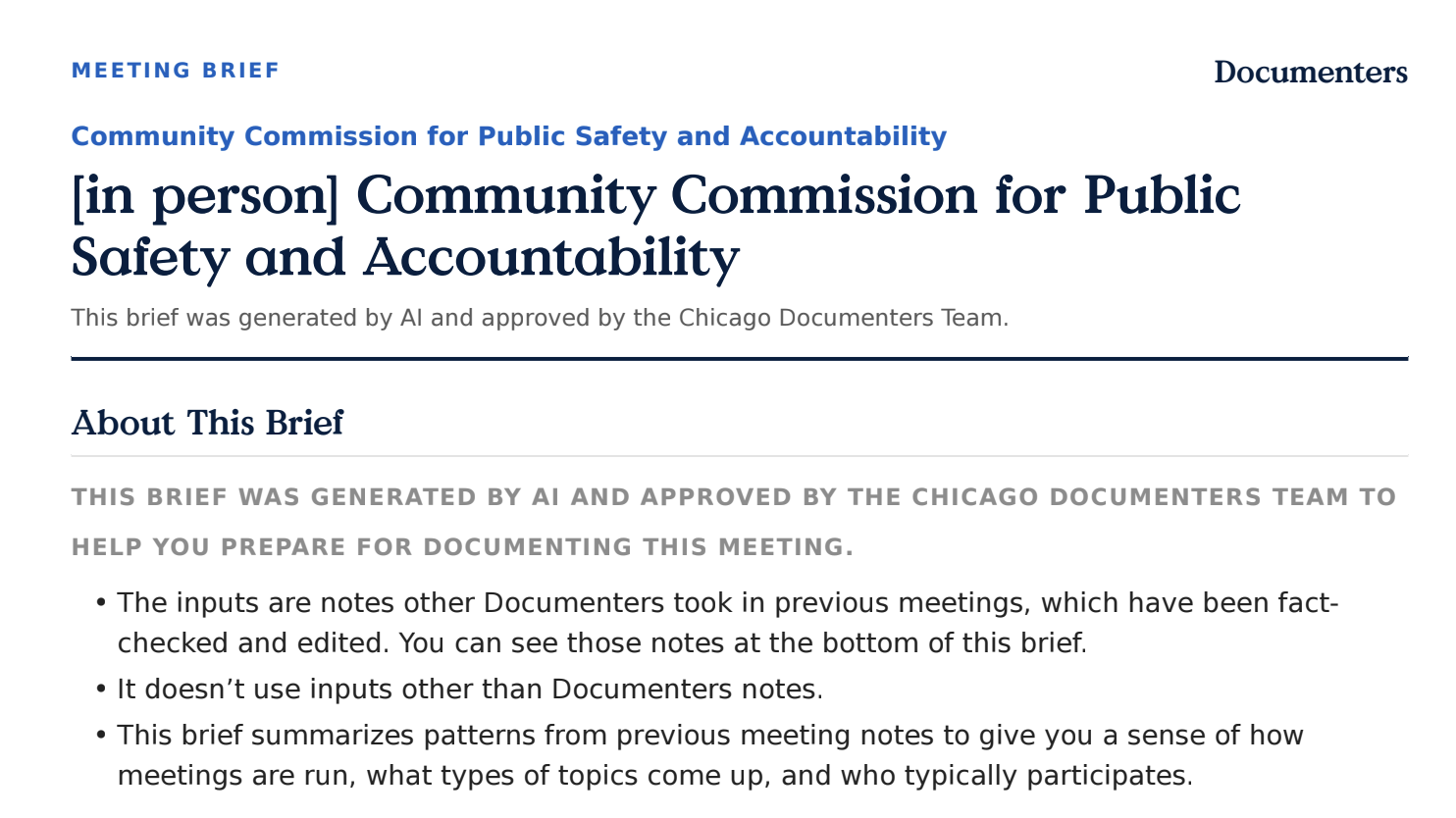
Sample Contextualizer Brief for a meeting of the Community Commission for Public Safety and Accountability.
We leveraged generative AI to make this possible. While there are many things we explicitly don’t use AI for, in this instance it opened up an opportunity that has historically been impracticable. With a huge repository of over 15,000 Documenters observations from over 6,000 Documenters across 30 municipalities, spotting patterns and trends within an agency by manual means often isn’t feasible. AI makes it possible to identify, summarize, and present essential information from that very complex information. We don’t leave editorial decisions in the hands of AI, though - the Brief is initially drafted by AI, then reviewed, edited and finalized by human editors with personal understanding of the content. The Brief also serves as an entry point to the full notes.
The name reflects the intent: not to exhaustively summarize what happened in the past, but to give Documenters the context they need to understand and document what’s happening in that public body right now.
We developed the Contextualizer with grant support from the American Journalism Project, which recognized something we also see: that the problem of meeting prep is a largely unsolved one. Most AI tools being built for journalism are focused on “in case you missed it,” auto-generated summaries of auto-generated transcripts. The Contextualizer is built as a “know before you go” guide. It’s a tool designed for the person showing up.
When we started designing, we had a hunch, a rich body of data, and a lot of open questions. Our guiding principle/north star was: How might we help Documenters feel more informed and confident covering an agency that’s new to them?
This kept us grounded and focused. It meant we had to put our energy on the two uncertainties that actually mattered: whether we could extract meaningful accurate information from past Documenter notes using AI, and whether that information would actually help Documenters feel more confident and focused on what was happening in the real world.
One of the most important things we learned is how specific the answer turned out to be. We originally assumed that surfacing frequently discussed topics would be most useful. But what Documenters actually needed more was recent topics, not common ones. They needed to know what was most urgent for the committee right now, not what had been talked about the most over time.
We also learned that understanding how a meeting works matters just as much as understanding what it’s been about. Knowing the agency’s usual structure, the typical meeting length, what kinds of votes happen when—this is the kind of orientation that a veteran reporter absorbs automatically over time, and that a community member walks in without. Making that legible turned out to be highly valuable.
Perhaps most importantly: the Contextualizer does not have opinions. It does not tell Documenters what’s important, what to think about a vote, or to flag something as controversial. That judgment belongs to the human in the room, the community member with lived experience. This principle is core to the program, and we built it into the design from the ground up.
What the pilot taught us
We piloted the Contextualizer with Documenters across Chicago, Detroit, and Cleveland, running real briefs in real meetings, gathering survey data, and debriefing with participants afterward.
The results gave us a lot of confidence. Among Documenters who were relatively new to covering a particular agency:
90% found the tool valuable
90% said the content was accurate
90% wanted to keep receiving it
100% found it easy to read and digest
70% said it saved them time in meeting prep
As we went through this process, these numbers were encouraging but not what stayed with me. What stuck with me were the words from Documenters themselves about how the tool boosted their confidence with new skills and terms, and helped them learn from one another.
“extremely helpful in organizing my thoughts and clarifying my focus”
“the glossary was especially useful; it helped me better understand and correctly apply terminology that I was referencing”
“I found the recommendations from previous notetakers to be extremely helpful.”
“I… could use it to quickly grab things like the purpose of the agency … in a fast-paced meeting setting.”
Staying focused on the problem, not the tech
Earlier this year, I asked How do we keep people at the center of AI-enabled features?
The answer is less about abstract AI usage ethics and more about design discipline in practice: starting with a real problem that people actually have, not a problem that sounds interesting or is impressive to explain at a conference. It means testing early and often, with real Documenters in real meetings, before you’ve built too much to change. It means designing with the people who will use the tool, not just for them. And it means being willing to throw out your assumptions when the evidence points somewhere else.
So, what’s next?
We see a lot of opportunity to build on the Contextualizer’s success to surface insights and trends from the wealth of Documenters notes with the help of generative AI. We have more than 15,000 meeting observations from more than 6,000 Documenters across 20+ municipalities, and that’s growing every day. That is a remarkable archive of civic life in communities all around this country. We’re exploring now how that information might be made more useful and accessible for community members and leaders - and if that’s something of interest to you, we want to know! Please reach out.
At the same time, we are committed to keeping community members in the room where it happens. Our goal is to equip residents to understand and shape their local public systems, and few things are as powerful as being present in the conversations as they happen. Just the presence of a Documenter in a meeting—often ones where no other member of the public is present—can be a powerful agent for community accountability. Likewise, trusted relationships between Documenters and their own networks are essential to sharing that information. As one of our partners put it, “AI doesn’t have neighbors.” So, while we’re excited about AI’s potential to empower Documenters and amplify their work, we’ll never replace Documenters with AI. And we’ll always keep community centered and part of the design process in the development of AI products.
If this is as exciting for you as it is for us, find me this week at the News Product Alliance Summit in Chicago, where I’ll be leading a workshop with Chicago Documenters Director Rachel Birkhahn-Rommelfanger about centering community needs in AI product development. Let’s keep the conversation about where AI does and doesn’t belong going.
Eve Lacivita is Director of Product at City Bureau. This is the third in a series on our approach to AI. Read “AI Is Increasingly Shaping Local Journalism. How Do We Keep People at the Center?” and “Why AI Will Never Replace Documenters.”