How one editor’s long-shot idea shows us that the Documenters Network can open new lenses for national reporting.
By Ariel Cheung
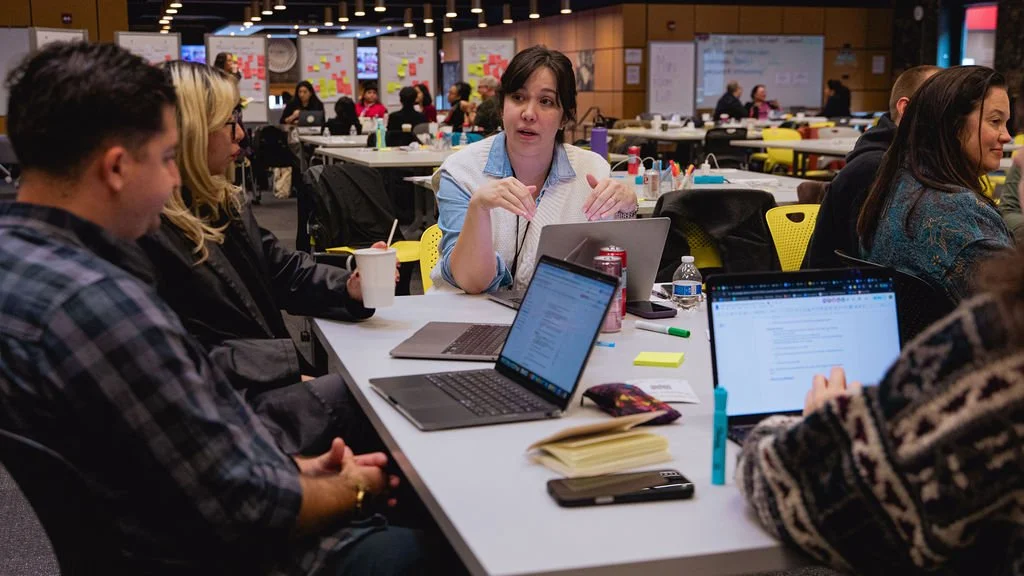
Ariel Cheung facilitates a session during the 2025 National Documenters Network Summit/Photo by Michael Izquierdo
We started exploring the idea of a reporting project across the Documenters Network in early 2025. What began as a seed of an idea grew into something that, to me, captures what it means to be a civic media lab: a willingness to experiment, learn along the way, and build new things collaboratively. It also showed us a new way to see national stories: from the public meeting spaces and communities where their impact is felt.
An ongoing frustration I have with coverage about government spending is a lack of meaningful context. It’s easy enough to picture football fields of money when trying to visualize what $1.4 billion in cuts looks like — but how is that loss actually felt across communities? In each of our hometowns and states?
As more than one of our sources put it: A “perfect storm.”
The Department of Government Efficiency’s cuts to federal workforces and budgets that began in 2025 are still affecting communities. Since taking office, President Trump has also moved quickly to rescind funding across a range of programs including green energy initiatives, resources for undocumented immigrants, access to gender-affirming care, and more.
At the same time, our reporters and fellows have continuously run up against a looming funding cliff: Across the country, federal money granted through the COVID-era American Rescue Plan Act must be fully spent by Dec. 31.
We realized we had the opportunity to do something fundamentally different than parachute journalism, in which a national reporter “drops in” to cover community-level issues without being part of the community itself.
Instead, we could draw on the power of the Documenters Network across 20+ communities and what community members themselves chronicle and share information about public meetings. These notes can capture what national coverage often misses, such as how a federal decision lands in city council meetings, budget hearings, and neighborhoods.
If we want to show how the loss of federal funding hits communities, we should get that information directly from those communities. It’s people-powered national reporting built from the community level.
We zoomed in on city budgets across the country, as a number of Documenters sites have covered budget hearings for years. In Chicago, we reviewed three dozen Documenters assignments to see what was on elected officials’ minds as they contended with the dropoff in federal dollars.
Those early findings are the basis of coverage on homelessness prevention, services for survivors of gender-based violence, renter assistance and mental health crisis funding in Chicago.
To look beyond Chicago, we needed to sift through a year’s worth of Documenters notes across multiple communities. With our product innovation team and Director of Product Eve Lacivita, we prototyped an AI-driven search tool that could help surface Documenters notes referencing federal funding cuts. It’s the kind of AI application I can get behind: one that lightens the load but leaves the investigation and analysis to the people who excel at it.
From there, our team did the critical work: Grace Del Vecchio, our Chicago Documenters editorial program manager, reviewed the tool’s findings and identified duplicate entries and relevant notes the tool had missed the first time around.
As our reporting continued, we recognized we could not rely on the prototype to tell us what was definitively cut — only where to look. Civic Reporting Fellowship alumna Kim Bellware, a veteran multimedia journalist, investigated what happened to the funding after the meetings to craft her report.
I’m an ardent AI skeptic, but this project clarified something for me. The tool was useful because of the people on either side of it. Documenters who know their communities had already sat through hours of budget hearings and created detailed and nuanced records about what programs public officials worried about losing, how they discussed expected cuts, and what solutions they proposed. The tool helped surface potential leads faster. But Documenters’ detailed records and journalists’ reporting were irreplaceable when it came to analyzing the results and rooting out the stories.
We analyzed notes from 23 communities, and Bellware found trends across eight Documenters sites: cuts to funding eroding our public safety net and affecting transmissible disease surveillance, disaster preparedness, and crime prevention.
Piloting this approach with a handful of Documenters sites taught us about where and when it might work best. Not every community saw federal funding come up in budget hearings. Often, non-government organizations grapple with their own loss of federal grants, which rarely come up in public meetings. These lessons also reinforced what makes this model promising: insights from Documenters who know their communities and show up consistently.
Federal funding was a test case. The same approach could work for other national issues that play out in local government: immigration enforcement, policing, disaster response and climate mitigation, and inflation. In each case, Documenters bring two things: information about how local governments are handling these issues, and their own insights and access to the communities affected.
That’s what working in a lab means: not every experiment succeeds cleanly, but each one teaches us something about what's possible. This one showed us that Documenters’ work offers a radically promising way to report on national issues from a local perspective.
Ariel Cheung is City Bureau’s civic information director, whose work focuses on creating journalistic resources that close information gaps and equip communities to advocate for themselves and take civic action. Prior to joining City Bureau in 2023, she worked for the Chicago Tribune, Modern Luxury and DNAinfo Chicago.