Public courtrooms are where government power is most visible—and where the public is most absent. Chicago Documenters set out to change that.
By Rachel Birkhahn-Rommelfanger
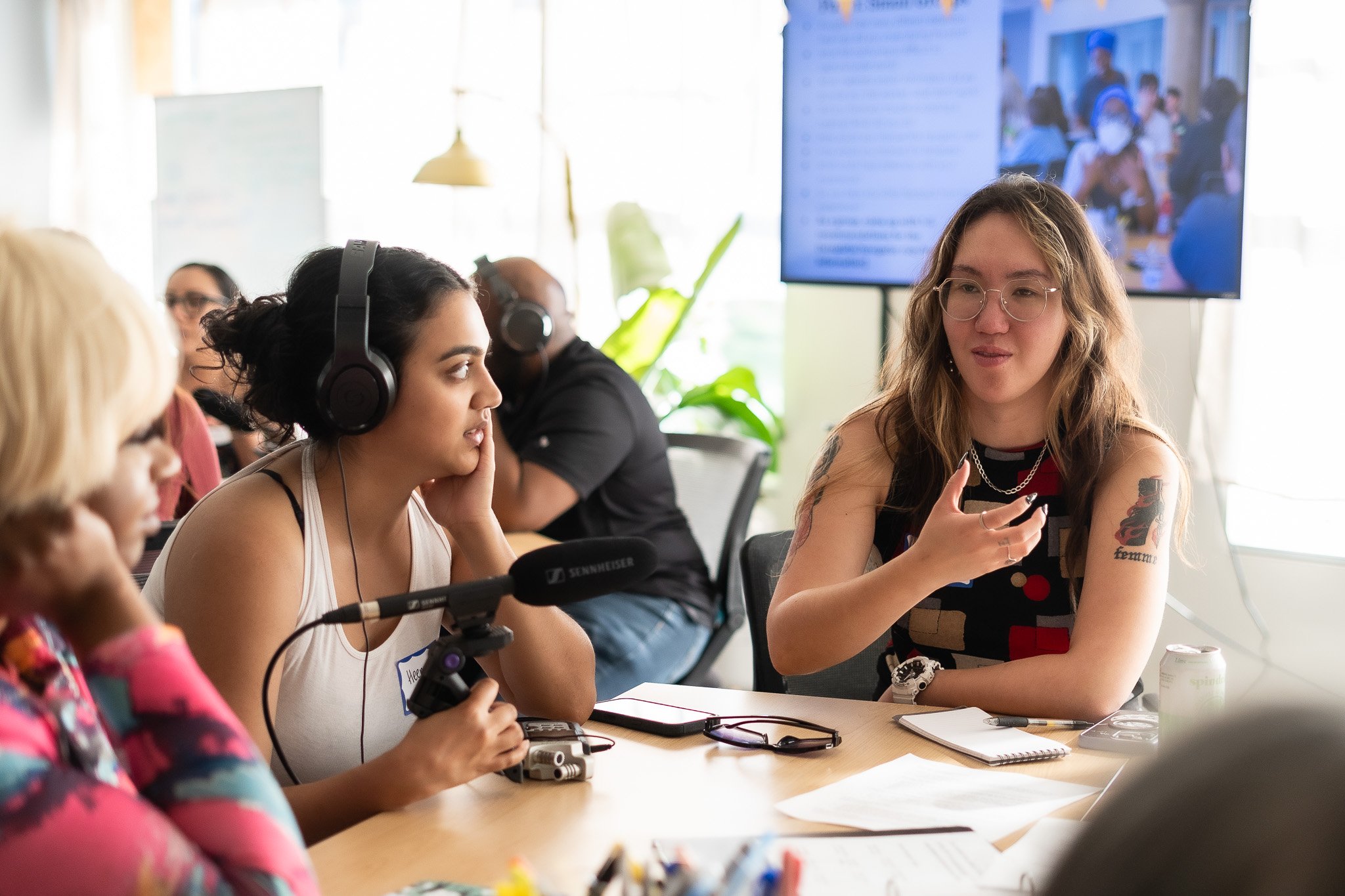
Chicago Documenters reflect on their observations and experiences from courtroom assignments in City Bureau’s office. (Photo: Jordan Esparza-Kelley/City Bureau)
Public courtrooms are one of the places where government power is most visible—and where the public is most absent. Court proceedings are technically open to the public, but you likely won’t see members of the public filling the observation area. Yet, what’s decided in these spaces is consequential, impacting millions of lives with disproportionate harm to low-income communities and people of color. Most people inside a courtroom are either paid to be there, facing charges, or supporting someone who is. Barriers keep the public out even when the doors are technically open: electronic devices are banned, dockets (agendas) are hard to find, and the space is heavily policed. The result is that most people have simply never been inside a courtroom; they only watch fictionalized dramatizations on TV.
Asking questions and being willing to try something new is at the core of how we work in Chicago. That spirit of experimentation led Chicago Documenters to enter courtrooms. We took our program model—equipping and paying community members to attend local public meetings, distill what matters, and bring actionable information back to their neighbors—and piloted it in Cook County Courts in the Pre-trial Detention Division.
Cook County operates one of the largest criminal court systems in the United States. Illinois raised the stakes further in 2023, when it became the first state in the country to implement the end of cash bail. Immediately, groups like the Illinois Network for Pretrial Justice began running court watching programs across the state to track implementation.
In 2024 and 2025, a new Cook County State’s Attorney and new Cook County Chief Judge took office—and advocates and observers closely watching the implementation of the law ending money bond wondered how it would fare under new leadership.
Courts are harder to document than public meetings. Many of us without legal training, myself included, have difficulty navigating those spaces and understanding what's happening. We partnered with the Illinois Network for Pretrial Justice, who coached our City Bureau team and Chicago Documenters on the nuances of detention hearings and how to do this work well. That’s the work of our civic media lab in action: finding the next public space, building the pathway in, and learning what it takes to equip people to be there.
“Documenters also went further than official court records, not only capturing what decisions were made, but describing how people were treated, how power operated in the room, and what happened around the official proceeding.”
Our Chicago Documenters staff quickly identified that Documenters could add a new depth of recording and observation to previous court watching projects. Documenters are experienced in going to public meetings and recording qualitative, observation-based summaries of what happens. They were ready to write down the arguments of the lawyers and the reasoning of the judges and to capture the outcomes of those hearings. Documenters also went further than official court records, not only capturing what decisions were made, but describing how people were treated, how power operated in the room, and what happened around the official proceeding. Documenters brought diverse perspectives to their observations and questions about the proceedings, and some also shared personal experiences with the criminal legal system.
This pilot project exceeded our expectations. We equipped more than 80 Documenters to observe over 200 pretrial detention hearings, the Illinois equivalent of a bond hearing, across almost 30 days between March and May 2026. Of those who took an assignment, 95% of Documenters said they would court watch again, and 85% said they would recommend the experience to someone else.
The impact of the workshops and preparation went beyond those who took court watching assignments. Fact checkers in our program reviewed the notes without ever stepping into a courthouse. They said the work gave them new insight into court hearings, the role of judges, and how the law is being implemented. Even Documenters who attended workshops but never took an assignment came away knowing more about a process most people never encounter.
Most people never see the inside of a courtroom, and that absence has consequences. We are helping the public navigate a space that already belongs to us. Public dollars fund these courtrooms, and the public deserves to know and understand what happens inside—because what happens in these rooms shapes people’s lives. That’s what Documenters are here to change.
This is the first in a series on the court watching pilot. Next, we’ll share reflections from the City Bureau staff and Documenters who did this work—what they witnessed, what surprised them, and what it means. Read and review our court watching notes at Documenters.org and help support Chicago Documenters.